
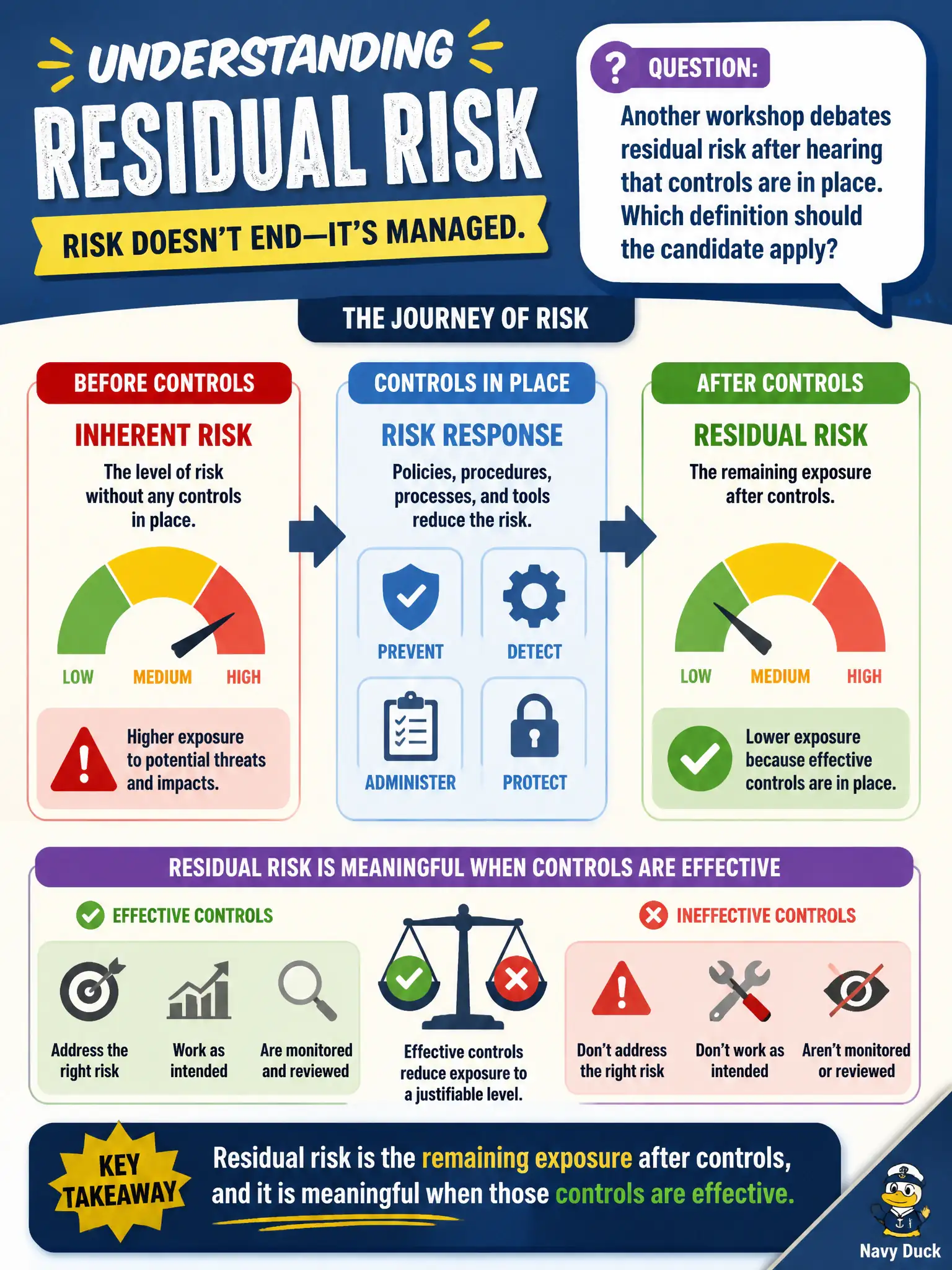
Another workshop debates residual risk after hearing that controls are in place. Which definition should the candidate apply?
Select an answer to reveal the explanation.
Short Explanation
Residual risk is what is left after the coat and umbrella are on. If the controls do not actually work, that leftover number is wishful thinking—not a real residual.
Full Explanation
Residual risk is the remaining exposure after controls, and it is meaningful when those controls are effective. If controls are poorly designed or not operating, the leftover number is wishful thinking and stays closer to inherent exposure despite optimistic slides. Candidates should apply that definition whenever workshops hear “controls are in place” without evidence of design quality and operating effectiveness for civic services. Residual ratings then guide treatment decisions, acceptance, or further mitigation rather than decorating a dashboard. Saying residual risk is always identical to inherent risk by definition erases the purpose of control assessment. Calling residual risk only the auditor’s personal opinion that cannot be scored denies structured IRM assessment practices. Claiming residual risk applies only to third-party risk management exams, not CIS-RC, falsely narrows a core IRM term. Exam caveat: residual depends on control effectiveness; ineffective controls do not magically create a low residual on the exam or in production. Operational check for the workshop: after documenting inherent risk for a civic service, evaluate related control test or attestation results, then set residual only where effectiveness evidence exists—and flag cases where missing tests leave residual effectively unproven.