
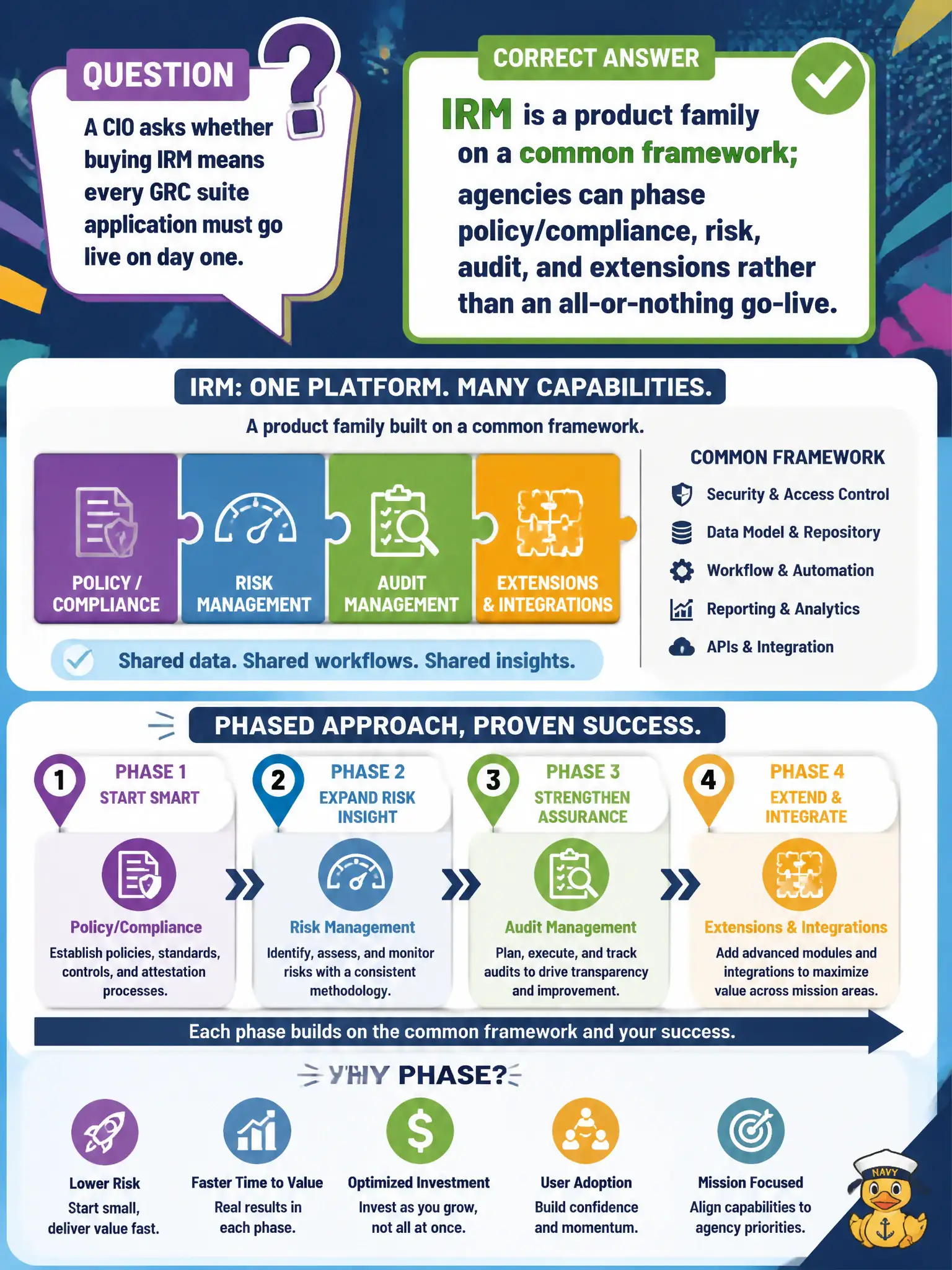
A CIO asks whether buying IRM means every GRC suite application must go live on day one. What phased positioning is correct?
Select an answer to reveal the explanation.
Short Explanation
Think condo complex, not one locked vault. You can move into policy and compliance first, then risk, then audit—same neighborhood, staggered move-in dates.
Full Explanation
IRM is a product family on a common framework; agencies can phase Policy and Compliance, Risk, Audit, and extensions rather than forcing an all-or-nothing go-live of every GRC suite application. A CIO asking whether buying IRM means every application must launch on day one should hear the condo-complex metaphor: same neighborhood of entities and shared elements, staggered move-in dates. Phasing reduces data-readiness and change-management failure while still building toward a full Risk and Compliance operating model. Requiring policy, risk, audit, and extended apps to launch simultaneously or else the platform will not work is false and dangerous for civic timelines. Mandating Software Asset Management and Security Incident Response in the same big-bang release confuses sibling products with IRM family phasing. Allowing only advanced audit features first while calling policy content optional forever inverts typical foundation sequencing and leaves risk and compliance without directive content. Exam caveat: overview items favor phased IRM family adoption on a shared entity framework. Operational check for the agency: approve a roadmap with phase-one Policy and Compliance on a bounded entity set, a dated phase-two Risk expansion, and explicit non-goals for SAM/SIR in wave one, then track go-live against that plan.