
A consortium of townships fears IRM is only for banks and capital markets. Which response best shows why civic organizations still need IRM?
Select an answer to reveal the explanation.
Short Explanation
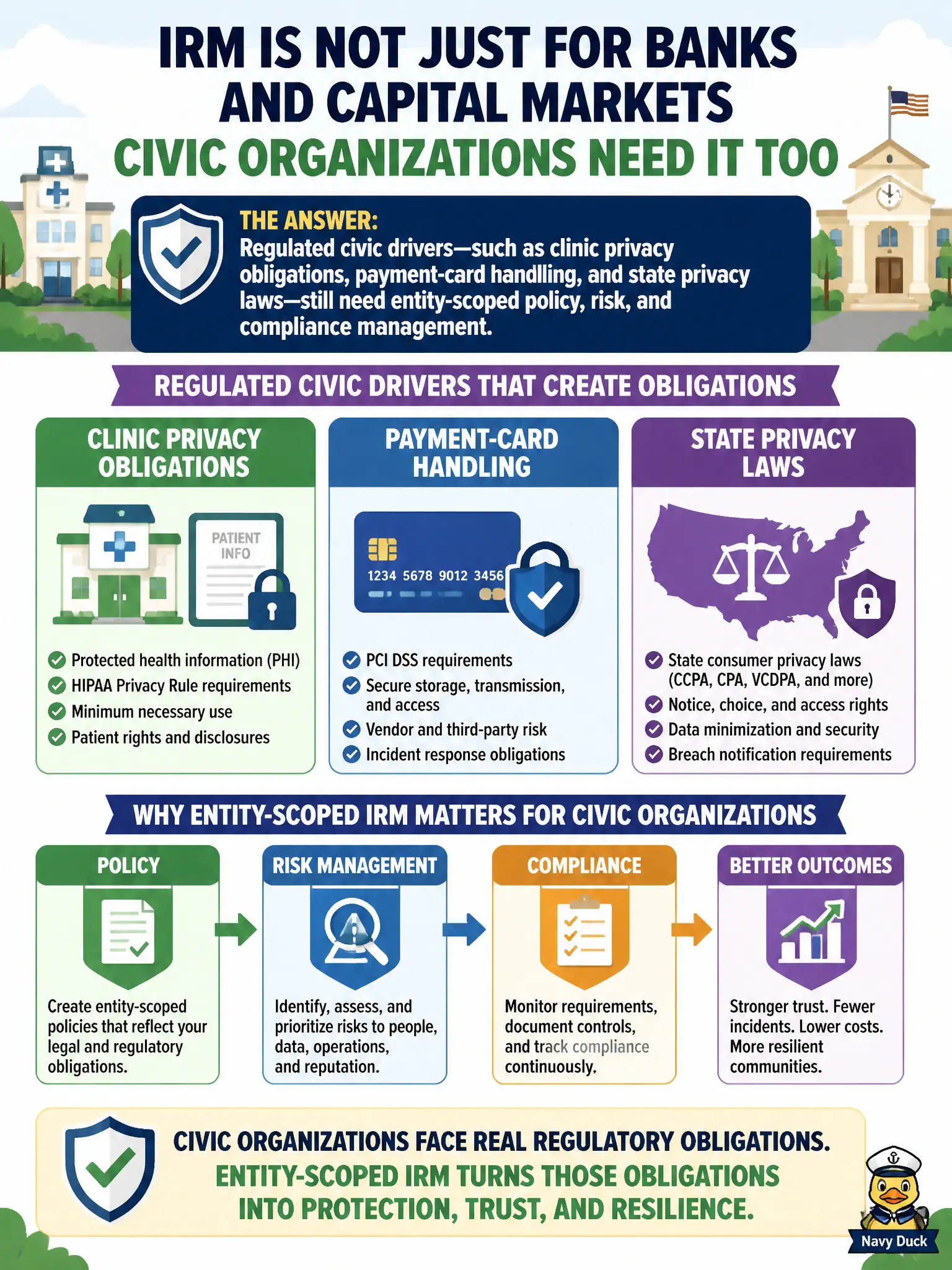
Banks are loud customers, not the only customers. A township clinic, a card-taking recreation desk, or a state privacy mandate still needs policies, risks, and proof tied to real entities.
Full Explanation
IRM applicability is not limited to banks and capital markets; regulated civic drivers still need entity-scoped policy, risk, and compliance management. Township clinics face privacy obligations, recreation desks that take cards face payment-handling duties, and state privacy laws apply to municipal data—each benefits from the same IRM model used in financial services. The consortium should hear that civic organizations remain in scope for CIS-RC-style GRC, not that IRM licenses are reserved for Wall Street. Telling civic agencies to use only ITSM because IRM is reserved for financial services invents a false industry gate. Implementing CIS-SIR playbooks instead of any GRC framework addresses incident response, not standing obligation and risk management. Claiming IRM applies only after a stock-exchange listing is an absurd prerequisite that excludes nearly all government. Exam caveat: overview positioning cites civic and regulated non-financial drivers without requiring industry exclusivity. Operational check for the consortium: inventory one privacy or payments obligation per township, name the entities that process the related data, and show how a shared control objective could attach to those entities in IRM rather than living only in ITSM tickets.