
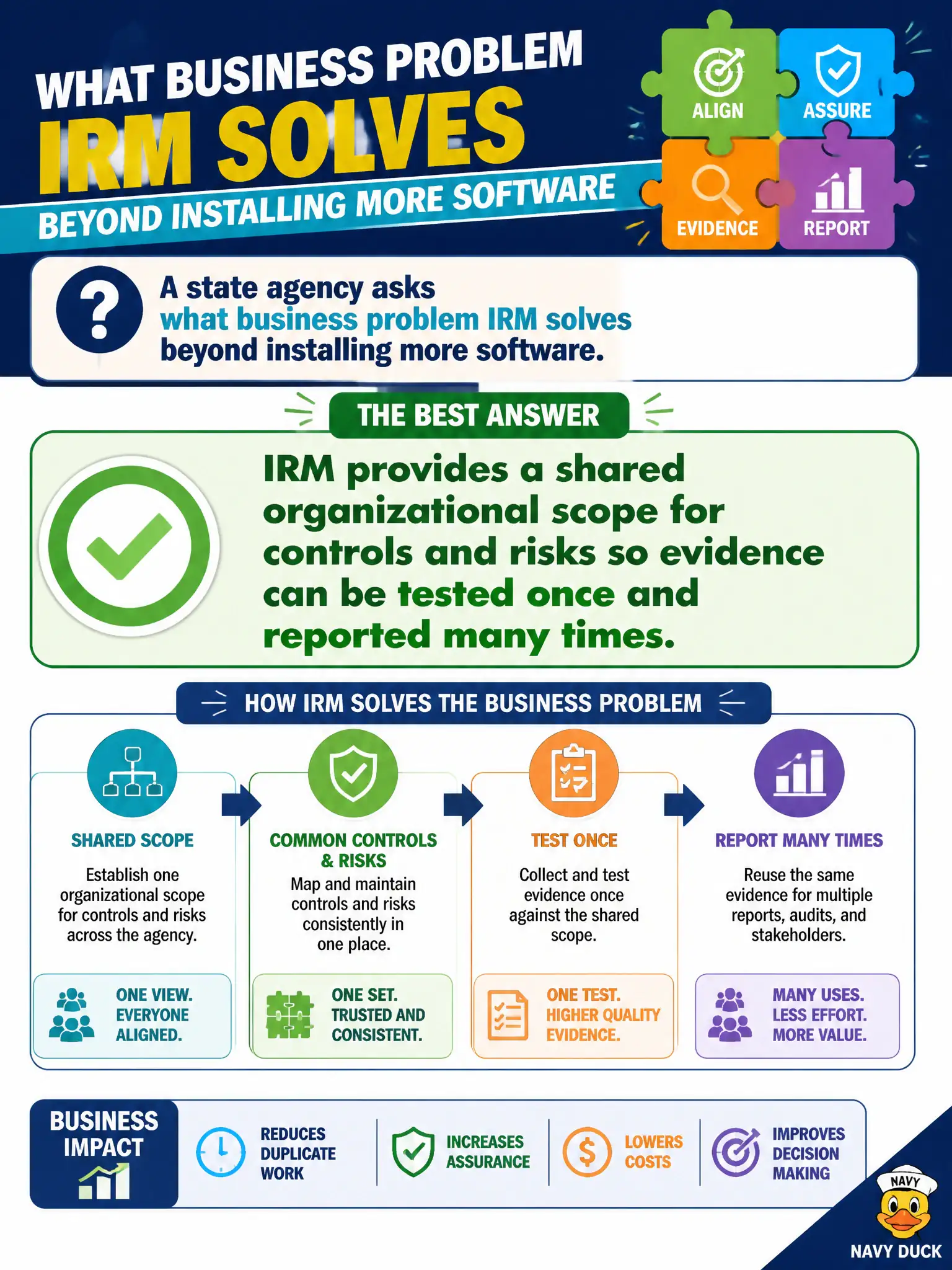
A state agency asks what business problem IRM solves beyond installing more software. Which value statement best answers the sponsor?
Select an answer to reveal the explanation.
Short Explanation
The win is not another app tile—it is one map of what you govern and proof you can reuse. Test a control once against that shared scope and feed many reports instead of redoing the scavenger hunt each quarter.
Full Explanation
IRM’s sponsor-facing value is a shared organizational scope for controls and risks so evidence can be tested once and reported to many consumers. A state agency already drowning in repeated quarterly scavenger hunts needs that common entity and content model more than another disconnected application tile. When policies, risks, and obligations attach to the same governable objects, attestations and tests feed compliance reports, risk committees, and assurance without rebuilding binders each time. Positioning IRM primarily as software license true-ups across the CMDB describes Software Asset Management outcomes, not Risk and Compliance. Claiming IRM replaces the SOC with automated security incident playbooks confuses the control ledger with Security Incident Response. Saying IRM eliminates written policies once indicators exist erases governance; indicators complement policies and controls, they do not abolish them. Exam caveat: overview value statements center on entity-scoped, reusable evidence—not SAM, SIR, or policy-free automation myths. Operational check for the agency: select one shared control on a critical service entity, complete a single platform test or attestation, and demonstrate that the same result supports both a compliance status view and a risk or audit consumer without recollecting files.