
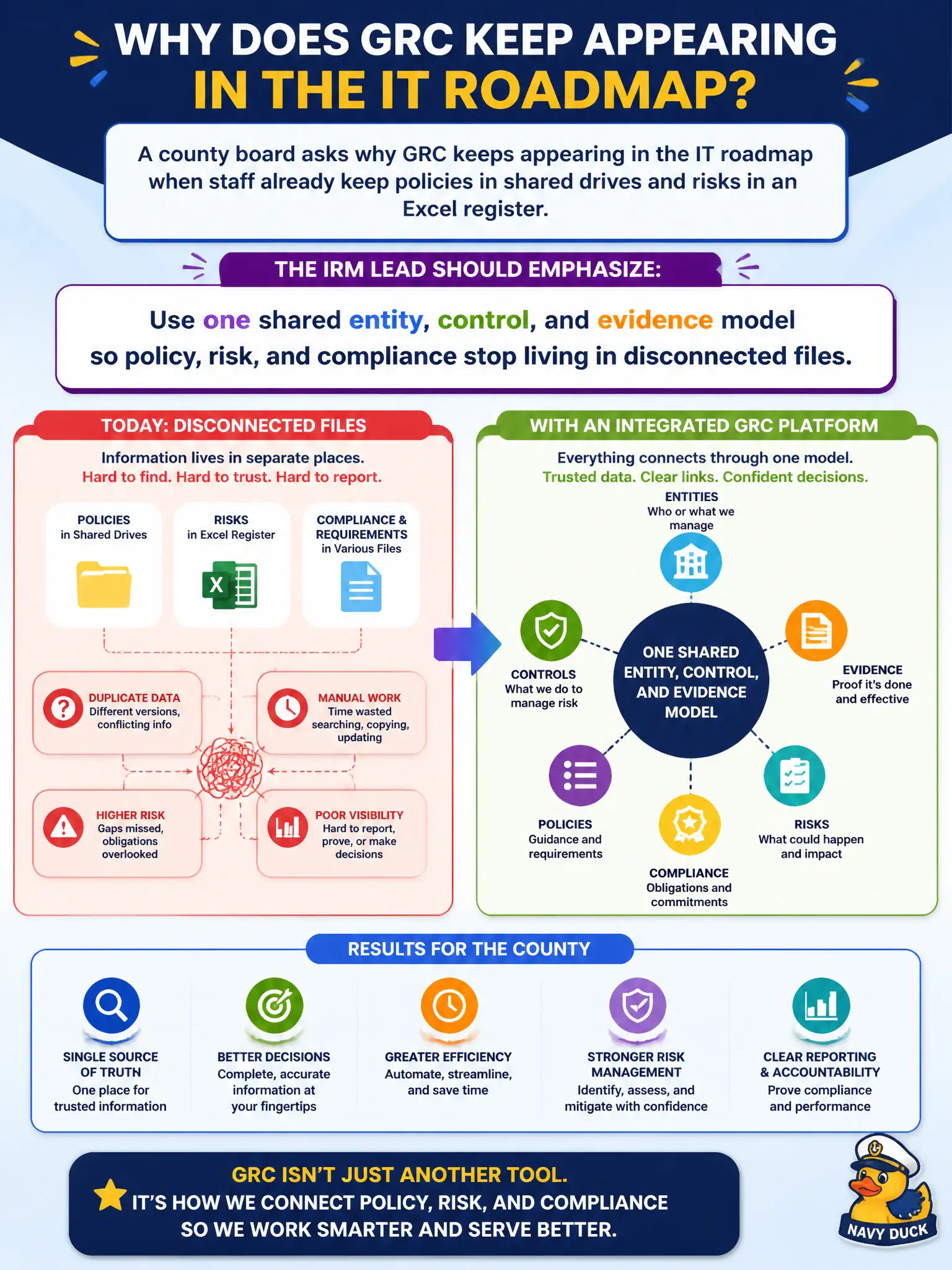
A county board asks why GRC keeps appearing in the IT roadmap when staff already keep policies in shared drives and risks in an Excel register. What should the IRM lead emphasize about an integrated platform?
Select an answer to reveal the explanation.
Short Explanation
Spreadsheets are fine until three teams argue about three different truths. Integrated IRM puts policy, risk, and compliance on the same entity and evidence backbone—one map of the organization, not three lonely files.
Full Explanation
An integrated IRM platform solves the civic silo problem by placing policies, risks, controls, and compliance obligations on a shared entity and evidence model. When a county keeps policies on shared drives and risks in Excel, each team maintains a different map of the organization, so evidence cannot be reused and leadership cannot trust a single posture view. The correct emphasis is therefore one governable scope—entities, controls, and reusable proof—rather than three disconnected file systems pretending to be GRC. Replacing spreadsheets overnight with a security-incident playbook workspace confuses IRM with operational Security Incident Response; playbooks handle breach cases, not the standing control-and-policy ledger. Buying Software Asset Management so license counts become the risk register mistakes entitlement true-ups for organizational risk and compliance scoping. Limiting GRC work to ITSM incident tickets collapses assurance into service-desk queues and leaves policy lifecycle, risk assessment, and control testing without a proper system of record. Exam caveat: CIS-RC overview items reward platform integration of GRC content on shared entities, not adjacent CIS products as substitutes for IRM. Operational check for the county: pick one critical business service as a pilot entity, attach at least one policy-backed control and one risk, store a test or attestation in the instance, and confirm the same evidence appears for both compliance and risk consumers before retiring the Excel register for that scope.