
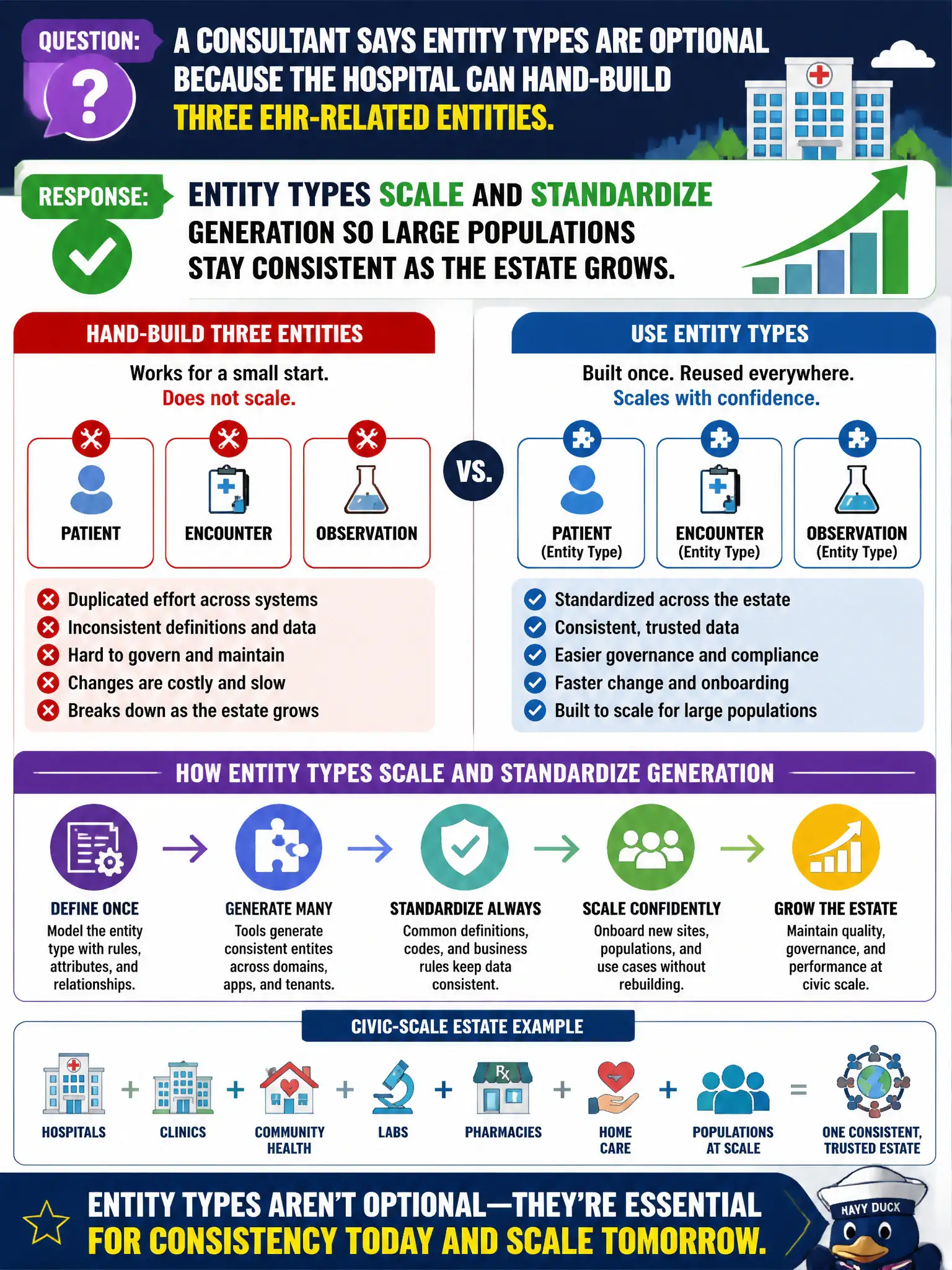
A consultant says entity types are optional because the hospital can hand-build three EHR-related entities. How should the implementer respond for a civic-scale estate?
Select an answer to reveal the explanation.
Short Explanation
Three handmade entities feel fine in a demo. A city-sized estate does not. Types are the cookie cutters that keep generation consistent when the tray gets full. Skip them and you invent a cottage industry of one-off records.
Full Explanation
For a civic-scale estate, entity types scale and standardize generation so large populations stay consistent as the estate grows. Manual hand-building of three EHR-related entities may suffice for a tiny proof of concept, but hospitals and cities continuously add applications, facilities, and organizational units that must enter IRM with consistent filters, classes, and ownership patterns. Types are the durable definition of how ServiceNow finds and generates entities from source tables. Claiming hand-built entities are always superior because types cannot point at CMDB tables is factually wrong—types routinely reference CMDB and other source tables. Saying entity types are only required when Audit Management is licensed misstates product boundaries; Policy, Risk, and Audit share the entity framework. Asserting three manual entities permanently replace the need for types across all departments ignores growth and cross-bureau consistency. Exam caveat: types do not remove the need for ownership hygiene and scope filters; they industrialize membership, they do not invent good data. Operational check: estimate entity population growth for the hospital or city over twelve months, prototype one entity type with filter and class, compare generation consistency to manual creation, and require types before expanding beyond the pilot set. Record in the implementation plan why civic scale mandated types over permanent hand-builds.