
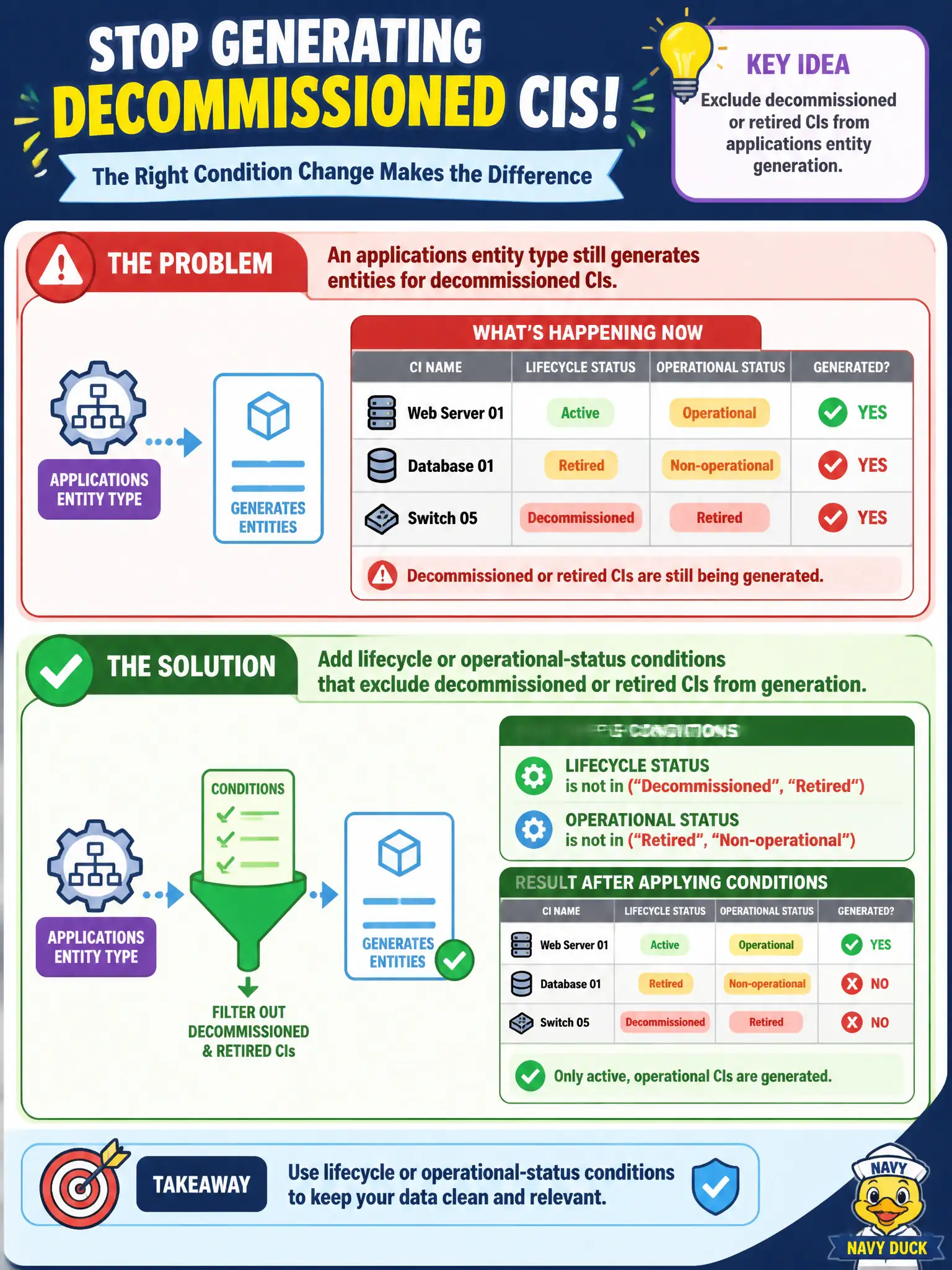
An applications entity type still generates entities for decommissioned CIs. What condition change should be made?
Select an answer to reveal the explanation.
Short Explanation
Retired apps hanging around in entity lists are like closed storefronts still getting health inspections. Bake status into the entity-type filter so decommissioned CIs drop out. Live scope should track live systems.
Full Explanation
When an applications entity type still generates entities for decommissioned CIs, add lifecycle or operational-status conditions that exclude retired or decommissioned CIs from generation. Retired apps hanging in entity lists are like closed storefronts still getting health inspections—wasting assessments and misleading compliance posture. Status-aware filters keep Entity Framework aligned with CMDB reality while retaining active populations. Ignoring lifecycle status because retired CIs must remain fully in scope forever preserves noise unless a deliberate exception program says otherwise. Deleting the CMDB class so decommissioned items cannot exist is destructive and unnecessary. Converting all retired CIs into Policy Exception records automatically misuses exceptions and pollutes that process. Exam caveat: lifecycle status belongs in entity-type conditions whenever the source tracks retirement. Operational check for the applications type: add operational status not retired/decommissioned (or equivalent), run refresh, confirm retired CIs drop out of new generation, and sample that active critical apps remain in scope with owners intact. Keep civic stakeholders aligned on the operating model, and verify platform records after each change before reporting posture to leadership. Revisit the design when CMDB classes, org structures, or program charters change.