
An agency chooses purely manual entity creation for roughly 5,000 servers in scope. What should the implementer advise?
Select an answer to reveal the explanation.
Short Explanation
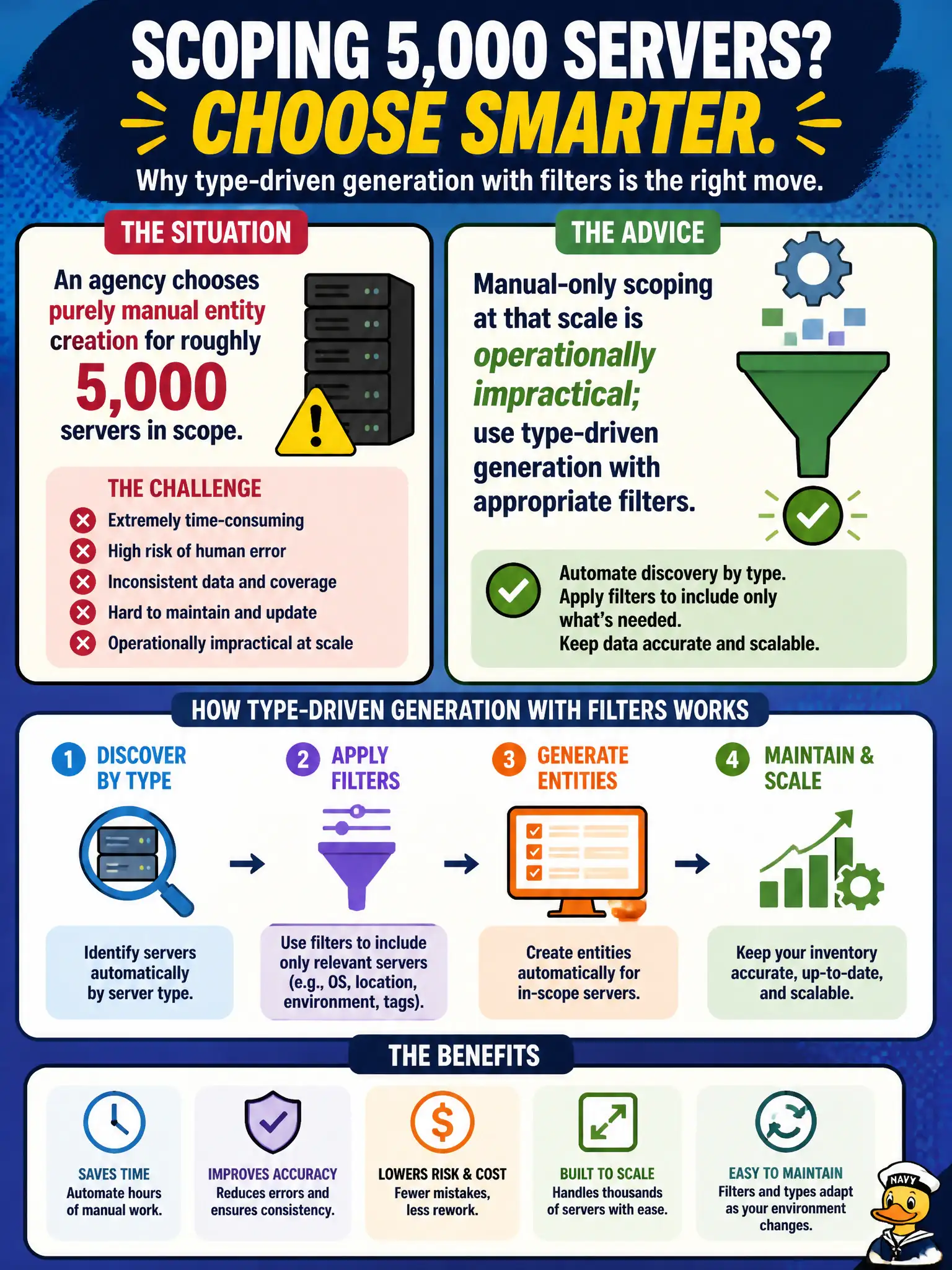
Hand-building 5,000 server entities is like naming every grain of sand on the beach with a Sharpie. Entity types pointed at the right CMDB class with filters do the heavy lifting. Save manual creates for exceptions, not the whole data center.
Full Explanation
Manual-only scoping for roughly 5,000 servers is operationally impractical; use type-driven generation with appropriate filters. Hand-building thousands of server entities is like naming every grain of sand with a Sharpie and invites omissions and drift. Entity types pointed at the server CI class with filters do the heavy lifting; manual creates remain for exceptions. Saying manual entry is required because entity types cannot reference CMDB tables is false. Creating one entity manually and duplicating it with update sets for each server is not a scalable generation strategy. Skipping entities and attaching all server controls to a single company record erases server-level ownership and evidence. Exam caveat: large homogeneous populations belong on the entity type approach. Operational check for the agency: define an entity type on the server class with environment or criticality filters matching the in-scope set, run generation for a pilot subnet or class, sample accuracy, then schedule recurring refresh instead of manual entry. In civic IRM programs, document the decision, name owners, and verify the platform records match the intended operating model before expanding scope. Re-check after organizational or CMDB changes so evidence remains defensible.