
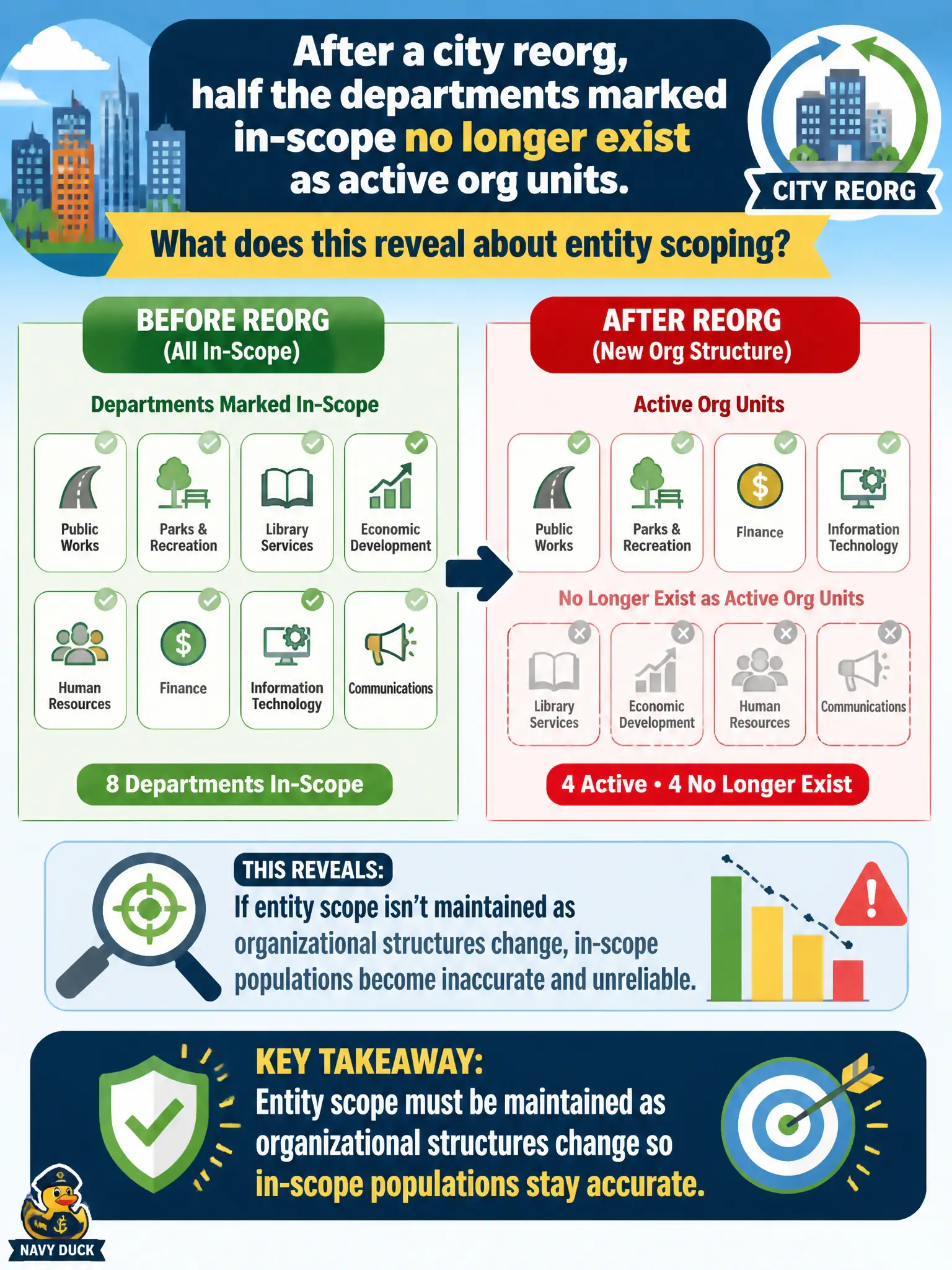
After a city reorg, half the departments marked in-scope no longer exist as active org units. What does this reveal about entity scoping?
Select an answer to reveal the explanation.
Short Explanation
Org charts age like milk on a hot dashboard. When half the “in-scope” departments vanish in a reorg, yesterday’s entity list becomes fiction. Treat scoping as living maintenance—refresh populations when the city reshuffles—or compliance and risk reports point at ghosts.
Full Explanation
Entity scope must be maintained as organizational structures change so in-scope populations stay accurate after a city reorg. When half the departments marked in-scope no longer exist as active org units, yesterday’s entity list becomes fiction and compliance reports point at ghosts. Treat scoping as living maintenance—refresh populations, owners, and entity-type conditions—not a one-time workshop souvenir. Saying entity scope is a one-time design workshop that should never change after go-live guarantees drift in civic environments. Claiming retired departments automatically convert into Advanced Risk indicators invents a nonsensical transformation. Saying scoping only matters for Policy and Compliance so Risk can ignore org-unit changes fragments the shared entity model. Exam caveat: ongoing scope maintenance after structural change is required for credible IRM. Operational check after reorg: compare in-scope department entities to the active org-unit table, retire or deactivate obsolete entities, add successor units, refresh generation, and reassign control and risk ownership before the next attestation cycle. In civic IRM programs, document the decision, name owners, and verify the platform records match the intended operating model before expanding scope. Re-check after organizational or CMDB changes so evidence remains defensible.