
A city must show HIPAA, state privacy, and PCI-aligned obligations but wants fewer duplicate control objectives to test. How do common-controls content packs help?
Select an answer to reveal the explanation.
Short Explanation
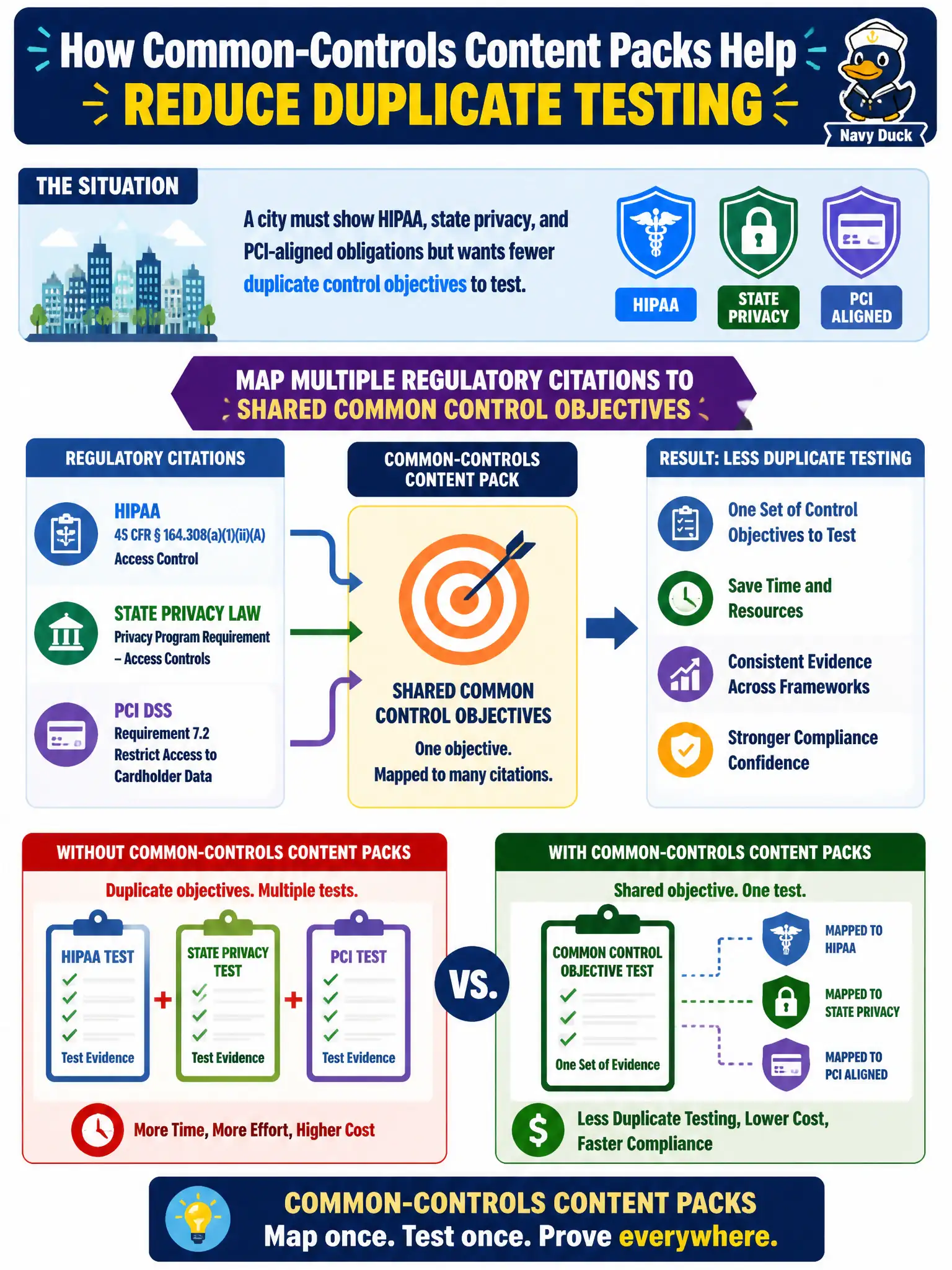
Three laws can still share one solid control if you map them that way. Common-controls content lets many citations point at fewer objectives so you test once, prove many. Cloning a twin objective per citation is busywork.
Full Explanation
Cities facing HIPAA, state privacy, and PCI-aligned obligations reduce duplicate testing by using common-controls content that maps multiple regulatory citations to shared common control objectives. Many-to-one citation-to-objective mapping lets one well-designed control prove multiple obligations. That is how municipal programs shrink test fatigue without dropping regulatory coverage.
Forcing a separate identical control objective copy for every citation with no reuse multiplies identical tests. Deleting all regulatory citations and keeping only vendor marketing one-pagers abandons authority traceability. Replacing control objectives with ITSM catalog items confuses request fulfillment with compliance control design.
Exam caveat: common controls map many citations → fewer objectives. Cloning one objective per citation is the anti-pattern CIS-RC warns against.
Operational check: for a privileged-access objective, map HIPAA/state/PCI-related citations as applicable; run one test cycle; show evidence reused across citations in reporting.
Maintain a traceability report showing which citations share each common control objective so examiners see intentional reuse rather than missing coverage. When obligations truly diverge, split objectives deliberately—default to share, not clone.