
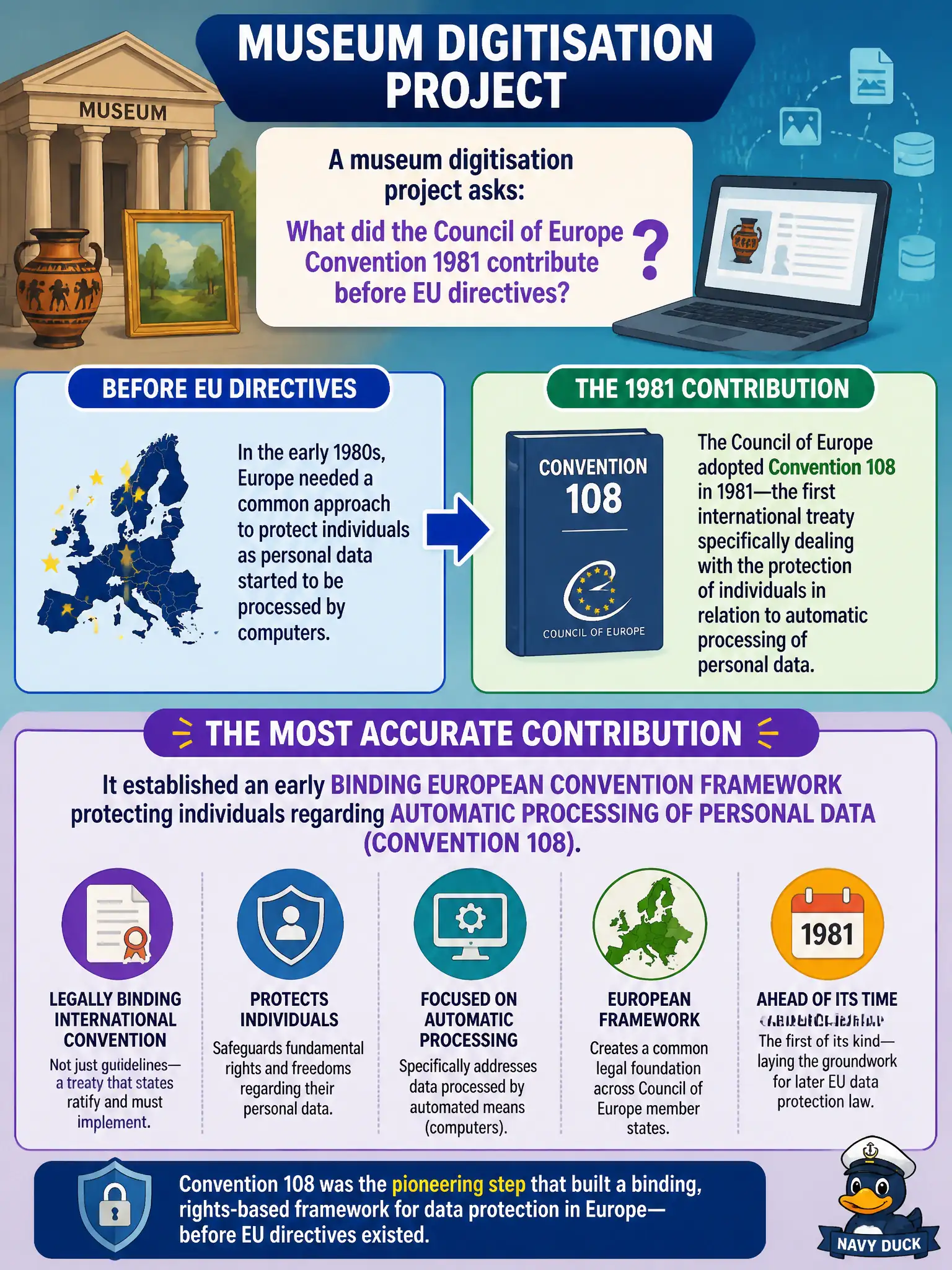
A museum digitisation project asks what the Council of Europe Convention 1981 contributed before EU directives. Which contribution is most accurate?
Select an answer to reveal the explanation.
Short Explanation
Long before the big EU directives, Convention 108 planted a binding European flag: protect people when computers automatically process their data. Museums digitising collections are walking into that same old concern with new scanners. Early convention, lasting idea.
Full Explanation
The Council of Europe’s 1981 Convention for the Protection of Individuals with regard to Automatic Processing of Personal Data (Convention 108) established an early binding European convention framework protecting individuals in relation to automatic processing of personal data. Museum digitisation teams should recognise it as foundational lineage before EU directives and the GDPR, not as the EU’s modern fining architecture. It did not create the EDPB or authorise GDPR-level administrative fines across the EU. It did not mandate US Safe Harbor certifications for European museums. It did not ban all museum catalogues that list donor names on paper cards. Convention 108 is CoE treaty law with a protective automated-processing focus that informed later European instruments while remaining distinct from Regulation (EU) 2016/679. Exam caveat: historical contribution items want Convention 108’s early binding automated-processing framework—not GDPR enforcement machinery projected backward. Operational check: when writing a digitisation DPIA background section, cite Convention 108 as historical foundation and the GDPR as the operative EU rule-set for current processing, keeping the citations in separate sentences.