
A regional authority wants the court that interprets the GDPR as EU law and helps ensure its uniform application. Which court fills that role?
Select an answer to reveal the explanation.
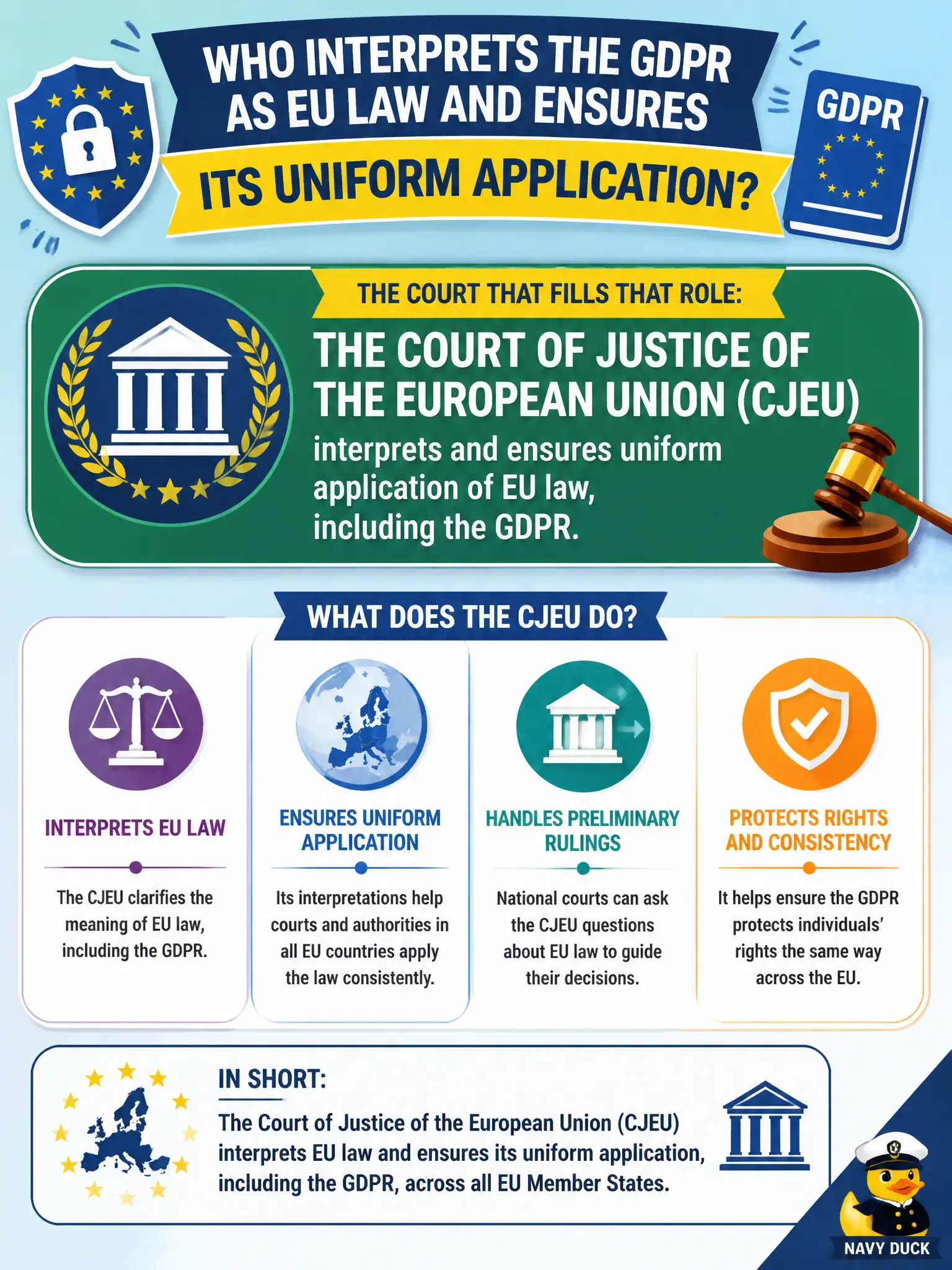
Short Explanation
When EU countries need one referee for what the GDPR means across the Union, that is CJEU territory. National judges still apply the law day to day, but the CJEU keeps the EU-law reading consistent. Think uniform playbook, not fifty different rulebooks.
Full Explanation
The Court of Justice of the European Union interprets EU law and helps ensure its uniform application across Member States, including the GDPR. When a regional authority needs the court that settles how the Regulation must be read as Union law, the CJEU is the correct institutional answer. Landmark transfer, rights, and scope judgments illustrate that role for public-sector controllers who must follow consistent EU interpretations. An International Court of Arbitration for cookie banners is fiction. The US Supreme Court is not the final appellate body for EU regulations. Local mayors’ courts do not exclusively interpret the GDPR without EU-level review pathways through national courts and preliminary references. Exam caveat: distinguish CJEU (EU law) from ECtHR (ECHR) even when both influence privacy discourse. Operational check: if national case law on a municipal processing activity conflicts across Member States, track whether a preliminary reference or CJEU authority already constrains the interpretation you plan to rely on before locking the compliance design. For municipal teams, keep a one-page decision note that states the governing instrument, why competing labels fail, and what evidence would change the conclusion.