
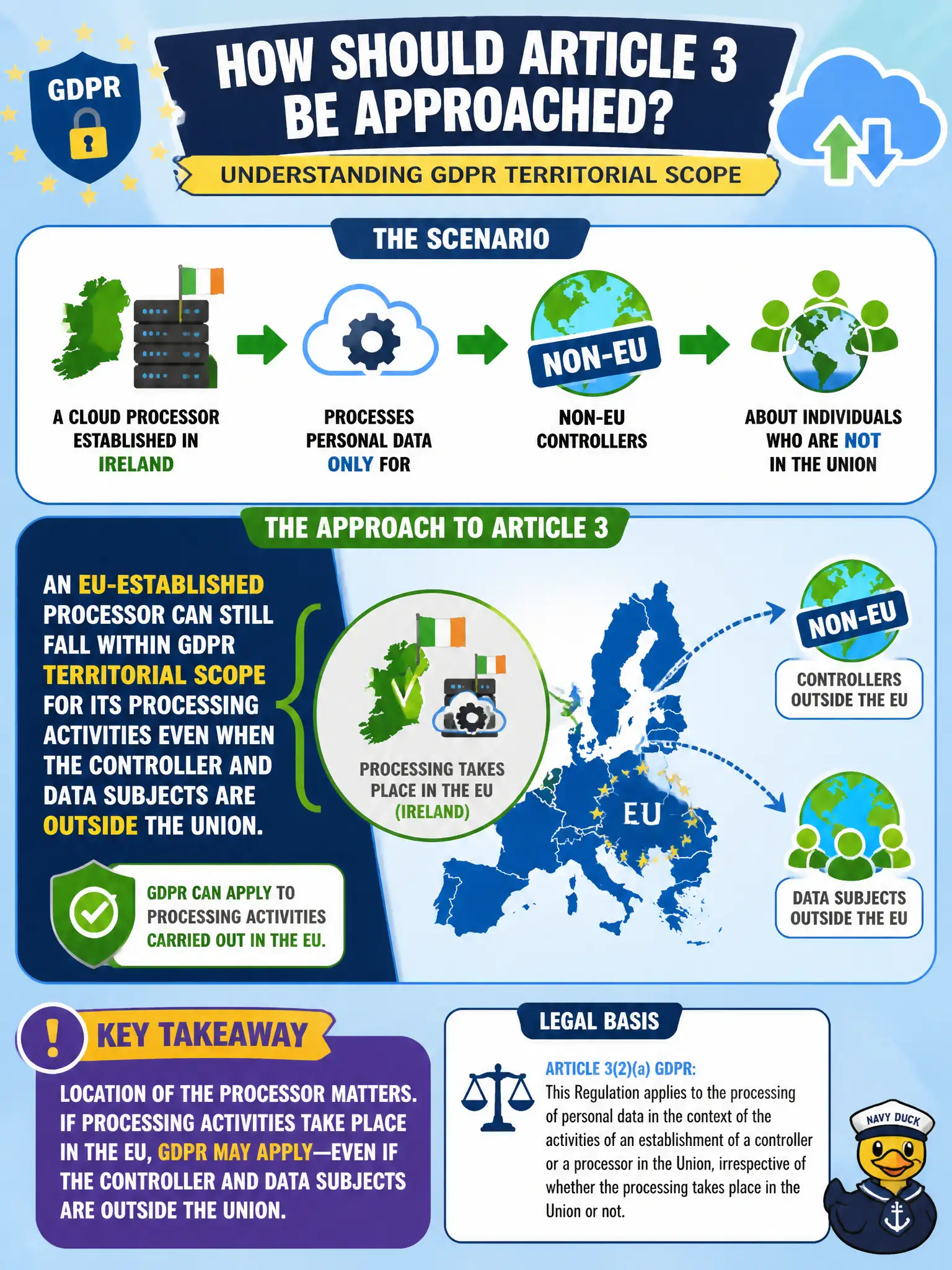
A cloud processor established in Ireland processes personal data only for non-EU controllers about individuals who are not in the Union. How should Article 3 be approached?
Select an answer to reveal the explanation.
Short Explanation
Picture a Dublin warehouse that stores boxes for overseas shops about overseas customers — the warehouse itself still sits under Union rules. Establishment of the processor can matter even if the client and the people in the files are abroad. Ignoring the Irish footprint is the trap.
Full Explanation
Article 3(1) can apply to a processor established in the Union in respect of its processing activities, even when the controller is outside the EU and the data subjects are not in the Union. An Ireland-established cloud processor therefore may remain under GDPR territorial scope for how it processes, secures, and sub-processes that personal data. Establishment in the Union is a powerful jurisdictional hook protecting the integrity of EU-located processing infrastructure.
EU processors are not automatically out of scope merely because clients and data subjects sit abroad. The non-EU controller’s home law does not erase Irish establishment relevance. Processor coverage is not limited to cases where the processor also markets to the EU as a controller.
Exam caveat: controllers outside the EU may still need their own Article 3(2) analysis for targeting/monitoring; processor establishment scope is a separate question. Article 28 duties still structure the relationship.
Operational check: apply GDPR security, Article 28, and sub-processor controls in the Irish processing environment, document territorial-scope reasoning in the accountability file, and avoid contracts that claim “non-EU data = no GDPR” for EU-based processing services.