
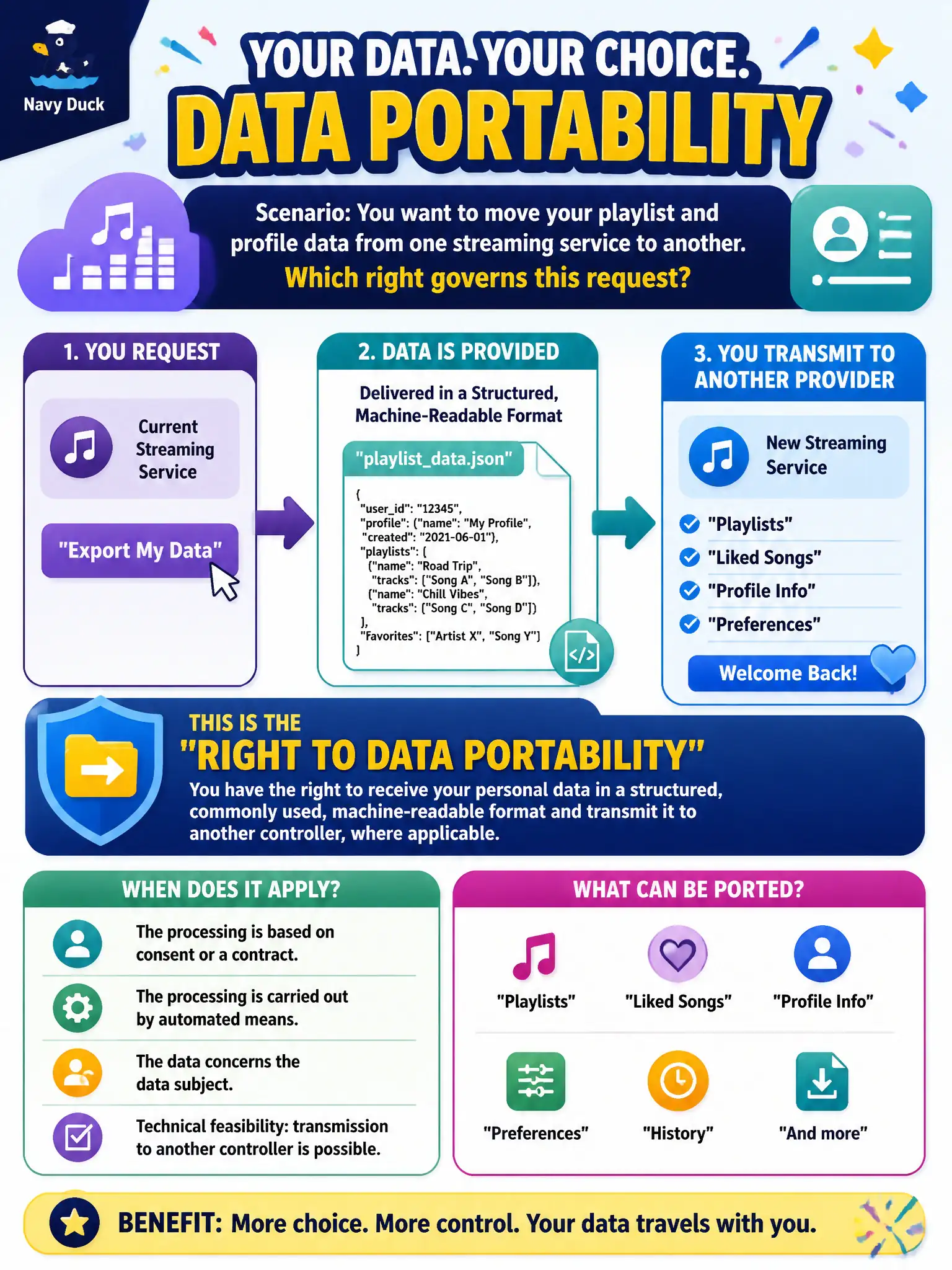
A user asks a streaming service to move their playlist and profile data to another provider in a structured form. Which right primarily governs this request when its conditions are met?
Select an answer to reveal the explanation.
Short Explanation
Want your playlist to travel to the next app? That's portability talking—structured, machine-readable data you can reuse, not a blurry PDF jail. When the legal conditions fit, controllers help the data move cleanly.
Full Explanation
When its conditions are met, the right to data portability entitles a user to receive personal data concerning them in a structured, commonly used, and machine-readable format, and to transmit those data to another controller without hindrance where applicable. Asking a streaming service to move playlist and profile data to another provider primarily engages portability—emphasising reuse and transmission—not merely a human-readable glimpse of records.
Providing only handwritten-style PDF scans that cannot be reused fails the machine-readable, commonly used format expectation. Mandatory erasure of the playlist before any copy is provided confuses portability with erasure. Supervisory-authority mediation is not a precondition for every small playlist export.
Exam caveat: portability ≠ access; format and reuse are the differentiators when conditions apply (typically consent or contract, automated processing, data provided by the subject). Operational check: confirm qualifying conditions, export structured files, support direct transmission where feasible, and explain any lawful limits. Digital services used by residents should make switching providers practically possible when the right applies, supporting user autonomy in a civic digital marketplace rather than locking people into unreadable exports.