
During training, staff ask why the GDPR restricts unrestricted transfers of personal data to third countries. What protective rationale best answers them?
Select an answer to reveal the explanation.
Short Explanation
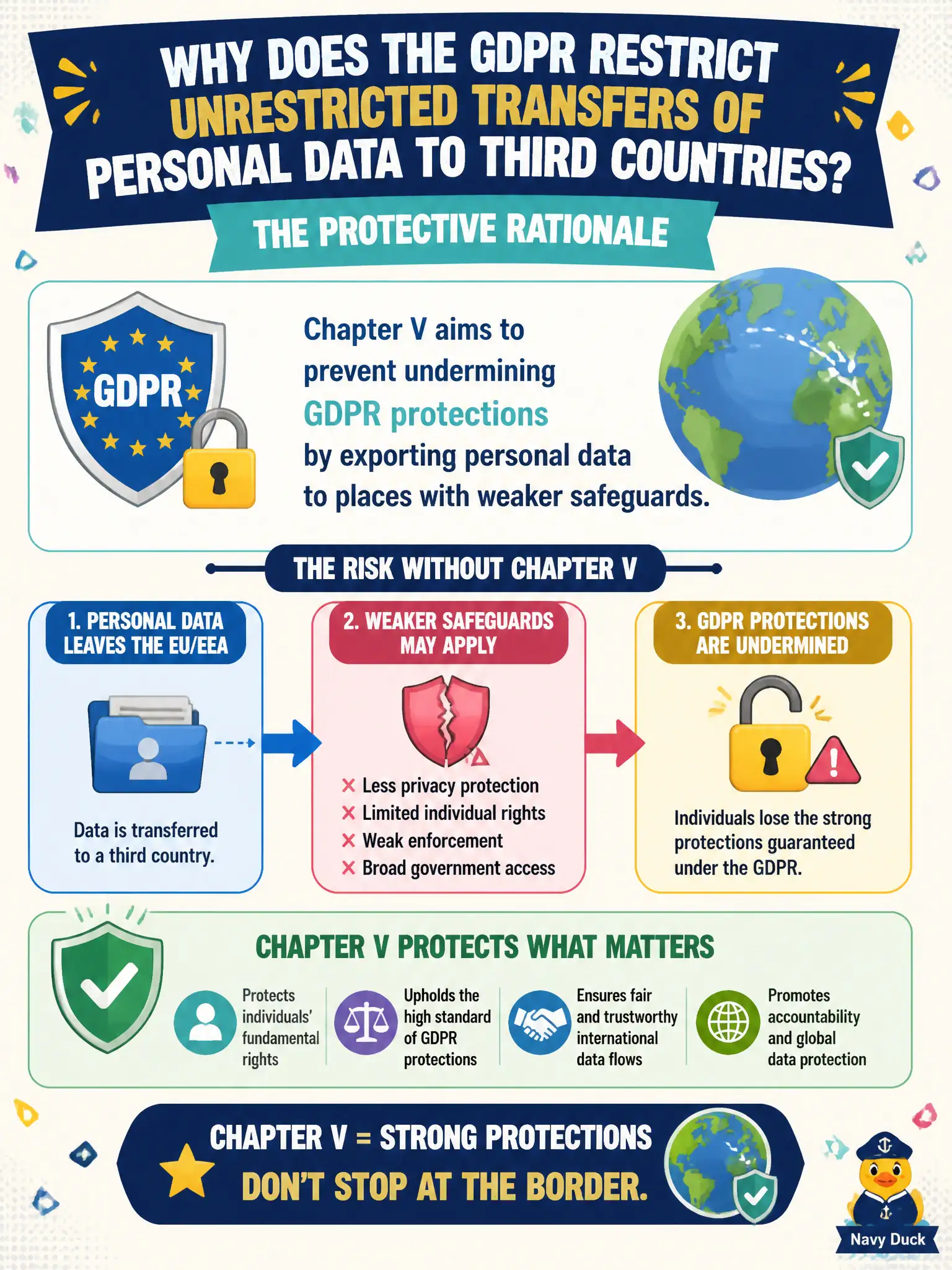
If you could freely dump EU personal data somewhere with weaker shields, the GDPR’s promises would spring a leak. Chapter V is the export control that keeps protection from evaporating at the border. It is about people’s rights—not customs paperwork or forcing US representatives on everyone.
Full Explanation
Chapter V exists so that moving personal data outside the EEA does not strip away the protections the GDPR affords inside the Union. Adequacy decisions, appropriate safeguards, and narrow derogations are designed to prevent exporters from undermining rights by shipping data to places with weaker safeguards or ineffective redress. That civic rationale—protecting people when their data cross borders—is the teaching answer staff need in training, not a customs-revenue or trade-paperwork story.
Chapter V is not mainly a device to increase customs revenue on digital trade invoices. The restrictions are not limited to encrypted backups; live production transfers of personal data are squarely in scope. The rules also do not exist solely to force every company to appoint a US representative—Article 27 representatives are a separate territorial-scope contact tool for certain non-EU controllers and processors.
Exam caveat: connect Chapter V’s protective purpose to Schrems case-law themes of essential equivalence and the practical effectiveness of safeguards, not mere formal signature of clauses without risk analysis.
Operational check: in staff training, map each outbound flow to an Article 45, 46, or 49 path, show how the privacy notice discloses transfers, and quiz teams on why “the vendor is abroad, so the GDPR stops applying” is false for exporters who remain accountable.