
Counsel confirms the European Commission has adopted an adequacy decision for the destination country where a SaaS vendor stores EU customer data. What does that adequacy finding primarily mean for the transfer?
Select an answer to reveal the explanation.
Short Explanation
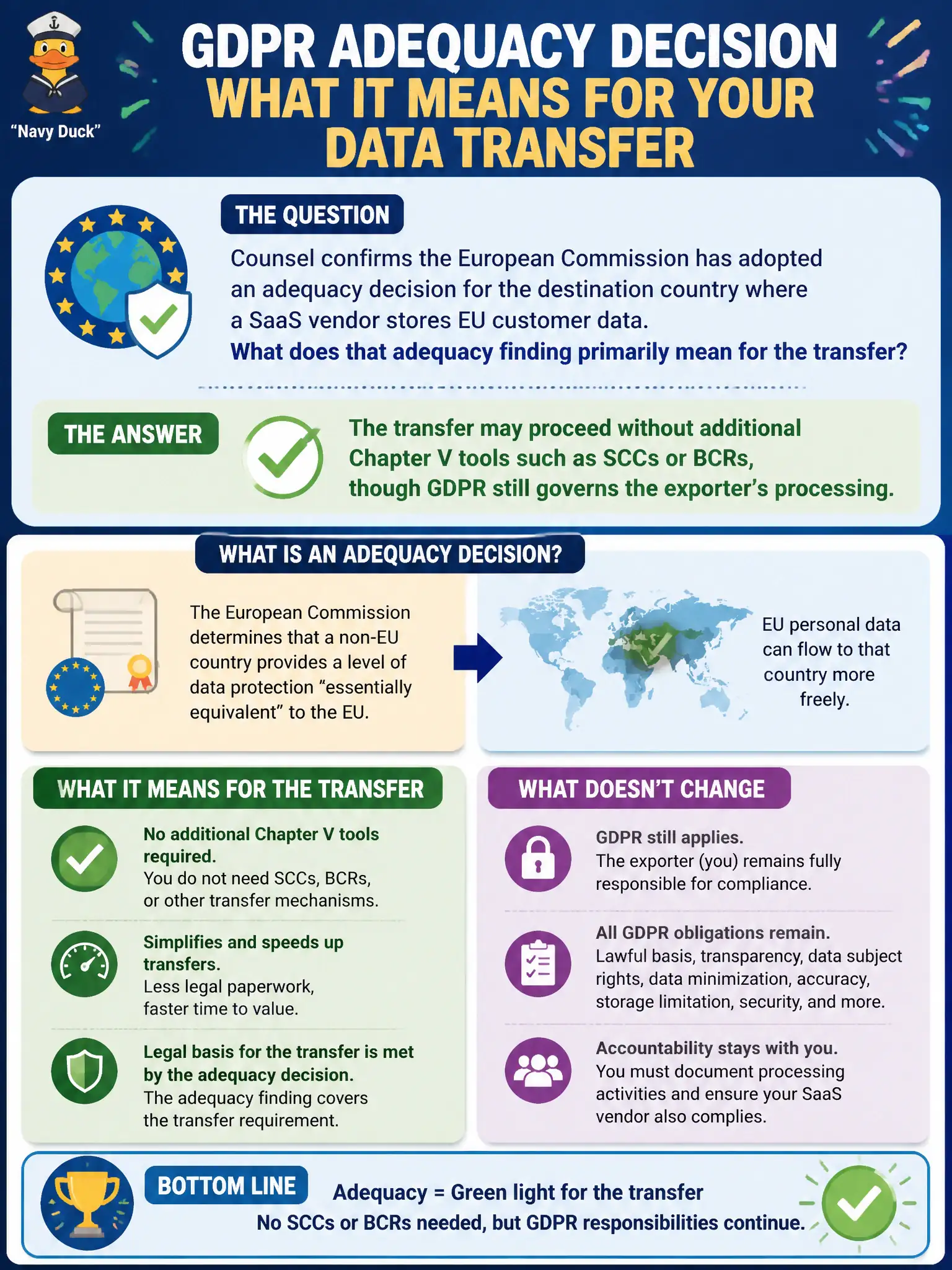
An adequacy decision is like a trusted-country passport stamp: the EU has judged protections essentially equivalent, so you usually don’t need a separate SCC or BCR for that hop. The GDPR still sticks to the exporter’s own processing. It is not a free pass to ignore European rules altogether.
Full Explanation
An adequacy decision under Article 45 means the Commission has found the third country’s (or specified sector’s) level of protection essentially equivalent, so transfers may proceed without additional tools such as SCCs or BCRs. GDPR still governs the exporter’s processing in the EEA: principles, Article 6 bases, transparency, and security continue to apply. For a SaaS vendor storing EU customer data in an adequate destination, adequacy simplifies Chapter V without creating a civic or commercial “GDPR off switch.”
Adequacy does not replace the GDPR for the exporter once data leave the EEA. The exporter need not still sign SCCs solely because data move to an adequate country—that would misunderstand Article 45’s effect. Adequacy can cover private-sector recipients when the decision so provides; it is not limited to public authorities only.
Exam caveat: verify the decision’s scope (whole country vs sectors, and any evolving US framework participation rules). Adequacy can be repealed or limited; monitor status rather than assuming permanence forever.
Operational check: record the adequacy decision citation in the RoPA and notice, confirm the vendor’s storage region matches the adequate destination, and revisit documentation if the vendor later dual-homes data in non-adequate locations or grants non-adequate remote access.