
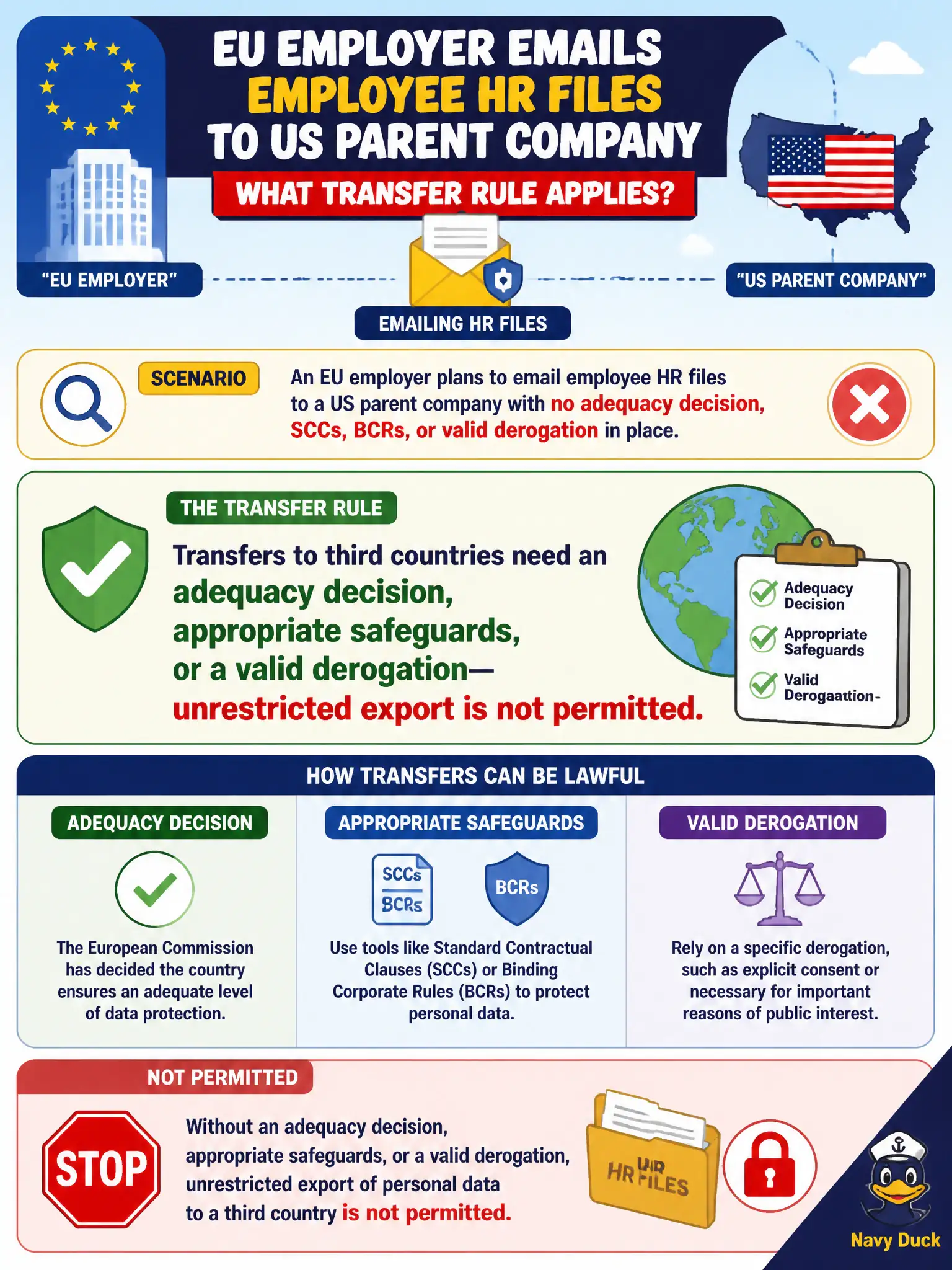
An EU employer plans to email employee HR files to a US parent company with no adequacy decision, SCCs, BCRs, or valid derogation in place. What transfer rule applies?
Select an answer to reveal the explanation.
Short Explanation
Sending EU HR files across the Atlantic without a transfer tool is like shipping valuables with no customs paperwork. Group ownership does not magically unlock Chapter V. Use adequacy, safeguards such as SCCs or BCRs, or a narrow valid derogation—don’t just hit send.
Full Explanation
Chapter V restricts transfers of personal data to third countries or international organisations. Absent an adequacy decision, appropriate safeguards (such as SCCs or BCRs), or a valid Article 49 derogation, unrestricted export—including emailing employee HR files to a US parent—is not permitted. Intra-group status does not create a free-transfer lane. Employers serving a civic workforce or a private payroll alike must treat HR exports as regulated transfers when the recipient sits outside the EEA protection sphere.
Employment law does not push intra-group HR transfers outside Chapter V as a general rule. Share ownership by the parent does not negate transfer status when personal data move to another country. Ordinary HR fields are still personal data; transfer mechanisms are not reserved only for special-category data.
Exam caveat: identify whether the US recipient is covered by a current adequacy mechanism (for example DPF participation where applicable) or needs SCCs/BCRs plus transfer impact analysis. Derogations are narrow and poor fits for routine HR syncing.
Operational check: stop ungoverned email exports, select an appropriate Chapter V tool, complete transfer documentation and any supplementary measures assessment, update the employee notice, and route HR files through controlled channels that match the chosen safeguards.