
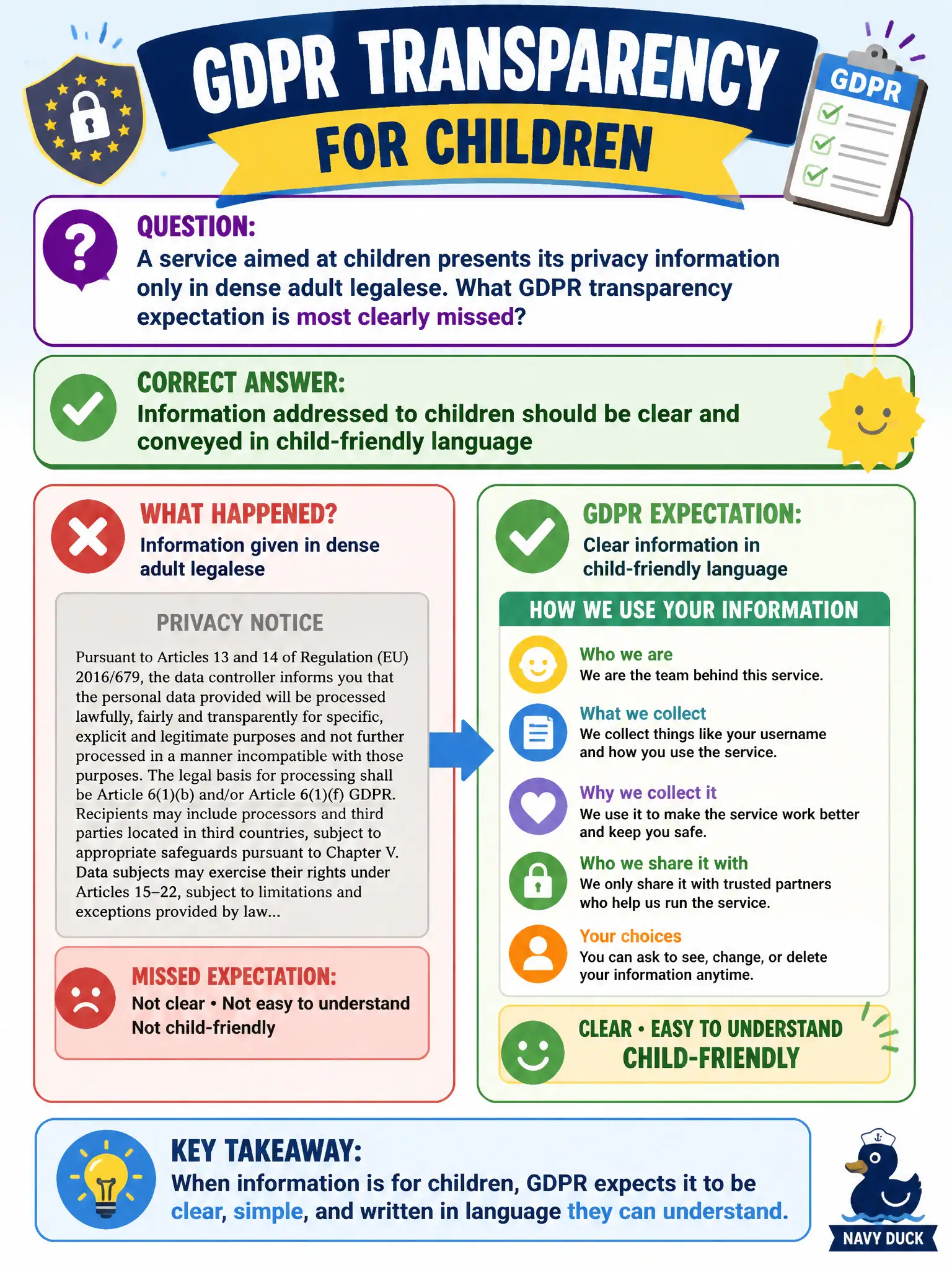
A service aimed at children presents its privacy information only in dense adult legalese. What GDPR transparency expectation is most clearly missed?
Select an answer to reveal the explanation.
Short Explanation
If kids are the audience, write for kids. Adult contract-speak fails the "intelligible" test. Plain, age-appropriate language is part of doing transparency right for children's services.
Full Explanation
Article 12(1) requires that when processing is addressed to a child, information be provided in clear and plain language that the child can understand. Dense adult legalese on a child-directed service misses that expectation and undermines fairness, consent quality where consent is used, and the child’s ability to exercise rights. Schools, municipal youth portals, and private edtech or entertainment apps share the civic duty to speak in age-appropriate terms about what happens to young people’s data.
Notices need not be published exclusively through Official Journal citations. Child-directed processing is not limited to vital interests; consent and other bases may apply under the conditions GDPR sets (including Article 8 for information-society consent). There is no rule that notices under 10,000 words are automatically non-compliant for minors—brevity and clarity help, verbosity does not.
Exam caveat: Article 8’s age thresholds and Member State variation matter for consent, but this item targets transparency language quality. Adult-only legal style can fail even when a lawful basis exists on paper.
Operational check: user-test the child-facing explanation with the intended age band, keep a guardian-oriented layer where appropriate, and ensure the durable notice remains accurate without relying solely on unreadable terms.