
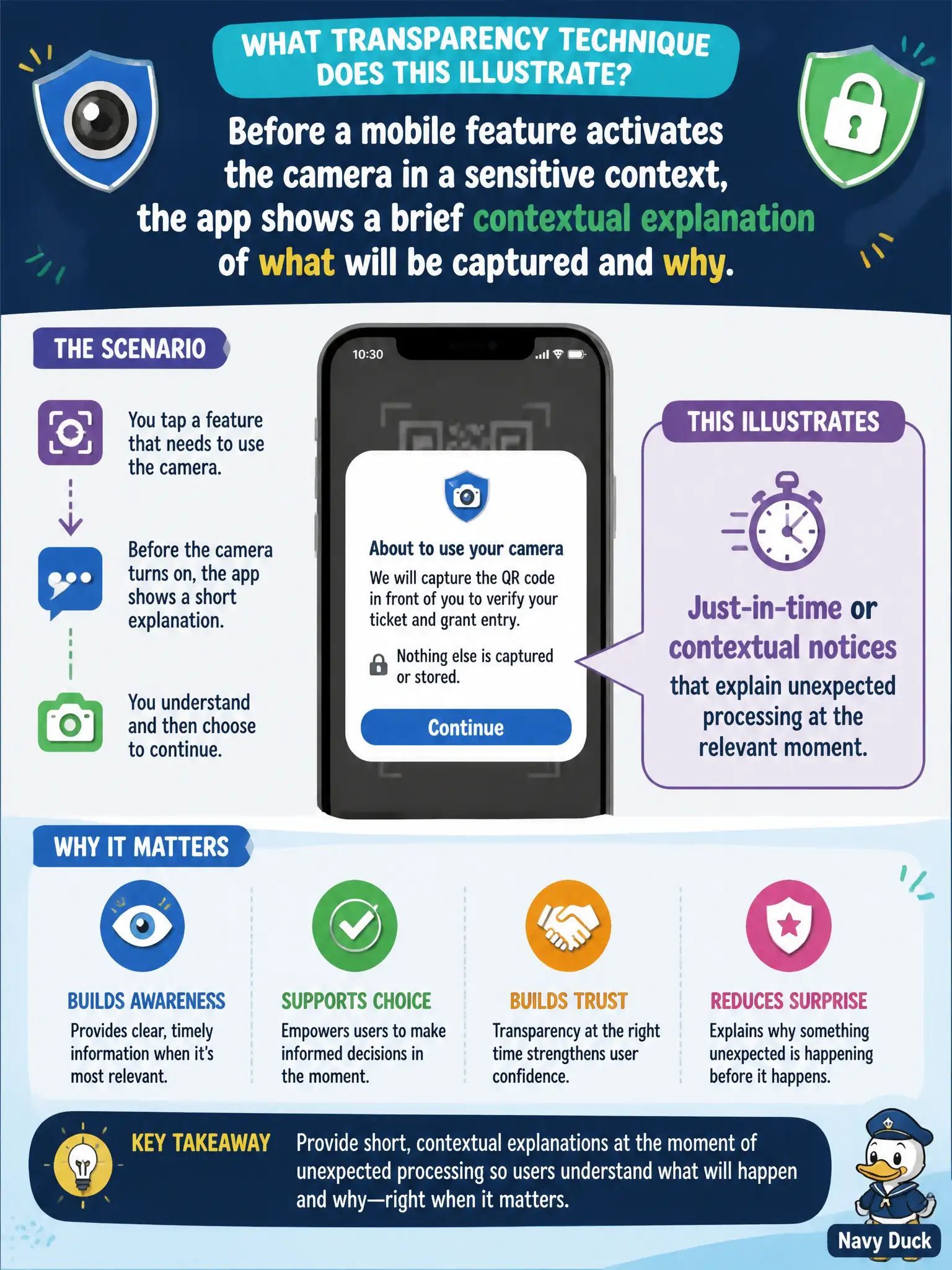
Before a mobile feature activates the camera in a sensitive context, the app shows a brief contextual explanation of what will be captured and why. What transparency technique does that illustrate?
Select an answer to reveal the explanation.
Short Explanation
Just-in-time notices are the tap-on-the-shoulder before something surprising happens—like a camera kicking in. Explaining in the moment helps people understand better than a one-time wall of text from install day.
Full Explanation
Just-in-time or contextual notices explain unexpected or sensitive processing at the moment it becomes relevant—such as before a mobile feature activates the camera in a sensitive context. They complement the durable privacy policy by giving people intelligible information when surprise is highest, aligning with Article 12’s emphasis on concise, transparent communication. Civic apps requesting camera access for document upload or identity checks illustrate why timing matters as much as legal completeness.
This technique is not anonymous statistical disclosure control under Convention 108, not a BCR substitute for front-end notices, and not something that requires European Council authorisation per frame. Those options mix unrelated instruments with UX transparency.
Exam caveat: just-in-time notices support transparency and consent quality; they do not replace the need for a findable full notice or for a valid lawful basis. Empty permission prompts without purpose language still fail.
Operational check: trigger a short purpose explanation before camera activation, link to deeper notice content, verify the copy matches real capture/upload behaviour, and regression-test that the prompt appears on first use in the sensitive flow—not only in a settings labyrinth.