
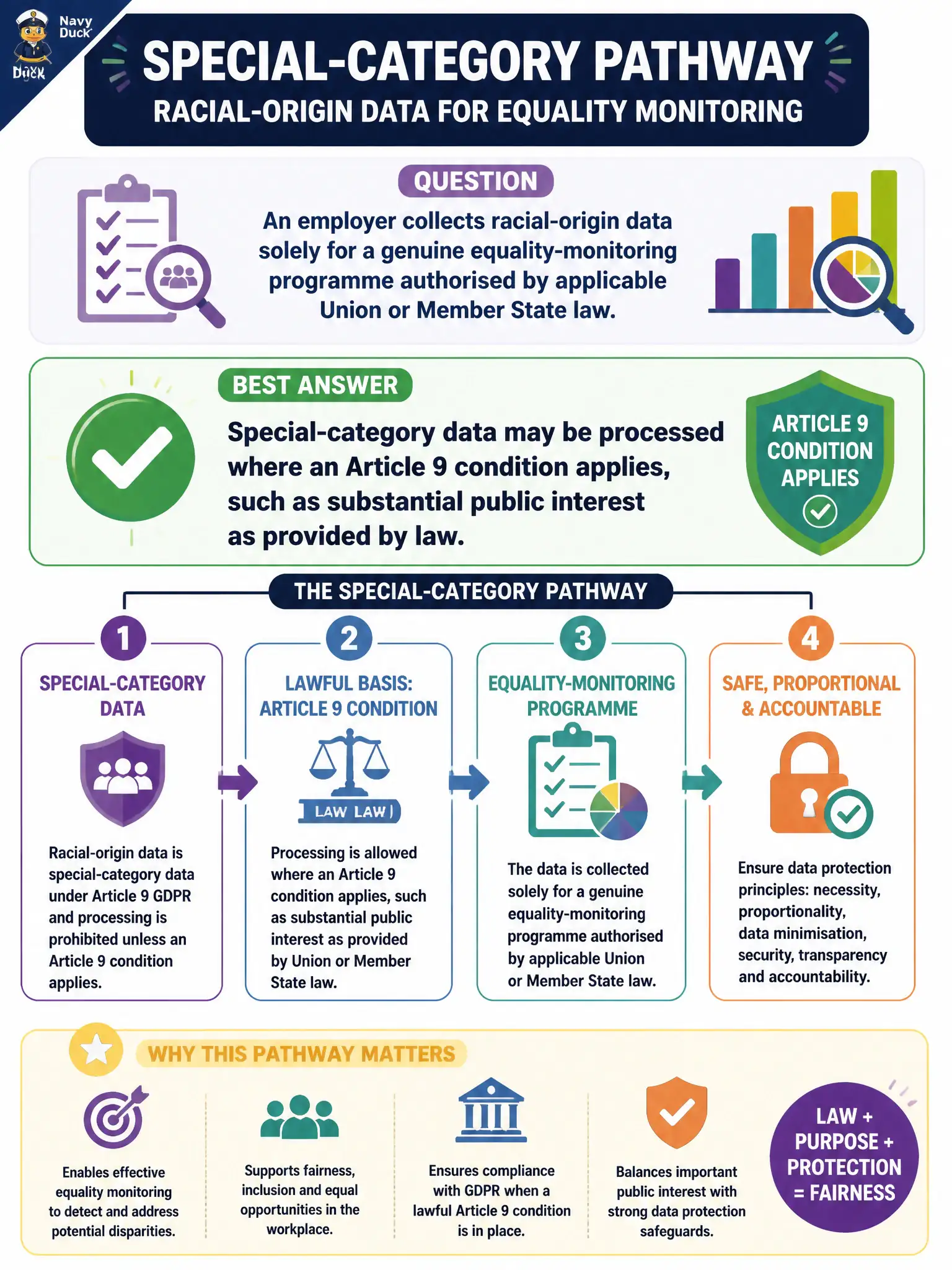
An employer collects racial-origin data solely for a genuine equality-monitoring programme authorised by applicable Union or Member State law. Which statement best reflects the special-category pathway?
Select an answer to reveal the explanation.
Short Explanation
Race data for equality monitoring is still special-category data. You need Art. 6 plus a fitting Art. 9 condition—often substantial public interest spelled out in law—not a dashboard label that waves the prohibition away.
Full Explanation
Racial or ethnic origin data are special-category data under Article 9(1). Processing them is prohibited unless an Article 9(2) condition applies. A genuine equality-monitoring programme authorised by applicable Union or Member State law often relies on substantial public interest (Article 9(2)(g)) or another employment/social-protection condition where the law so provides, together with a suitable Article 6 basis, safeguards, and minimisation. Civic employers running statutory equality monitoring illustrate why special-category pathways are gated by law and safeguards rather than by dashboard convenience.
Racial-origin data do not cease to be special-category merely because they feed HR analytics dashboards. Article 6 legitimate interests alone never unlocks Article 9 processing; special-category data need both layers. Equality monitoring is not automatically exempt from Articles 6 and 9 in every Member State—exemptions and conditions are specific and must be grounded in the applicable law.
Exam caveat: “substantial public interest” is not a vague civic slogan; it requires a basis in Union or Member State law and proportionate safeguards. Explicit consent is another Article 9 route but is often unreliable in employment contexts because of imbalance.
Operational check: identify the precise Article 9(2) condition and national implementing provision, limit fields to what monitoring requires, restrict access, set retention, update the notice and DPIA, and verify that reporting outputs are aggregated where individual identification is unnecessary.