
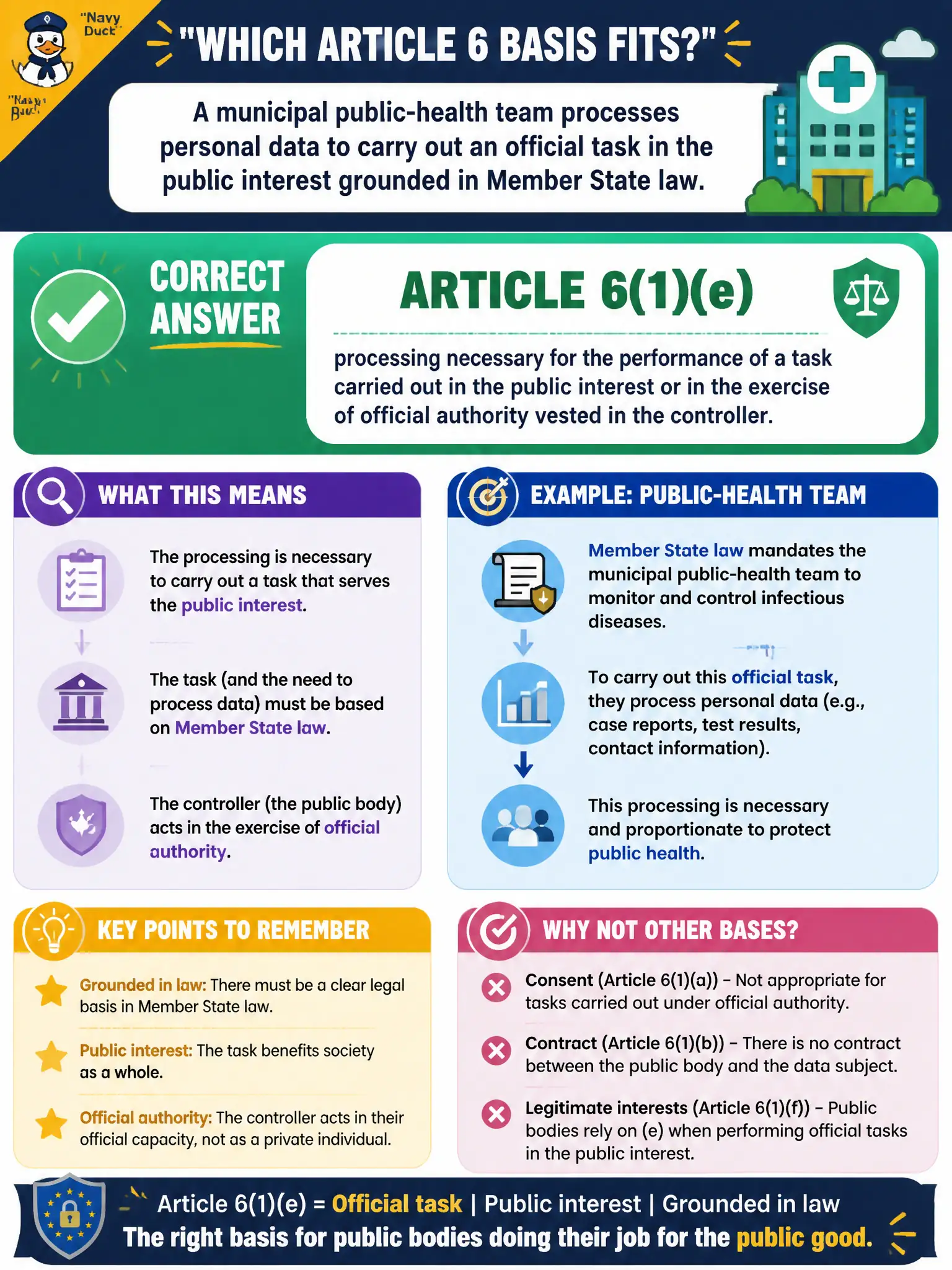
A municipal public-health team processes personal data to carry out an official task in the public interest grounded in Member State law. Which Article 6 basis primarily fits?
Select an answer to reveal the explanation.
Short Explanation
City public-health work with a legal mandate is classic ‘official task / public interest’ processing—not a retailer’s legitimate-interests pitch. Article 6(1)(e) is the basis when the controller is doing its public job under the law. Consent gimmicks are usually the wrong frame for that work.
Full Explanation
Article 6(1)(e) covers processing necessary for the performance of a task carried out in the public interest or in the exercise of official authority vested in the controller, grounded in Union or Member State law. A municipal public-health team processing personal data to carry out an official task in the public interest under Member State law fits that basis: the mandate is public and legal, not a private bargain or a retailer preference.
Consent bundled with a library-card application is not the primary basis for official public-health tasks and may fail freeness if bundled. Legitimate interests of a private retailer with no official mandate do not substitute for Article 6(1)(e). Contractual necessity for selling festival merchandise online is a different, private-contract pattern.
Exam caveat: official public tasks → Article 6(1)(e) with a legal basis in Member State/Union law. Operational check: identify the enabling law, minimise data to the task, apply proportionality, and provide transparent public notices. Municipal public-health programmes should show residents the legal task behind the processing, reinforcing that civic power is authorised, purpose-bound, and accountable.