
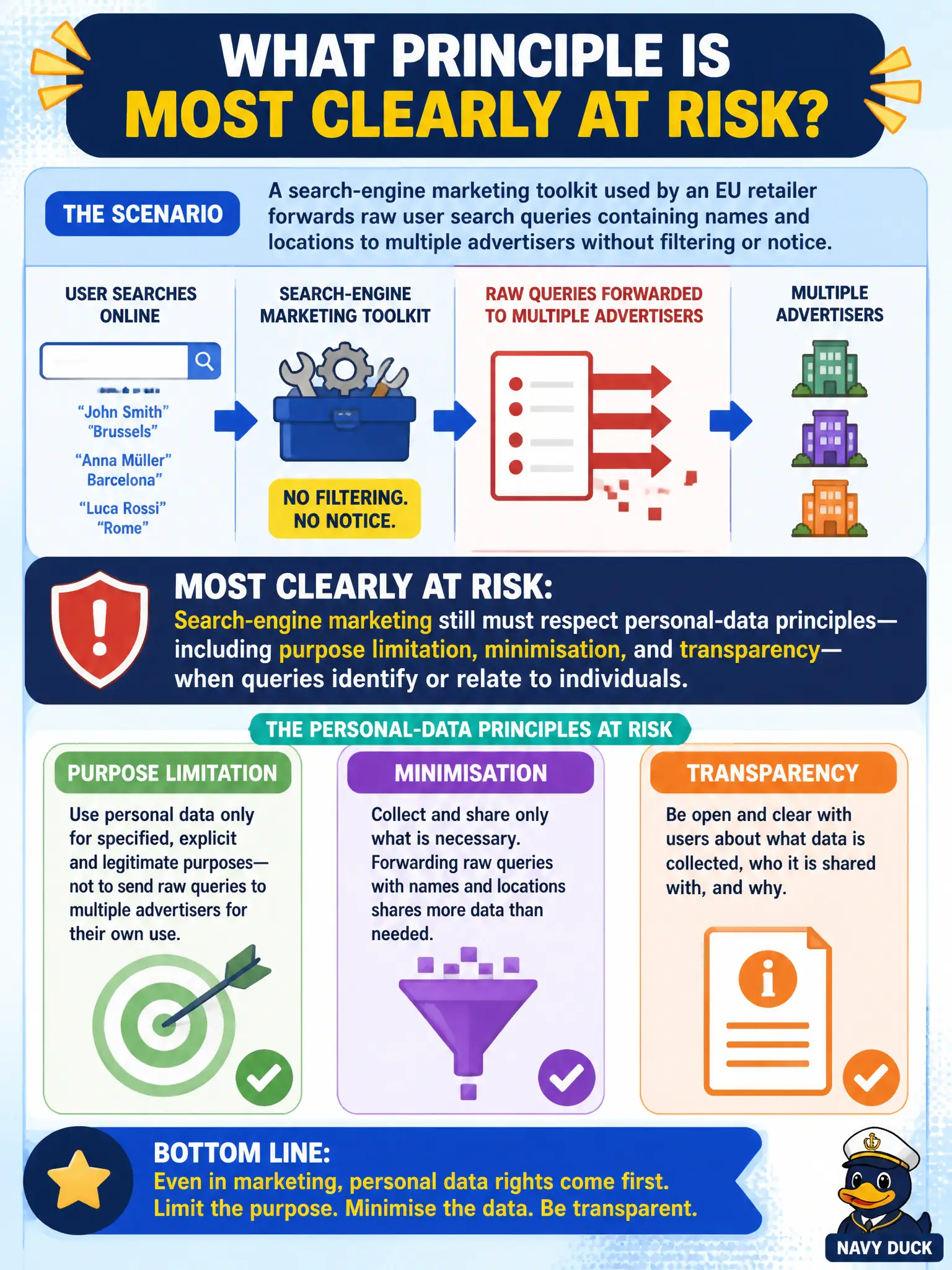
A search-engine marketing toolkit used by an EU retailer forwards raw user search queries containing names and locations to multiple advertisers without filtering or notice. What principle is most clearly at risk?
Select an answer to reveal the explanation.
Short Explanation
A search that says 'cardiologist near Maria Rossi Milan' is personal data wearing work boots. Shipping raw queries to a pile of advertisers without care breaks minimisation and transparency. SEM tools do not get a GDPR hall pass.
Full Explanation
A search-engine marketing toolkit used by an EU retailer that forwards raw user search queries containing names and locations to multiple advertisers without filtering or notice most clearly puts at risk that search-engine marketing still must respect personal-data principles—including purpose limitation, minimisation, and transparency—when queries identify or relate to individuals. A query like a named person plus a city is personal data wearing work boots. Claiming search queries are never personal data when typed into a marketing tool fails. Saying advertisers may receive any query string because SEM is excluded from GDPR fails—there is no SEM hall pass. Asserting only paid-click conversion IDs, never query text, can implicate privacy law fails when query text identifies people. Exam caveat: tooling convenience does not create a sectoral exemption; controllers and processors in the SEM chain share accountability for indiscriminate query leakage. Operational check: filter or hash sensitive query content, minimise advertiser payloads, provide notice of SEM disclosures, contractually restrict downstream use, and audit vendors for raw-query sprawl. In public-interest terms, documenting the lawful analysis, assigning owners, and retaining evidence of how individuals were protected is how organisations demonstrate accountability when supervisory questions arrive.