
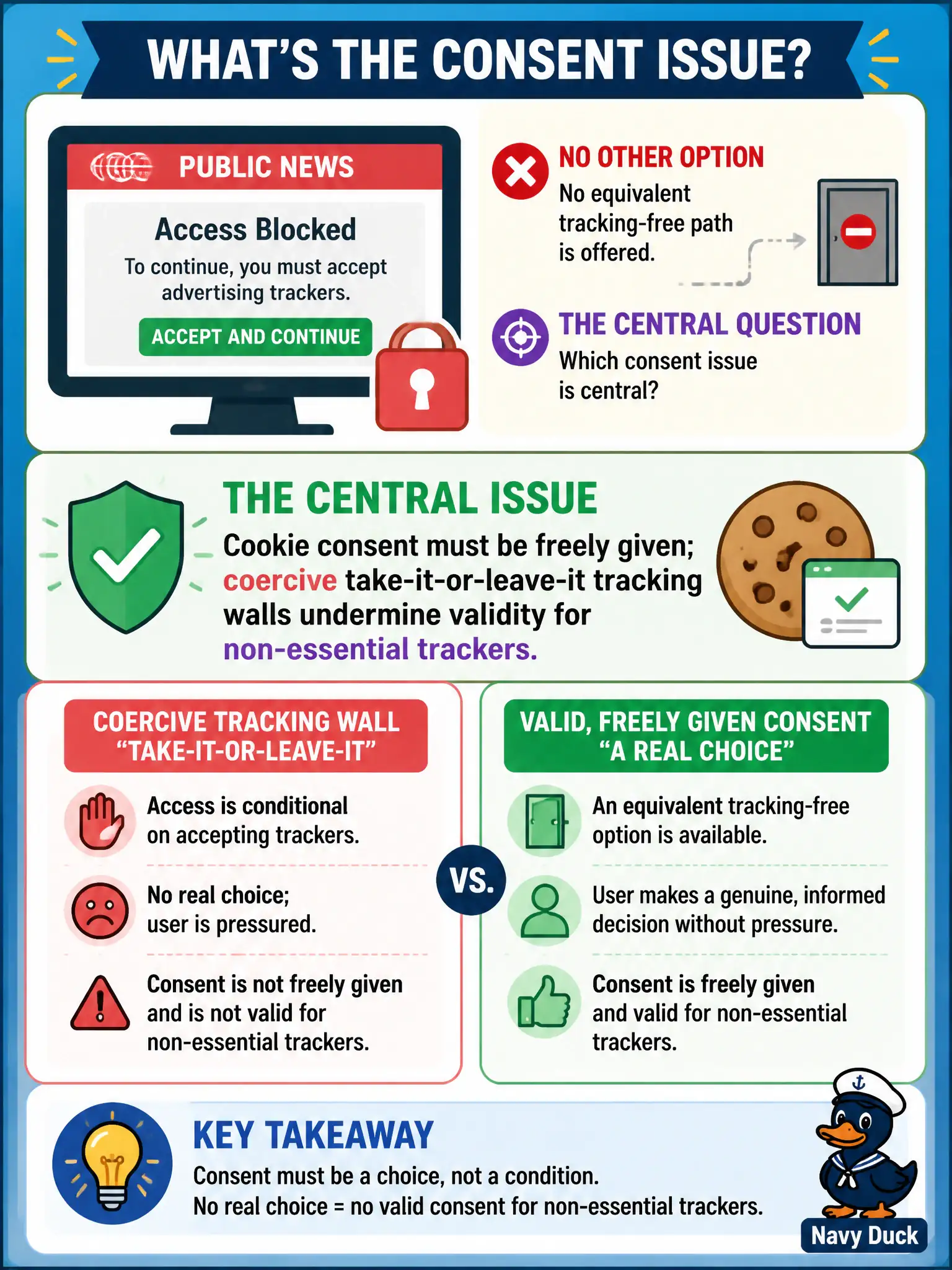
A public news site blocks all access unless the visitor accepts advertising trackers, offering no equivalent tracking-free path. Which consent issue is central?
Select an answer to reveal the explanation.
Short Explanation
Consent that you can only give by swallowing trackers—or going without the news entirely—is not freely given. European practice frowns on coercive cookie walls for ordinary access. Offer a real choice, not a toll booth.
Full Explanation
A public news site that blocks all access unless the visitor accepts advertising trackers, offering no equivalent tracking-free path, centrally raises that cookie consent must be freely given; coercive take-it-or-leave-it tracking walls undermine validity for non-essential trackers. Consent that exists only by swallowing ads trackers or losing the news is not free civic choice. Claiming forced tracker walls always produce valid consent because the choice is binary fails freeness. Saying consent is freely given even when refusal means total service denial for ordinary public content fails supervisory scepticism toward coercive walls. Asserting news sites are exempt from ePrivacy consent rules for all cookies fails—non-essential trackers still need valid consent. Exam caveat: strictly necessary cookies differ; conditioning general access on advertising trackers is the pattern authorities criticise, especially for public information services. Operational check: offer access without non-essential trackers, present refuse and accept with comparable ease, load trackers only after consent, and document the consent UX against freeness criteria. In public-interest terms, documenting the lawful analysis, assigning owners, and retaining evidence of how individuals were protected is how organisations demonstrate accountability when supervisory questions arrive.