
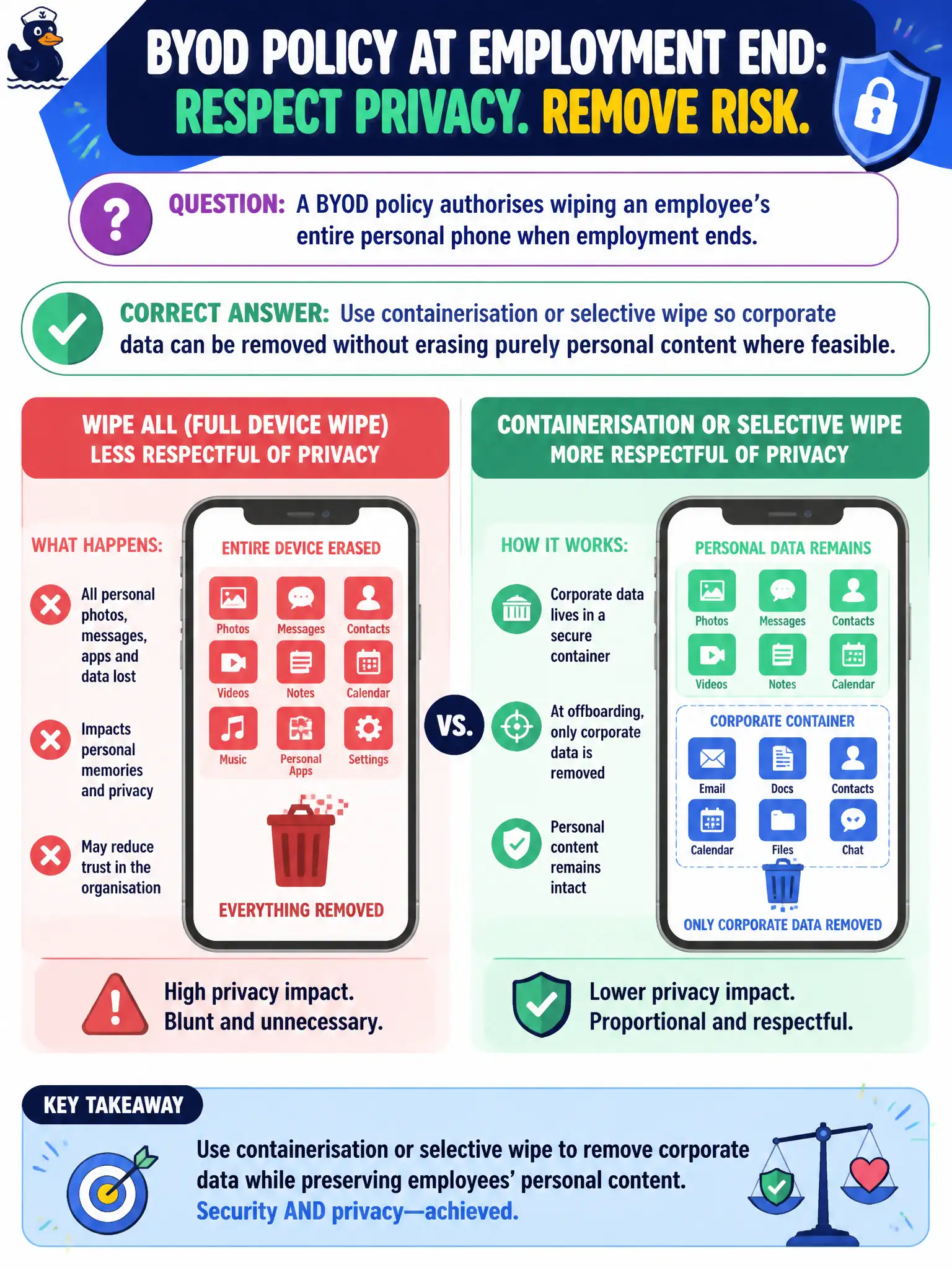
A BYOD policy authorises wiping an employee’s entire personal phone when employment ends. Which control design better respects privacy?
Select an answer to reveal the explanation.
Short Explanation
Nuking someone’s whole phone to remove work email is using a wrecking ball for a sticky note. Prefer work containers and selective wipe. Protect the company data without torching the family album.
Full Explanation
A BYOD policy that authorises wiping an employee’s entire personal phone when employment ends better respects privacy if it uses containerisation or selective wipe so corporate data can be removed without erasing purely personal content where feasible. Offboarding should reclaim work email, not torch family photos—a civic-minded boundary between job and private life. Always factory-resetting personal devices because employer security outweighs all personal data fails proportionality when selective controls exist. Forbidding employees from storing any photos or messages on phones used for work may be unrealistic and still does not justify blunt full wipes as the only design. Requiring permanent surrender of personal phones at offboarding fails as a disproportionate seizure of private property and data. Exam caveat: where containerisation is technically unavailable, limited full-wipe scenarios may be argued, but policies should prefer selective controls and clear notice at enrolment. Operational check: deploy work profiles/MDM containers, enable selective remote wipe, test offboarding on sample devices, disclose wipe scope in the BYOD agreement, and verify personal data is not unnecessarily destroyed.