
A metrics store defines active household differently from the business glossary by a few quiet edge cases. What alignment action should metadata management take?
Select an answer to reveal the explanation.
Short Explanation
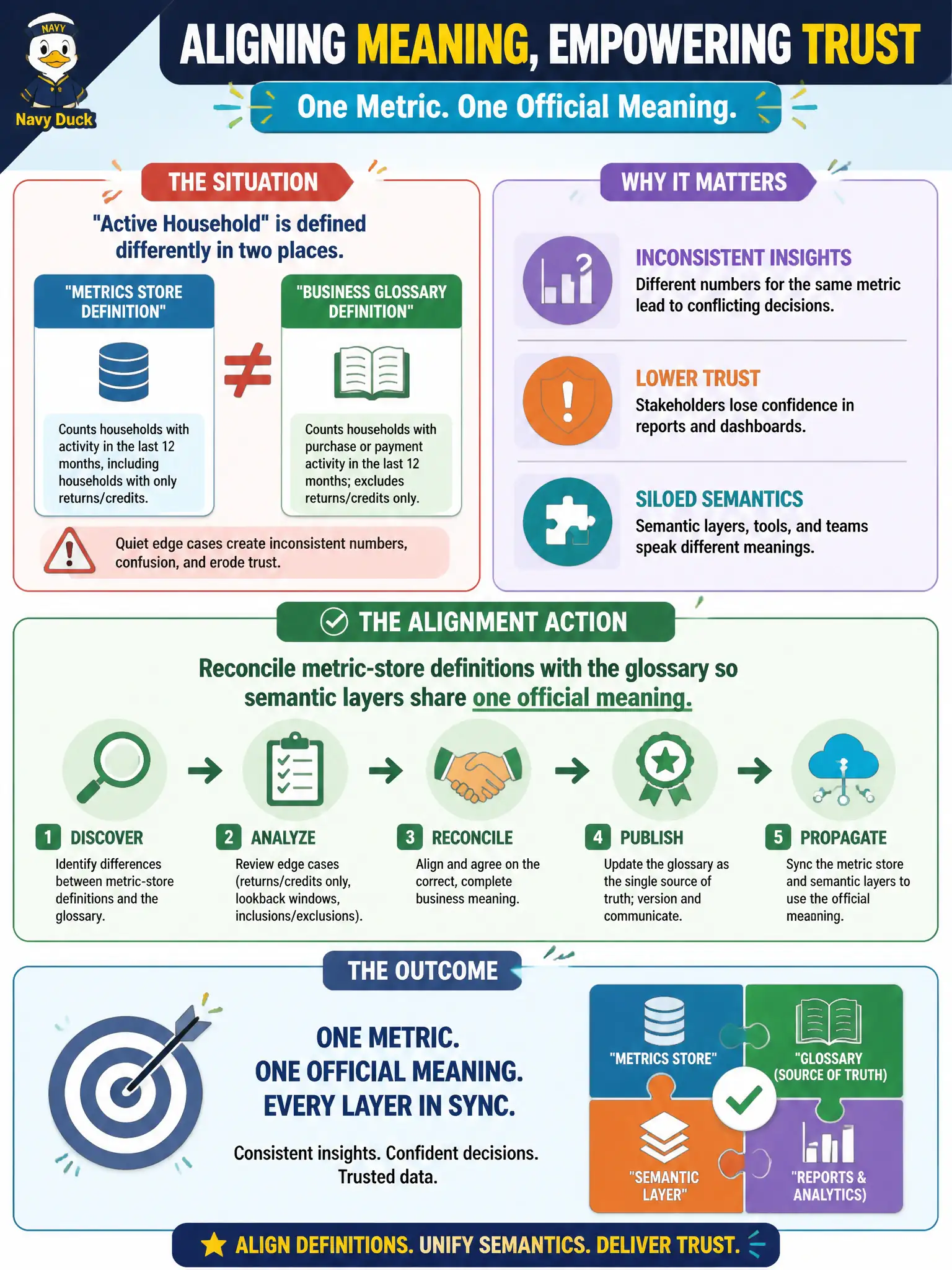
When the metrics store and glossary disagree, it is like two thermometers in the same room showing different temperatures. Reconcile them so the semantic layer and glossary share one official meaning. Quiet edge-case drift still breaks trust.
Full Explanation
Quiet edge-case drift between a metrics store and the business glossary still breaks enterprise meaning. Metadata management should reconcile metric-store definitions with the glossary so semantic layers share one official meaning for “active household” and similar civic metrics. Ignoring drift because dashboards still render numbers prioritizes pixels over truth. Duplicating conflicting definitions across more BI tools increases variety and confusion. Deleting the glossary so each dashboard author invents local terms abandons governance. Exam focus: align semantic layers, do not multiply them. Caveat: if a metrics store needs a narrower operational definition, document it as a scoped variant linked to the glossary parent—not as a silent fork. Operationally, diff metric-store formulas against glossary text, resolve edge cases with stewards, update both layers, and add a periodic reconciliation check for priority household and housing metrics. Automate a periodic diff between glossary text and metric-store formulas for top civic household metrics and open defects when edge cases diverge. When edge cases are intentional, record them as scoped variants linked to the parent glossary term rather than allowing quiet formula drift inside the metrics store.