
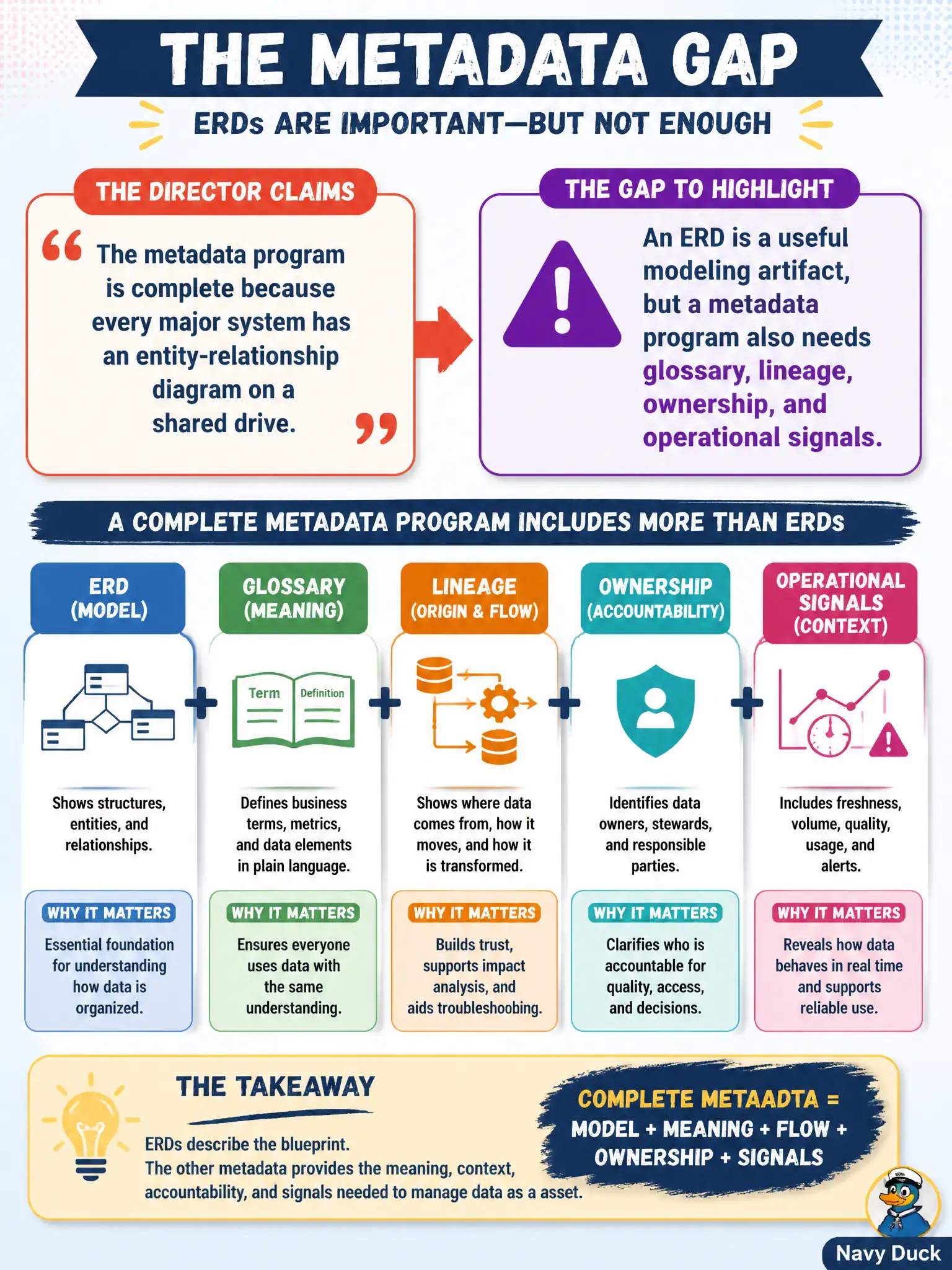
A director claims the metadata program is complete because every major system has an entity-relationship diagram on a shared drive. What gap should the CIMP practitioner highlight?
Select an answer to reveal the explanation.
Short Explanation
An ERD is a blueprint of the building, not the whole facilities program. You still need a glossary of terms, lineage of pipes, ownership contacts, and ops signals that say what is fresh. Diagrams help—they do not finish metadata management.
Full Explanation
An entity-relationship diagram on a shared drive is a modeling artifact, not a complete metadata program. The CIMP practitioner should highlight that programs also need glossary semantics, lineage, ownership, and operational signals such as freshness—capabilities ERDs alone do not provide. ERDs do not automatically populate certified glossary terms and live lineage. Shared-drive diagrams do not replace catalogs, stewardship, or freshness metadata. Business definitions and data-product certification remain necessary even when ERDs exist. Exam distractors often elevate one artifact into a whole program; reject that collapse. Caveat: ERDs remain valuable inputs and should be linked from the catalog, versioned, and kept aligned with logical models—not dismissed as useless. Operationally, inventory what the city has beyond ERDs: glossary coverage, lineage for priority KPIs, named owners, and refresh metadata; fund the largest gaps before declaring the metadata program “complete.” Use the ERD inventory as an input list: each diagram should link to glossary terms, owners, and lineage for the civic entities it depicts. Stewards should confirm consumer-facing behavior in a controlled check before closing the change.