
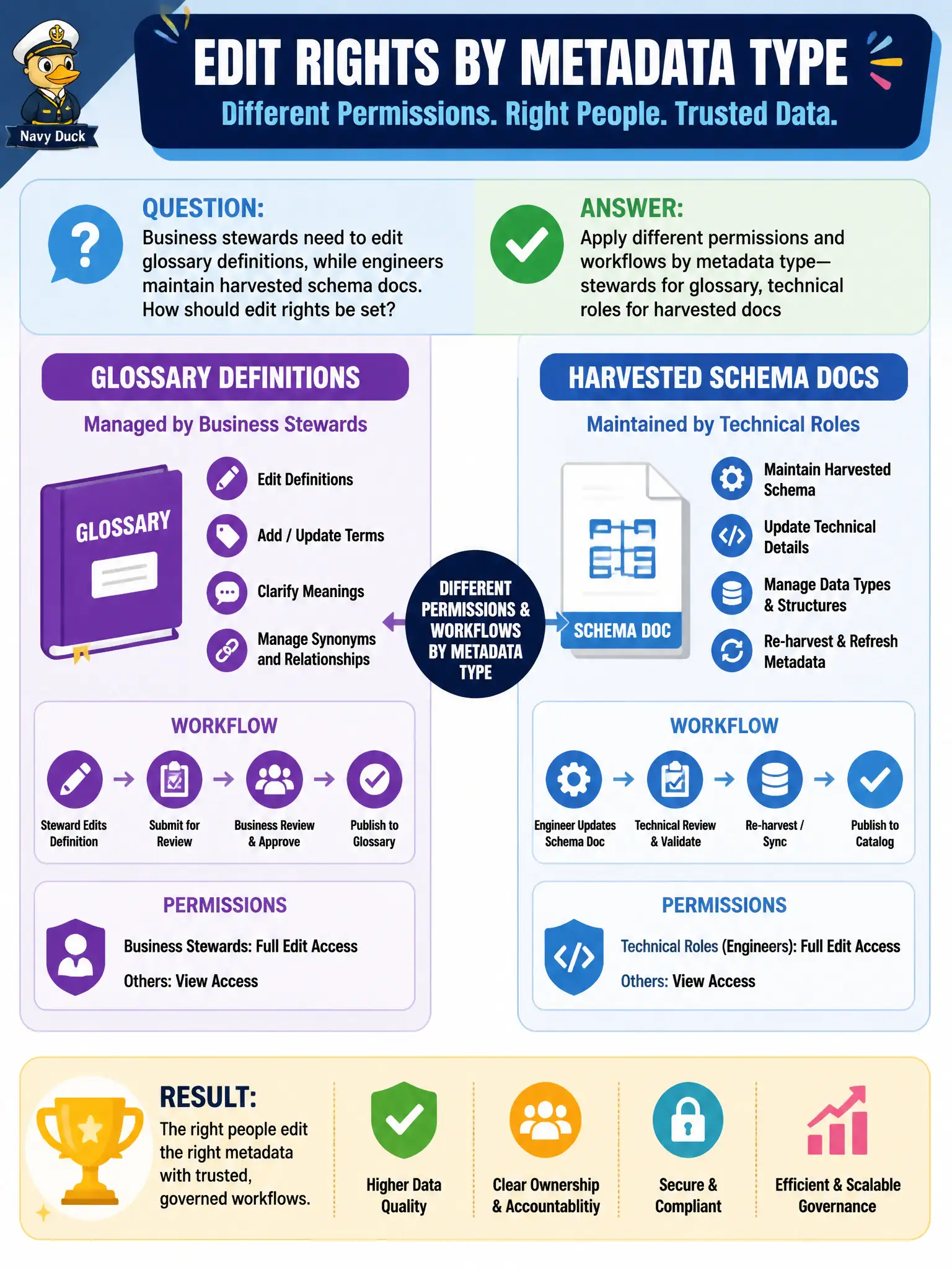
Business stewards need to edit glossary definitions, while engineers maintain harvested schema docs. How should edit rights be set?
Select an answer to reveal the explanation.
Short Explanation
Not every door uses the same key. Glossary meaning is a stewardship workflow; harvested schema docs are an engineering workflow. Match edit rights to the metadata type.
Full Explanation
Edit rights should follow metadata type and role. Business stewards need workflows to edit glossary definitions, while engineers maintain harvested schema documentation—different permissions and approval paths by metadata class. Unrestricted edit rights for every employee invite vandalism and semantic drift across civic terms. Allowing only anonymous internet users to change glossary terms is an obvious control failure. Locking both glossary and technical metadata so nobody can update either freezes the catalog into staleness. Exam scenarios test separation of duties in metadata management. Caveat: technical stewards may propose business definition changes, but acceptance should remain with accountable business owners for meaning. Operationally, configure steward-only edit plus review for glossary terms, restrict harvested schema docs to technical roles with change tickets, and audit a sample of recent edits for correct role and workflow. Workflow history on glossary edits also supports auditability when a contested civic definition changes—showing who approved the new meaning and when it became effective for reporting. Separating permissions by metadata type also clarifies training: business stewards learn glossary workflows, while engineers learn harvest and technical-doc pipelines, without conflating the two.