
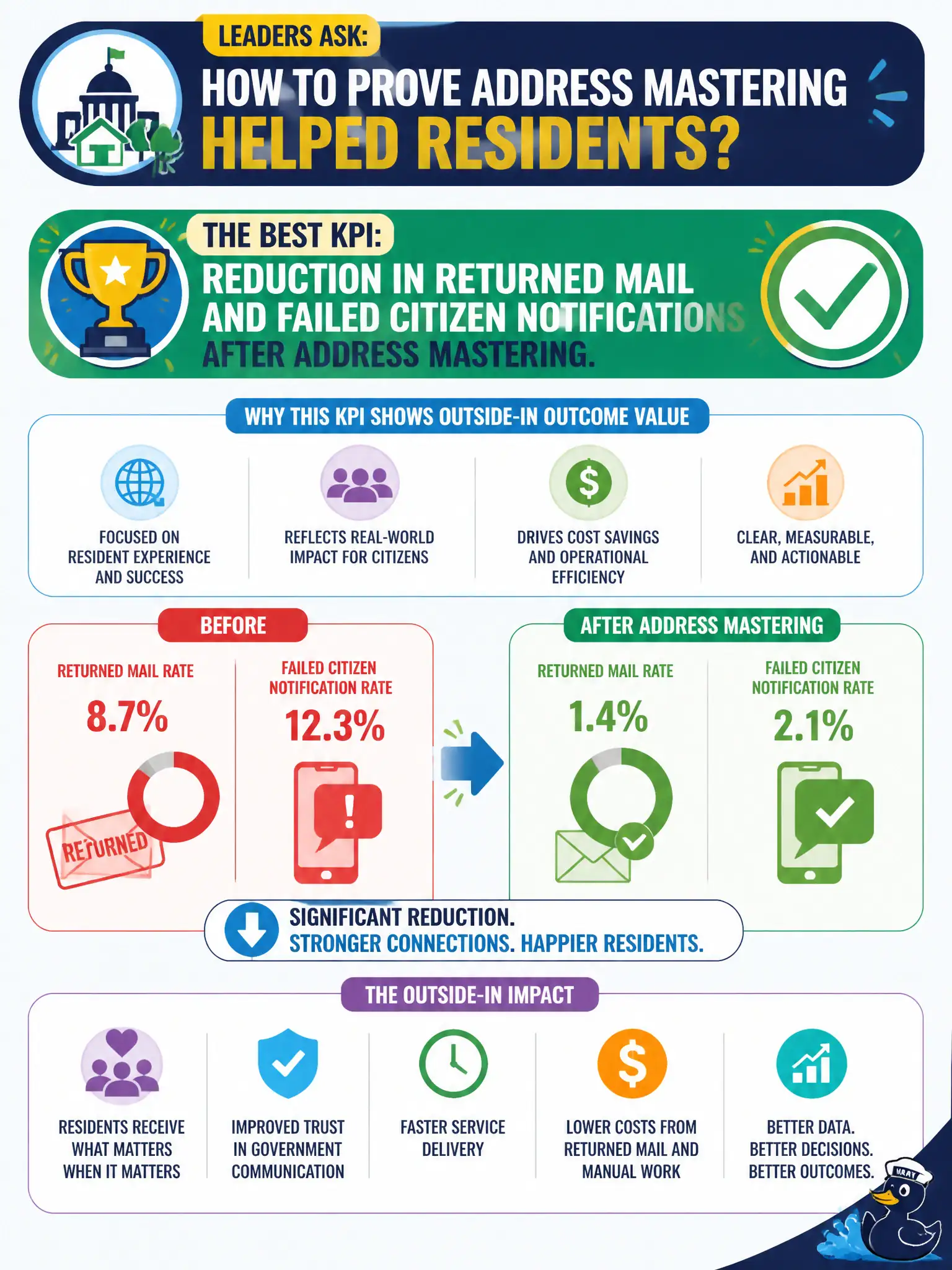
Leaders ask how to prove address mastering helped residents. Which KPI best shows outside-in outcome value?
Select an answer to reveal the explanation.
Short Explanation
Outcome beats vanity. Fewer returned mailers and failed notices mean address mastering actually helped people—not schema decoration or quiz scores.
Full Explanation
To prove address mastering helped residents, the best outside-in outcome KPI is reduction in returned mail and failed citizen notifications after address mastering. Civic value shows up in fewer failed contacts, not in schema vanity. Counting unused optional columns added to the hub schema fails as an internal technical vanity metric. Counting stewards who completed a vendor logo quiz fails as training trivia. Counting pages of architecture diagrams printed in color fails as documentation theater. Exam caveat: prefer outside-in outcome KPIs (returned mail, failed notices) over internal vanity counts. Operational check: baseline returned-mail and failed-notification rates, remaster addresses, remeasure, and report to sponsors. Tie the KPI to the municipal customer-communication program so MDM funding stays linked to resident outcomes. Keep verification evidence with the municipal runbook so audits can prove the chosen control was applied as designed and that rejected alternatives would have left city services exposed to the failure modes described above. Keep verification evidence with the municipal runbook so audits can prove the chosen control was applied as designed and that rejected alternatives would have left city services exposed to the failure modes described above.