
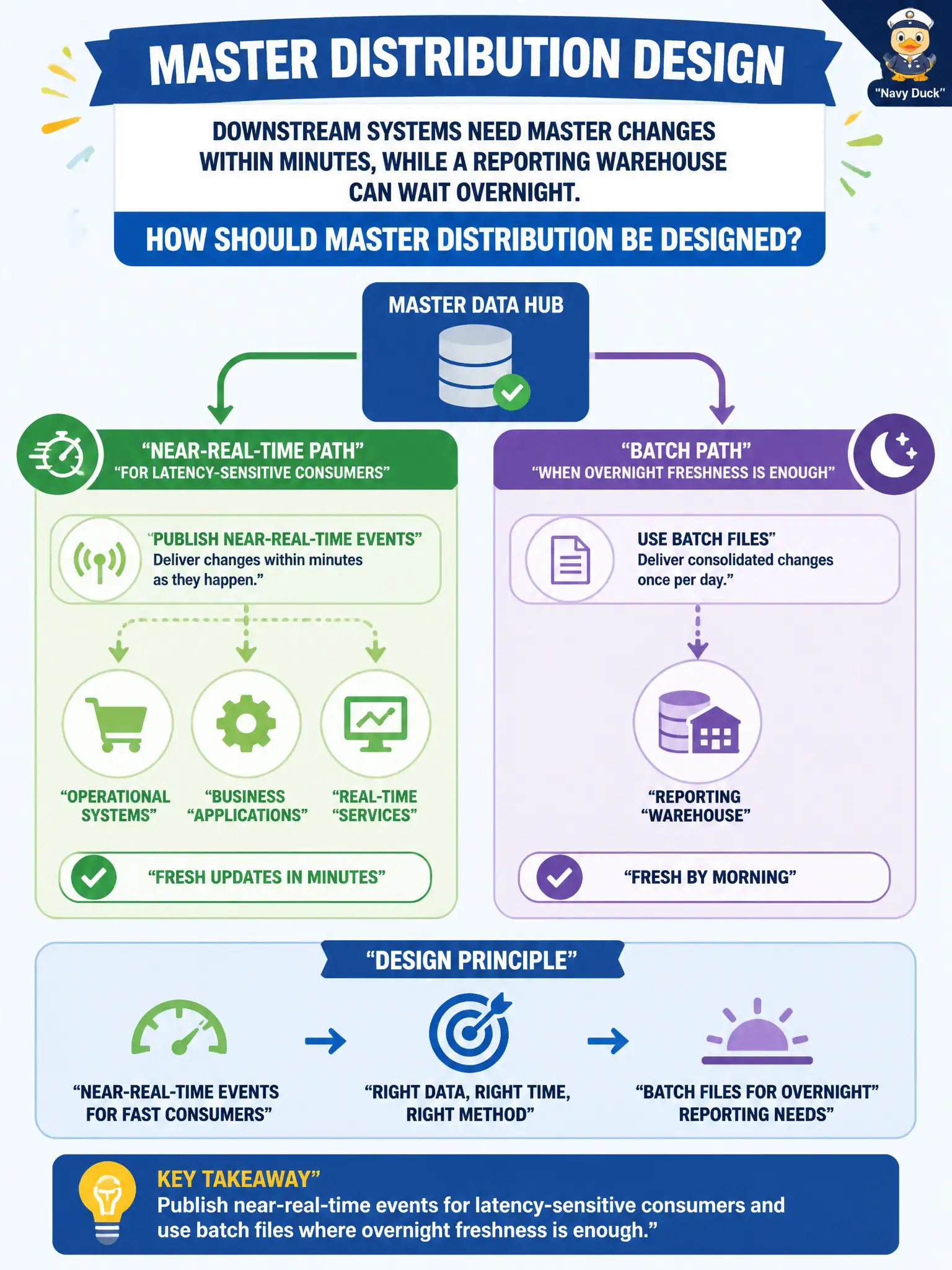
Downstream systems need master changes within minutes, while a reporting warehouse can wait overnight. How should master distribution be designed?
Select an answer to reveal the explanation.
Short Explanation
Not every consumer needs the same delivery truck. Event publish for systems that can’t wait; nightly files for ones that can.
Full Explanation
When downstream systems need master changes within minutes while a reporting warehouse can wait overnight, master distribution should publish near-real-time events for latency-sensitive consumers and use batch files where overnight freshness is enough. Civic integration design matches freshness to use case. Forcing every consumer onto a single weekly flat-file drop fails latency-sensitive channels. Never distributing masters and requiring each system to re-key entities manually recreates inconsistency. Emailing CSV attachments from stewards as the only integration pattern fails scalability, security, and auditability. Exam caveat: multi-speed distribution (events vs batch) is sound MDM architecture—one cadence rarely fits all consumers. Operational check: classify consumers by latency need, implement event publish for operational apps and batch for the warehouse, and monitor delivery lag. Document consumer SLAs in the municipal interface catalog. Keep verification evidence with the municipal runbook so audits can prove the chosen control was applied as designed and that rejected alternatives would have left city services exposed to the failure modes described above. Keep verification evidence with the municipal runbook so audits can prove the chosen control was applied as designed and that rejected alternatives would have left city services exposed to the failure modes described above.