
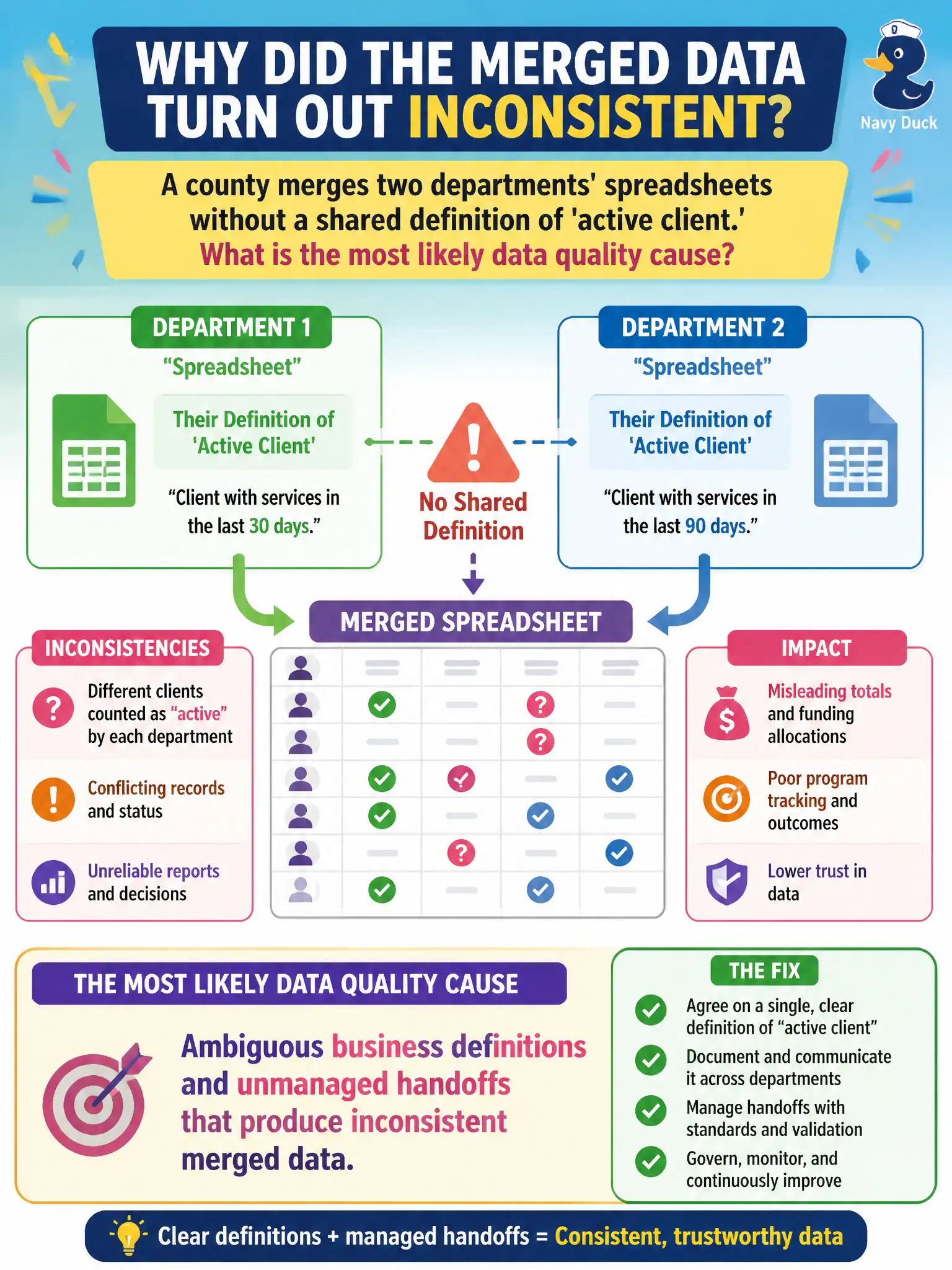
A county merges two departments' spreadsheets without a shared definition of 'active client.' What is the most likely data quality cause of the resulting inconsistencies?
Select an answer to reveal the explanation.
Short Explanation
If 'active client' means 'open case' in one shop and 'billed this year' in another, the merge is a blender full of mismatched fruit. Process and definition gaps—not magic—create inconsistent data. Shared definitions have to land before the spreadsheets do.
Full Explanation
Inconsistent merged results often follow from ambiguous business definitions and unmanaged handoffs rather than from storage media alone. When a county merges two departments' spreadsheets without a shared definition of 'active client,' each source contributes incompatible populations and the merged file looks inconsistent by design. Blaming hardware encryption settings that scramble numeric IDs overnight invents a technical cause unrelated to definitional drift. Overly strict referential integrity that rejects every valid row is a different failure mode and does not explain definition mismatch across departmental extracts. Excessive timeliness that forces all data to arrive before it exists is not a coherent cause of active-client inconsistency. Exam caveat: fix definitions and stewardship of the term before investing heavily in match-merge tooling; otherwise cleansed files remain semantically misaligned. Operational check: convene both departments, write an operational definition of active client with inclusion and exclusion rules, version it in the glossary, and rematerialize the merge only against that definition. County human-services and finance leads should sign the definition so downstream dashboards stop arguing about whose 'active' count is correct.