
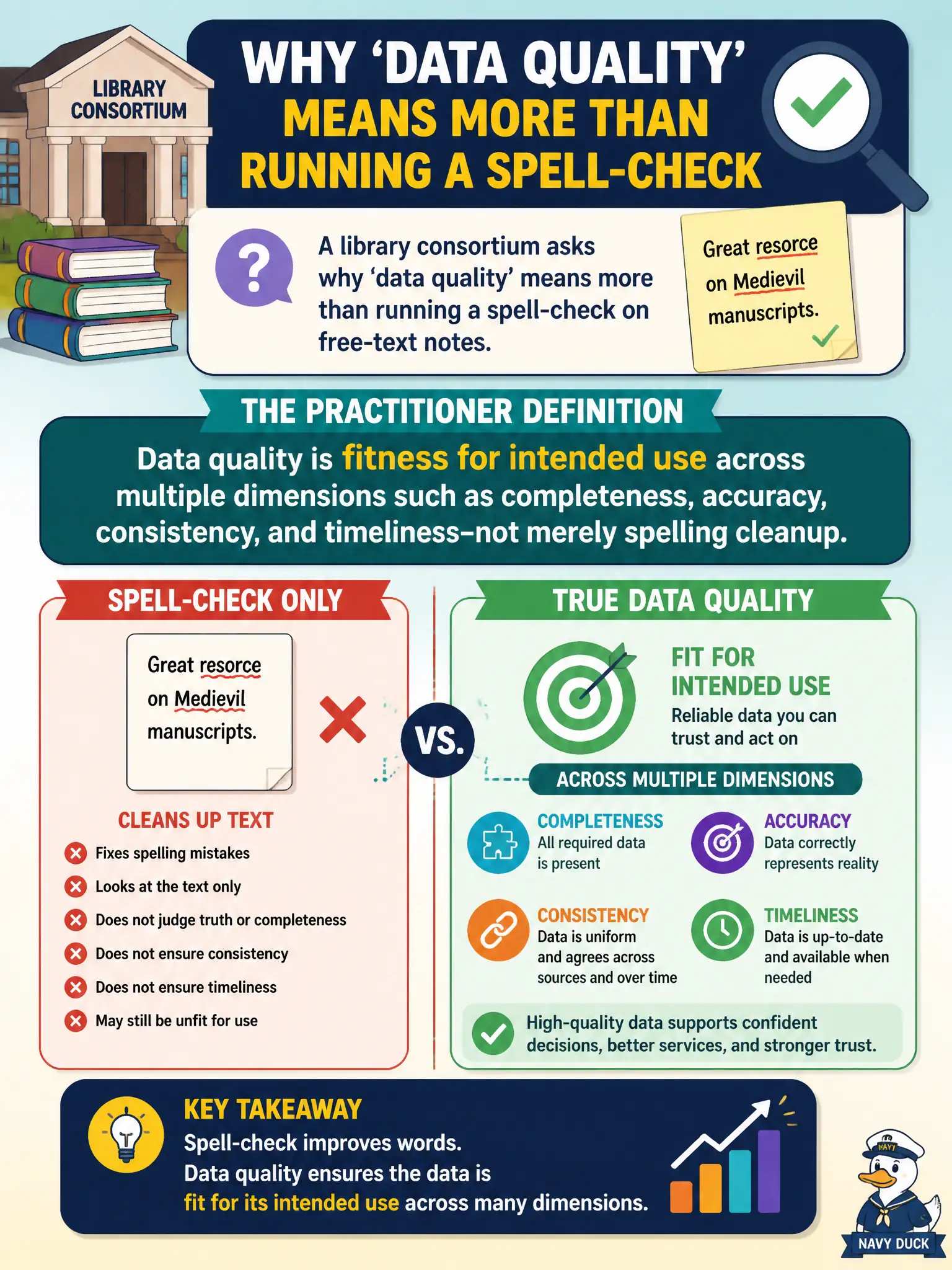
A library consortium asks why 'data quality' means more than running a spell-check on free-text notes. Which statement best captures the practitioner definition?
Select an answer to reveal the explanation.
Short Explanation
Spell-check is like wiping the windshield and calling the whole car roadworthy. Real data quality asks whether the data is fit for the job—complete enough, consistent enough, timely enough, and correct enough. Typos matter, but they are only one slice of fitness for purpose.
Full Explanation
Practitioner data quality is defined as fitness for intended use evaluated across multiple dimensions such as completeness, accuracy, consistency, uniqueness, validity, and timeliness. A library consortium that equates quality with spell-checking free-text notes is addressing only a narrow surface issue and missing the broader fitness judgment CIMP practice requires. Reducing data quality to typo cleanup alone and shoving other criteria into 'security' misassigns dimensions and leaves operational defects unmeasured. Claiming quality is achieved solely by encrypting fields confuses confidentiality controls with fitness for cataloging, circulation, or consortium sharing. Accepting whatever a vendor dashboard paints green, irrespective of business use, outsources judgment and can certify unfit data. Exam caveat: security and privacy are related information-management concerns but are not substitutes for multi-dimensional quality assessment against stated uses. Operational check: pick one critical consortium use (for example hold fulfillment), list the dimensions that matter for that use, measure them on a sample, and report gaps to stewards—not only a spell-check pass rate. Municipal and library consortia should publish a short fitness-for-use statement per shared dataset so members know what 'good enough' means before exchanging records.