
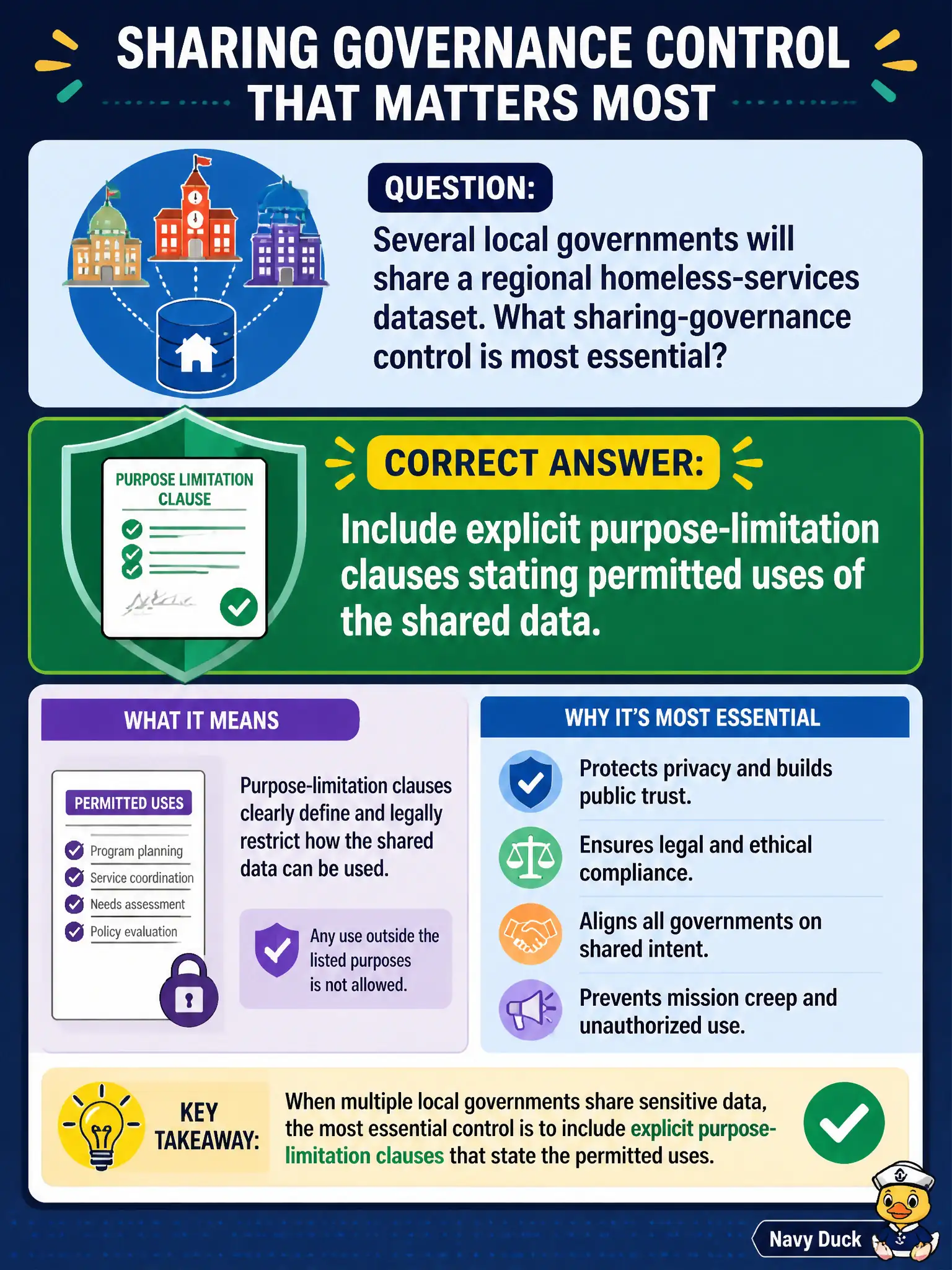
Several local governments will share a regional homeless-services dataset. What sharing-governance control is most essential?
Select an answer to reveal the explanation.
Short Explanation
Sensitive shared data needs a “use only for this” sticker, not an open buffet sign. Purpose limitation clauses tell every partner what the dataset is for—and what it is not.
Full Explanation
When several local governments share a regional homeless-services dataset, the most essential sharing-governance control is explicit purpose-limitation clauses stating permitted uses of the shared data. Purpose limits protect vulnerable residents from secondary uses that partners never agreed to. Sharing the full dataset with no purpose limits to maximize reuse flexibility fails by prioritizing convenience over lawful and ethical constraint. Relying only on informal goodwill emails instead of written sharing terms fails because goodwill is not enforceable governance when staff turn over or incentives diverge. Removing all identifiers later if misuse is discovered, with no upfront limits, fails as a reactive, incomplete remedy that still allowed improper use. Exam caveat: purpose limitation is a cornerstone of responsible data sharing—especially for sensitive civic services. Operational check: execute a written sharing agreement with purpose clauses, permitted recipients, prohibited uses, and breach notice duties; brief partner agencies; and sample downstream uses against the clause list. Revisit purposes when the regional program expands so new civic analytics ideas do not silently exceed the original authorization.