
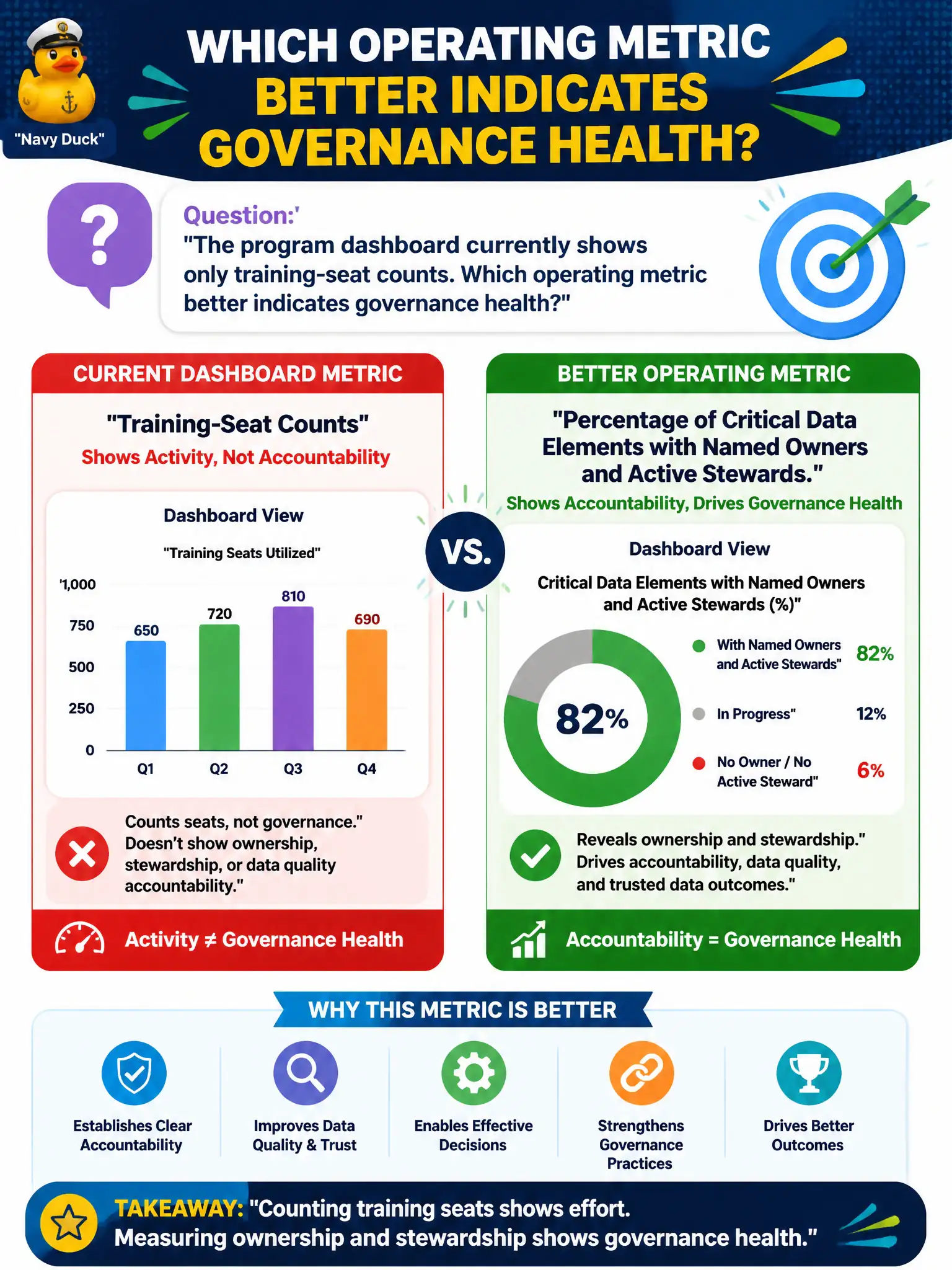
The program dashboard currently shows only training-seat counts. Which operating metric better indicates governance health?
Select an answer to reveal the explanation.
Short Explanation
Seat counts in a class do not prove anyone owns the critical fields. A sharper health check is how many of those must-care elements actually have named owners and living stewards.
Full Explanation
A program dashboard that shows only training-seat counts measures activity, not governance health; a stronger operating metric is the percentage of critical data elements with named owners and active stewards. Civic governance maturity shows up as accountable coverage of what matters, not as classroom attendance alone. Counting unused software licenses purchased last year fails as an irrelevant procurement leftover metric. Tracking total slides produced by communications fails by equating documentation volume with control effectiveness. Counting logo placements on the intranet page fails as pure visibility theater. Exam caveat: prefer outcome or accountability metrics over vanity activity counts when asked what indicates governance health. Operational check: maintain a critical-element register, require named business and technical stewards, compute coverage percentage monthly, and escalate uncovered elements to the data council. Pair that metric with issue aging for a fuller municipal operating picture than training seats can provide. Keep verification evidence with the municipal runbook so audits can prove the chosen control was applied as designed and that rejected alternatives would have left city services exposed to the failure modes described above.