
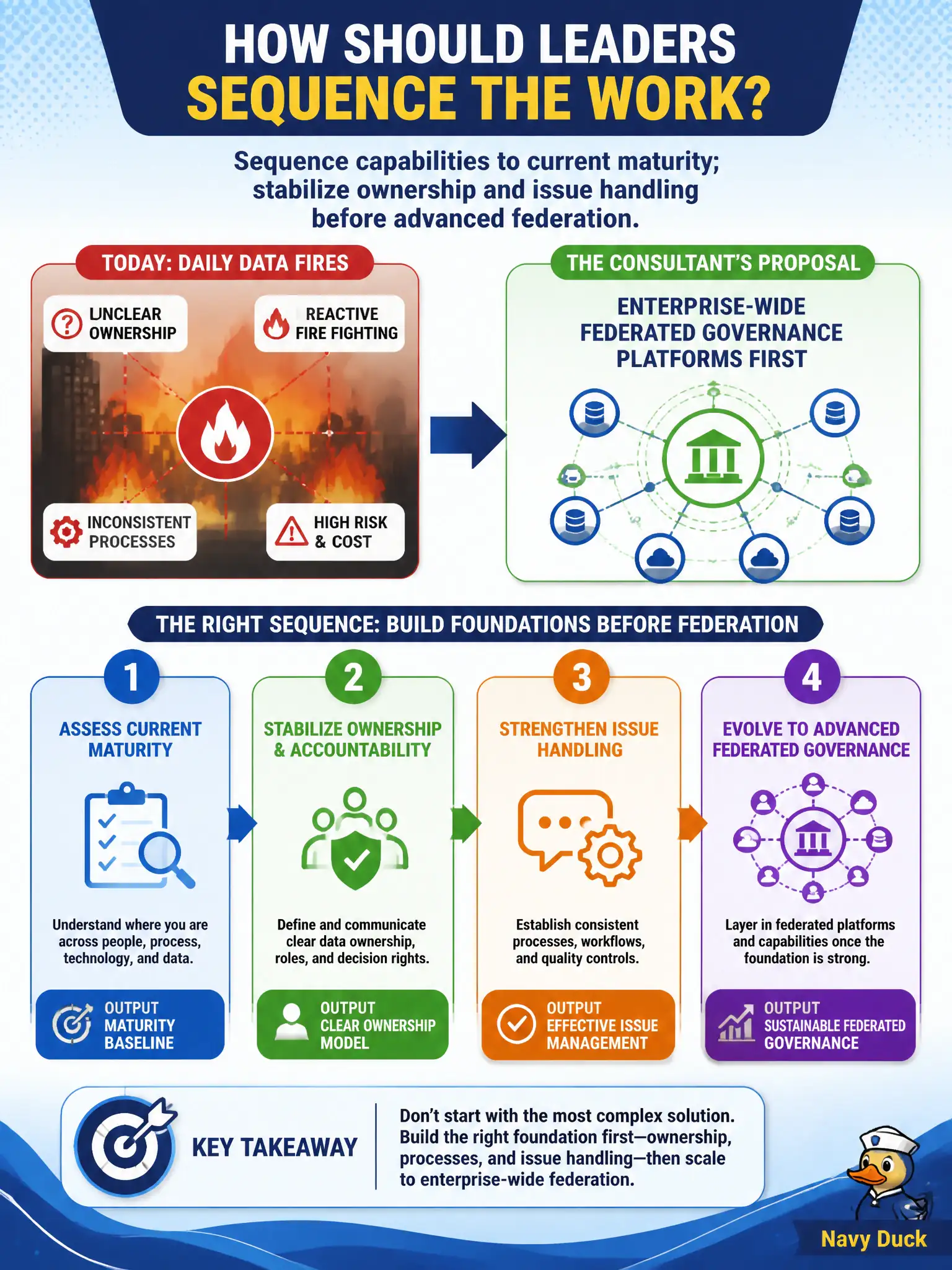
An agency still fights daily data fires with unclear ownership, yet a consultant proposes enterprise-wide federated governance platforms first. How should leaders sequence the work?
Select an answer to reveal the explanation.
Short Explanation
You do not buy a fancy group-chat tool for a team that has not yet agreed who answers the phone. Fix the basics—who owns what and how issues get fixed—before you federate the galaxy. Maturity first, architecture second.
Full Explanation
Leaders should sequence governance capabilities to current maturity: stabilize ownership, issue handling, and basic standards before investing in enterprise-wide federated governance platforms. Advanced federation assumes shared definitions, clarified roles, and working escalation paths; without those foundations, a regional or citywide federation tool becomes an expensive shell over the same firefighting. Deploying the federation platform immediately to skip foundational ownership work fails because tooling does not invent accountable stewards or triage paths. Freezing all reporting until a multi-year architecture redesign finishes fails by starving civic operations of needed information while waiting for perfection. Outsourcing all stewardship to the consultant and postponing local roles fails because consultants leave and municipal accountability must remain inside the agency. Exam caveat: maturity-before-architecture is a recurring governance sequencing theme—do not confuse ambitious platform diagrams with operating capability. Operational check: confirm named owners exist for priority datasets, prove a working DQ/issue path with status and SLA, then pilot federation for domains that already meet those basics. Document the maturity gate in the program roadmap so procurement cannot leapfrog foundational civic accountability with a vendor slide deck.