
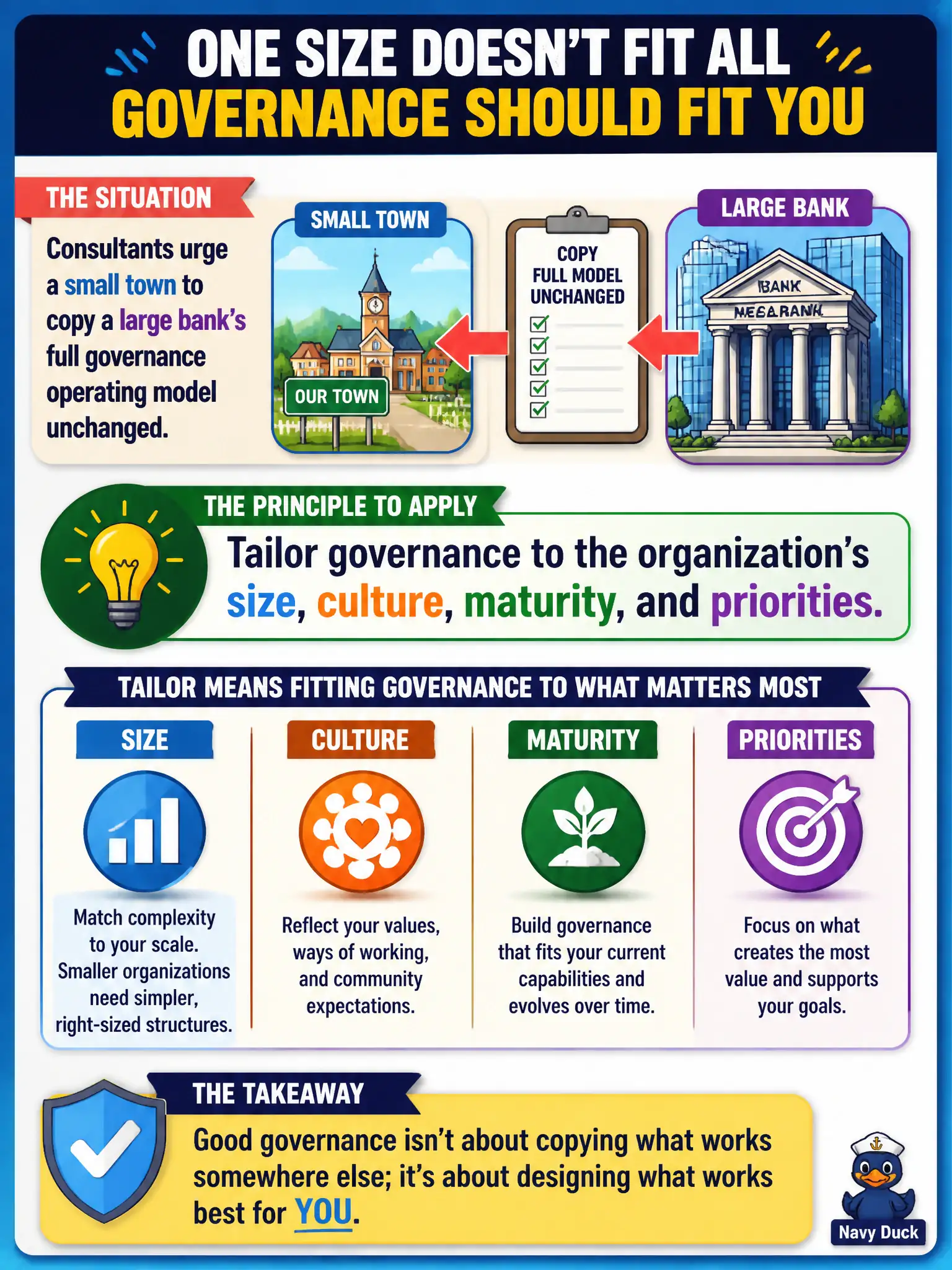
Consultants urge a small town to copy a large bank's full governance operating model unchanged. What principle should the town apply?
Select an answer to reveal the explanation.
Short Explanation
A community bank's org chart does not fit a five-person town hall. Borrow ideas, then resize for culture, maturity, and real priorities. Copy-paste governance collapses under its own committees.
Full Explanation
Governance frameworks must be tailored to the organization's size, culture, maturity, and priorities—especially in small towns. When consultants urge copying a large bank's full operating model unchanged, the town should scale roles, forums, and policy depth to what it can sustain. Blindly copying every bank committee, tool, and policy regardless of town size creates unused bureaucracy and cynicism among staff who lack capacity for that model. Rejecting all governance because banks use different accounting software misses transferable decision-rights concepts that still apply to municipal data. Implementing only the bank's branding guidelines while skipping decision rights adopts cosmetics without control. Exam caveat: tailoring is not an excuse for zero accountability; even small towns need owners for critical personal and financial data. Operational check: assess current maturity and capacity, select a minimal viable council and CDE scope, phase tooling later, and revisit complexity only when demand and staffing support it. Town leadership should fund a thin but real RACI and meeting cadence before buying an enterprise suite designed for global banks, preferring a working monthly forum over an unused multi-committee copy. Prefer one reliable monthly forum with clear decision rights over an unused copy of a global bank's twelve-committee operating model.