
A city manager asks whether standing up data governance mainly means buying a catalog tool. How should the information management lead define data governance?
Select an answer to reveal the explanation.
Short Explanation
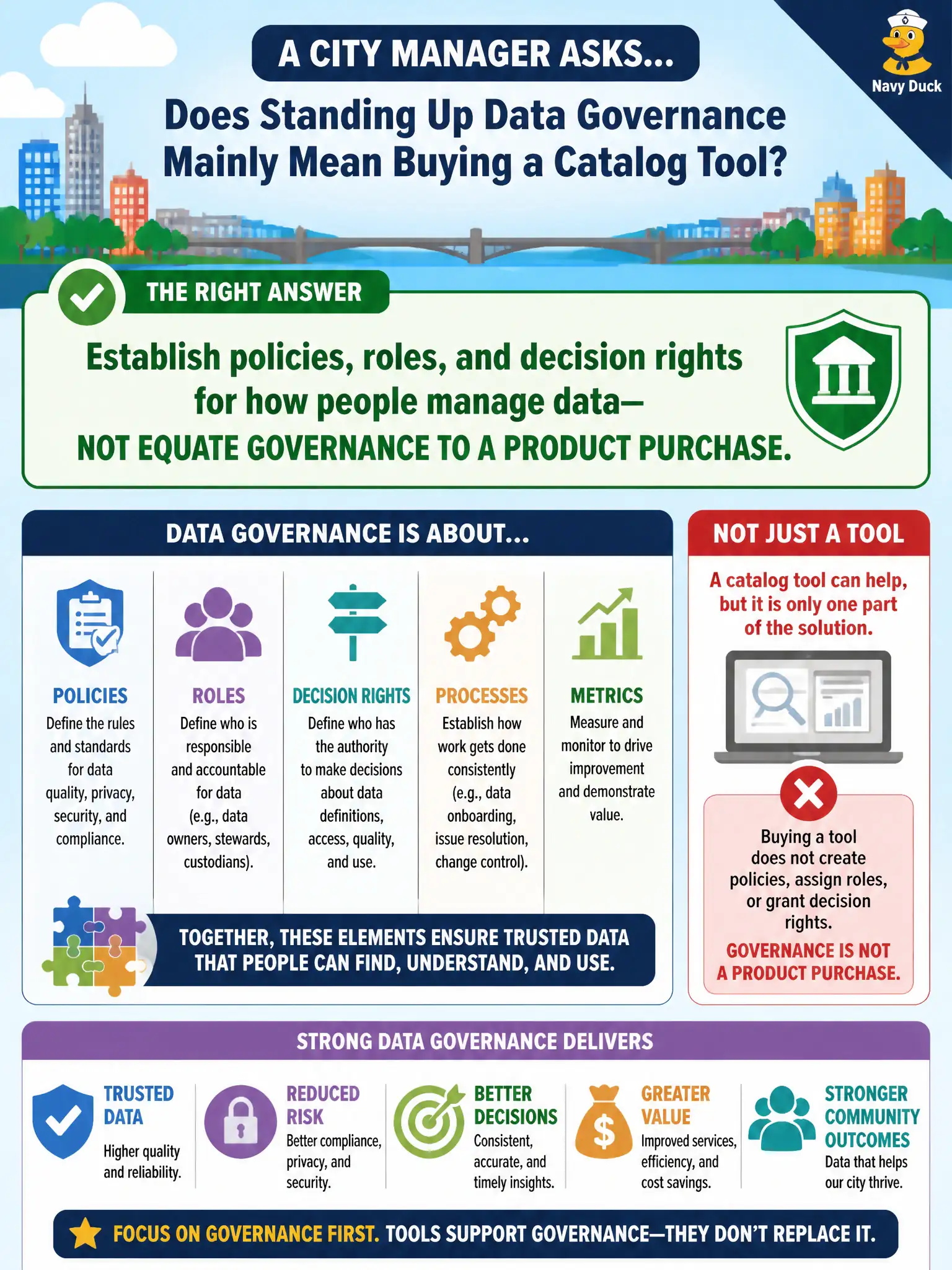
Buying a catalog is like buying a filing cabinet and calling it a records program. Governance is the who-decides-what rules—policies, roles, and decision rights—not the shopping cart. Tools help later; they do not replace accountability.
Full Explanation
Data governance establishes policies, roles, and decision rights for how people manage data—it is not equated to purchasing a catalog product. When a city manager asks whether standing up governance mainly means buying a catalog tool, the IM lead should redefine governance as an operating system for decisions, accountability, and standards across municipal data. Purchasing the highest-rated catalog and treating the license as the program leaves decision rights, stewardship capacity, and policy unaddressed. Outsourcing all data decisions to a vendor’s professional-services team abandons civic ownership of definitions and risk appetite. Replacing existing policies with a one-page slogan about data being an asset creates posters without enforceable rights. Exam caveat: catalogs are valuable metadata tooling inside a governance program; tool selection follows use cases and ownership design, not the reverse. Operational check: draft a lightweight charter covering scope, roles, forums, and decision rights; pilot on one critical domain; and only then evaluate catalog features against those operating needs. Council and CIO sponsors should fund roles and forums, not only software, if they want governance that changes how the city manages information.