
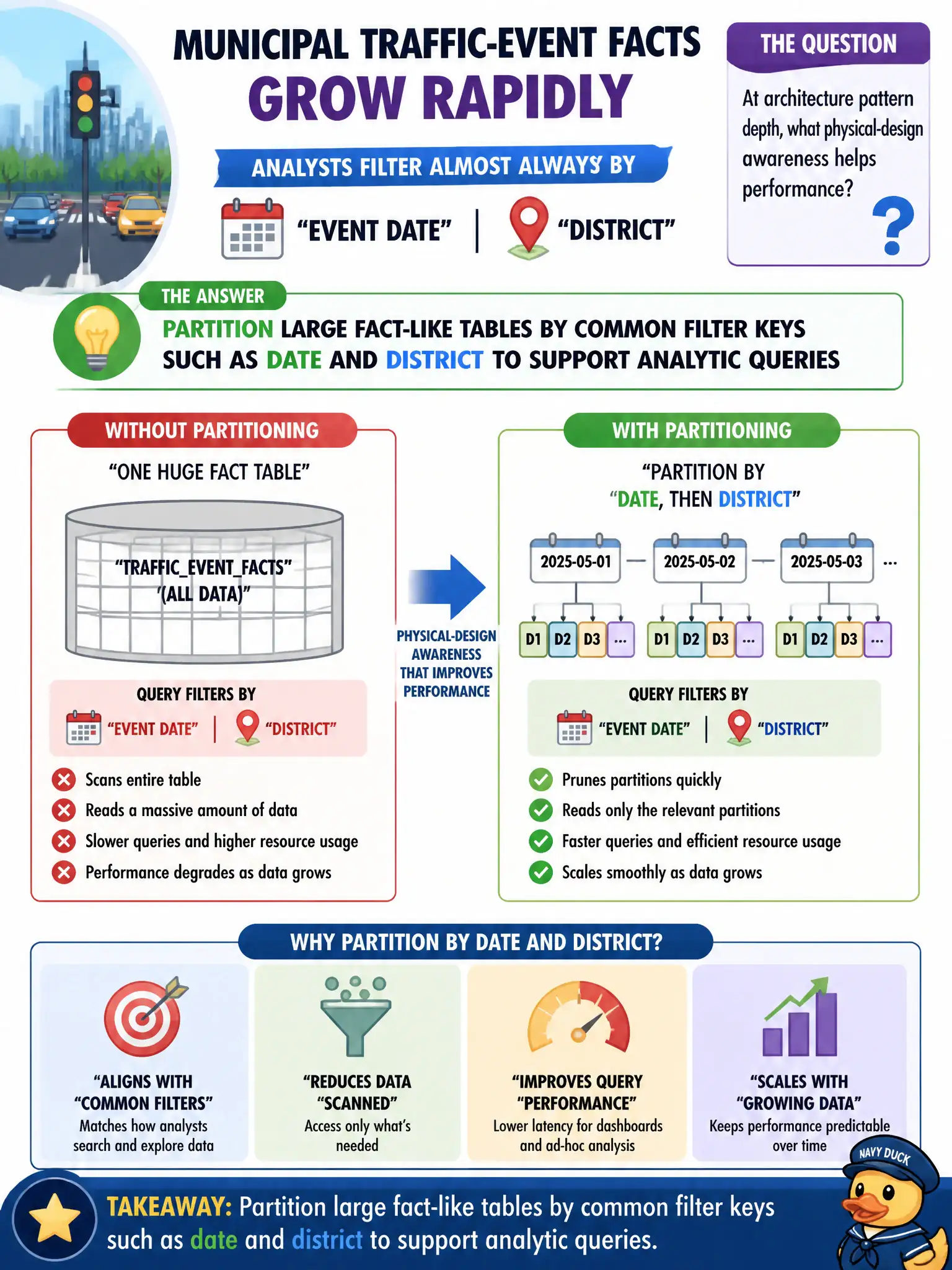
Municipal traffic-event facts grow rapidly and analysts filter almost always by event date and district. At architecture pattern depth, what physical-design awareness helps performance?
Select an answer to reveal the explanation.
Short Explanation
If everyone asks “what happened last Tuesday in District 4,” slicing the big table that way is just good manners. Partitioning along real filters keeps analytics from scanning the whole planet.
Full Explanation
At architecture pattern depth, physical design choices such as partitioning matter when they shape performance envelopes for large municipal fact-like tables. Traffic-event facts that analysts almost always filter by event date and district should be partitioned (and often clustered) along those common predicates so analytic queries avoid scanning the entire history. Architecture sets standards and expectations for such patterns without requiring every practitioner to memorize vendor-specific DBA syntax. Storing the entire history as one unpartitioned heap forces expensive scans as volume grows and slows civic analytics. Disabling all indexes and partitions merely to simplify vendor migration trades short-term migration convenience for lasting operational pain. Replicating full OLTP row stores onto every laptop is not a scalable analytic pattern and creates security, consistency, and governance problems. Exam caveat: partitioning helps when aligned to real filter predicates and lifecycle policies; blind partitioning on unused keys adds complexity without benefit, and physical design still sits under logical and semantic architecture. Operational check: confirm dominant filters from query logs (date, district), design partition strategy accordingly, validate prune behavior on representative queries, and document the standard in the platform blueprint for future event tables.