
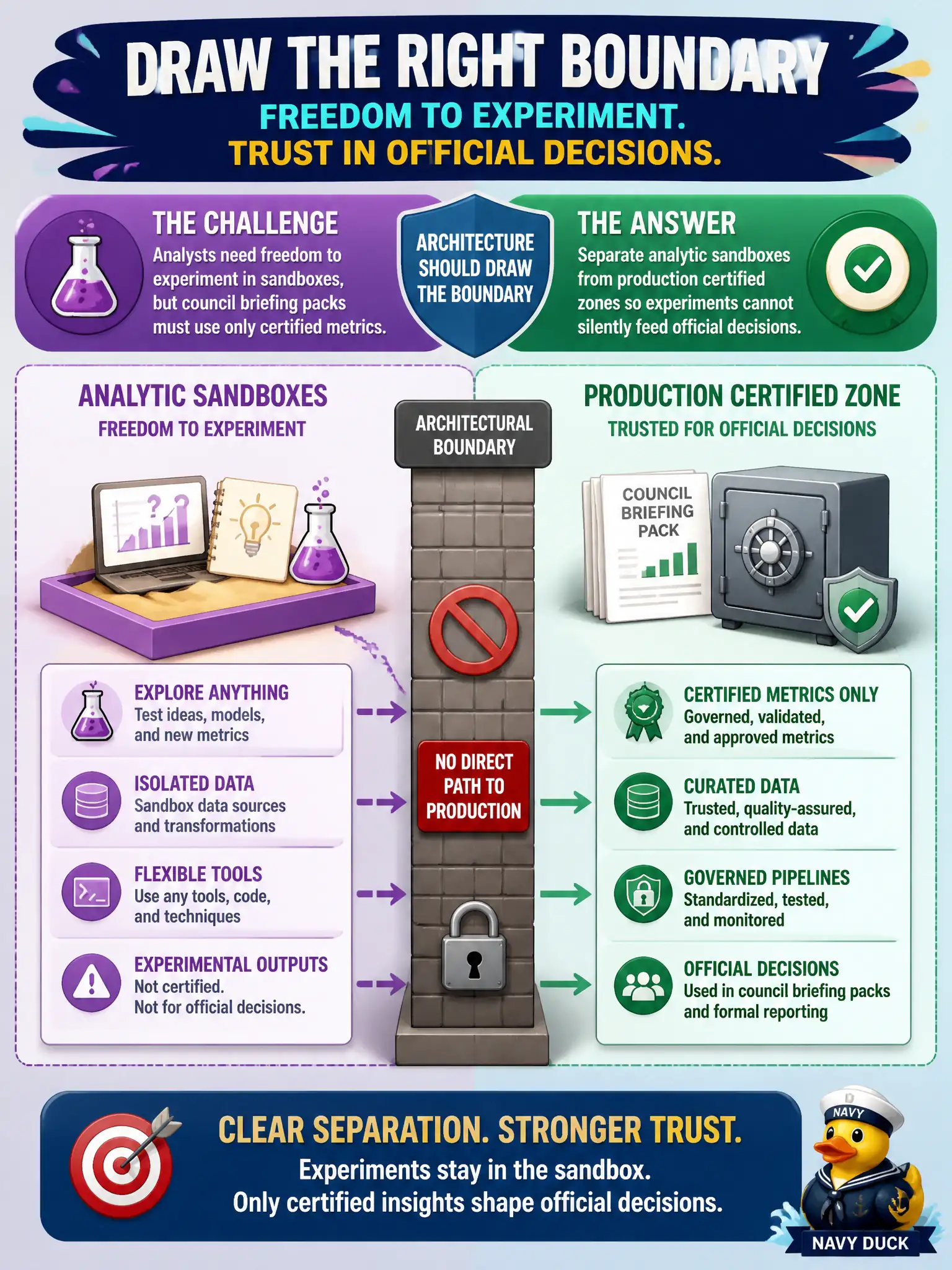
Analysts need freedom to experiment in sandboxes, but council briefing packs must use only certified metrics. How should architecture draw the boundary?
Select an answer to reveal the explanation.
Short Explanation
The kitchen scrap bowl is not what you serve at the banquet. Keep sandbox play separate from the certified zone that council briefings trust.
Full Explanation
Analytics architecture must separate experimental sandboxes from production certified zones so provisional logic cannot silently feed official civic decisions. Sandboxes give analysts freedom to explore joins, prototypes, and incomplete sources; certified zones enforce quality, semantic definitions, access policy, and promotion controls before council briefing packs and public metrics rely on the numbers. Without that boundary, unmanaged sandbox tables become accidental systems of record. Pointing every official briefing at unmanaged sandbox tables by default collapses trust levels and invites unverified calculations into governance decisions. Deleting sandboxes entirely removes healthy experimentation and drives shadow work outside the estate. Merging sandbox and certified zones into one unlabeled schema with equal trust erases the very distinction decision makers need. Exam caveat: separation does not forbid promotion—sound estates define explicit promotion paths, labeling, and steward sign-off from sandbox to certified; the exam rejects unlabeled equivalence of trust, not iterative analytics. Operational check: tag datasets and workspaces by zone, block certified briefing extracts from sandbox schemas, require promotion checklists (tests, definitions, owner), and sample quarterly whether any council metric still resolves to unlabeled experimental objects.