
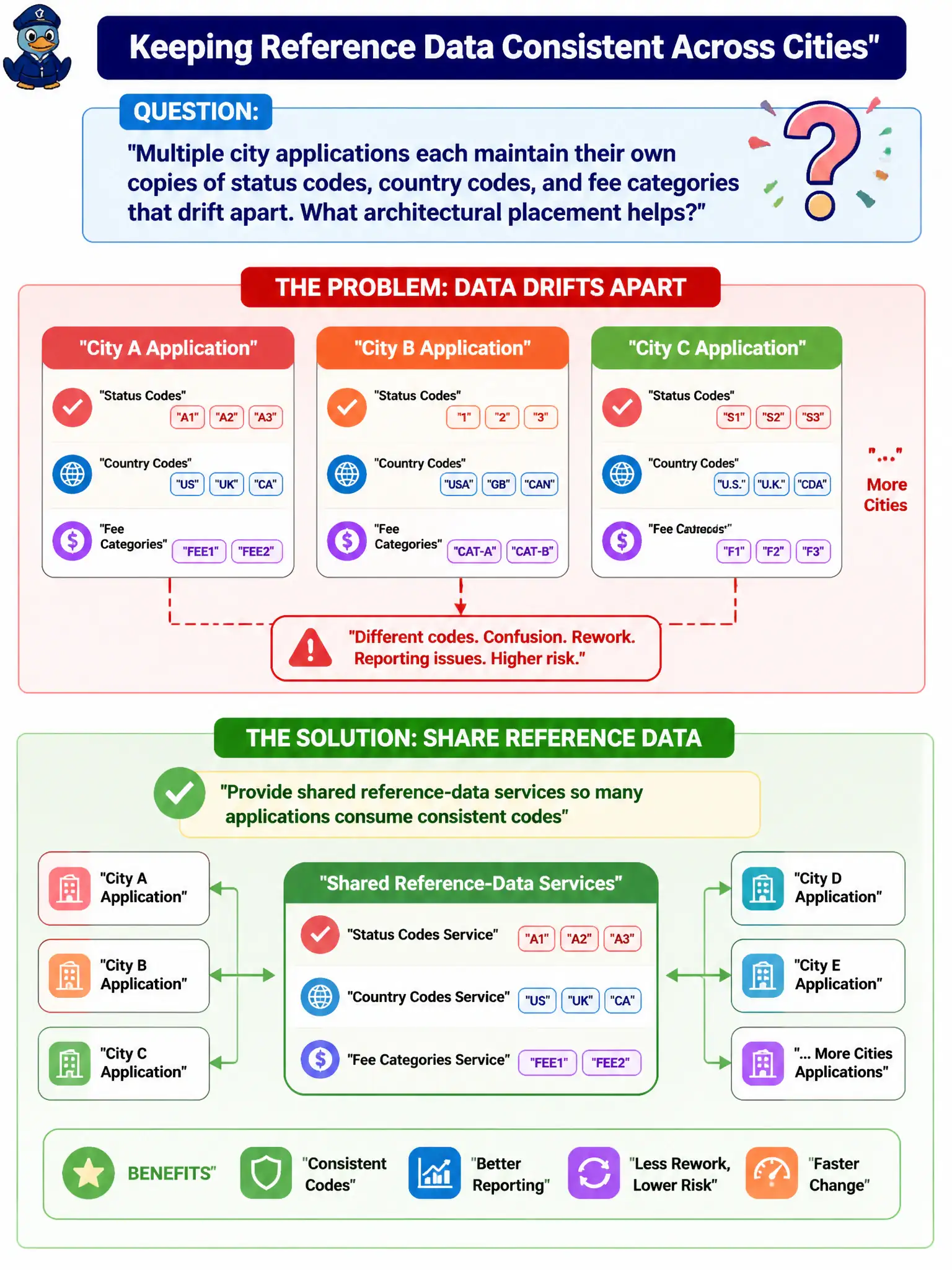
Multiple city applications each maintain their own copies of status codes, country codes, and fee categories that drift apart. What architectural placement helps?
Select an answer to reveal the explanation.
Short Explanation
When five apps invent five meanings for “closed,” reports start arguing. A shared reference-data service is the town dictionary everyone looks up instead of scribbling their own.
Full Explanation
Status codes, country codes, and fee categories are reference data that should be managed as a shared operational capability. Providing shared reference-data services lets many city applications consume consistent controlled vocabularies with stewardship, versioning, and clear publication channels. Consistency improves interoperability, reporting, master-data matching, and citizen communications that depend on shared meanings of statuses and fees. Encouraging every app to invent private code lists guarantees semantic drift and conflicting “closed” or fee meanings across systems. Embedding conflicting codes only in slide decks never operationalizes the vocabulary in systems of record. Disabling reference data so analysts invent labels per dashboard transfers the problem into analytics and destroys comparability. Exam caveat: a shared service is not a one-time spreadsheet email; it needs ownership, change control, and consumer onboarding, and local extensions must be governed rather than silently forked. Operational check: inventory divergent code lists for the top cross-app domains, stand up or designate a reference-data service with a steward, version published lists, and measure reduction in cross-system code mismatches after adoption.