
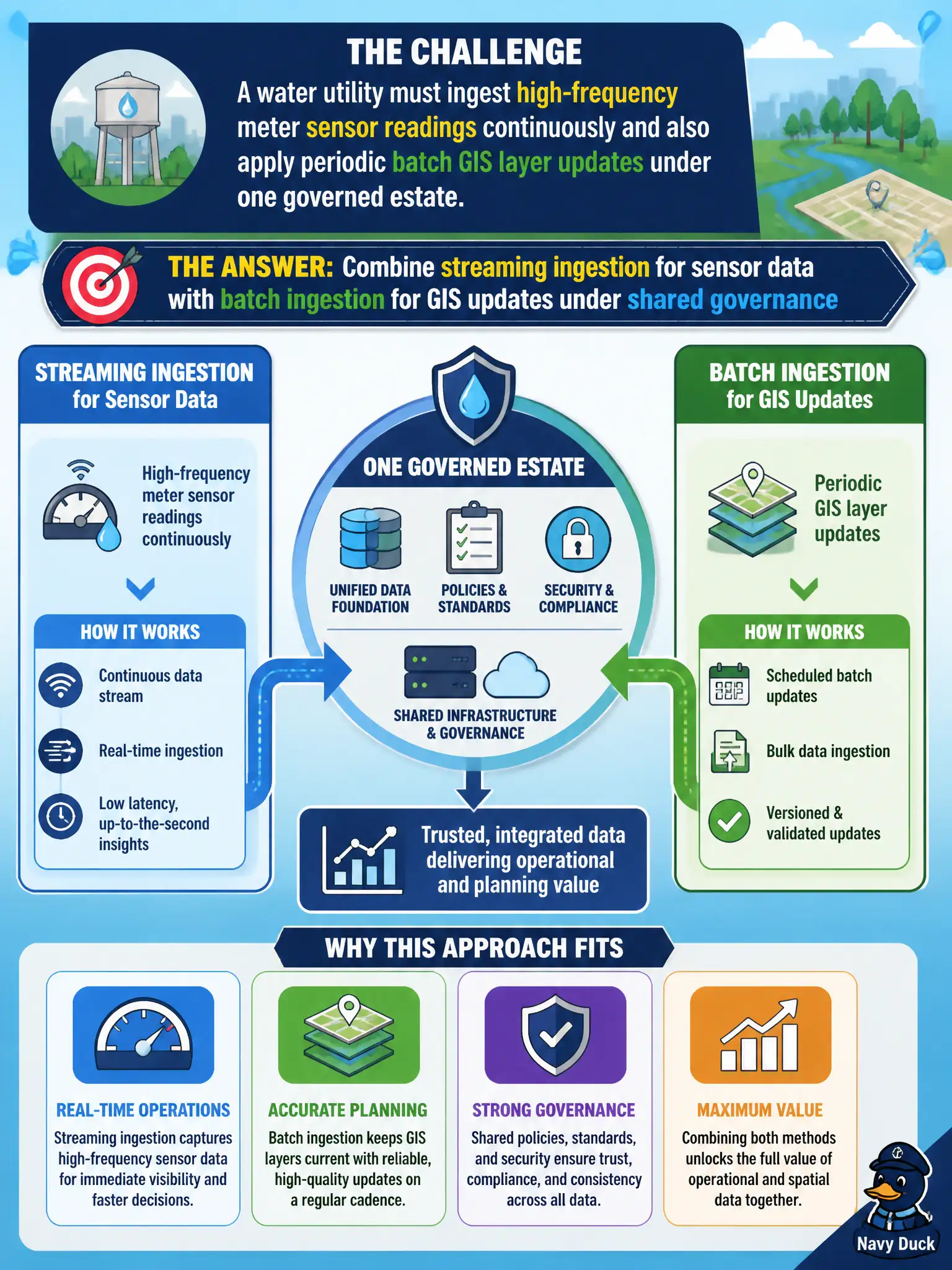
A water utility must ingest high-frequency meter sensor readings continuously and also apply periodic batch GIS layer updates under one governed estate. What ingestion approach fits?
Select an answer to reveal the explanation.
Short Explanation
Some data arrives like a fire hose; some like a weekly truck. Good estates accept both streaming and batch under the same rules instead of pretending one pipe fits every cargo.
Full Explanation
Modern municipal data estates commonly need multi-modal ingestion under shared governance. High-frequency water-meter sensor readings fit streaming paths that preserve timely telemetry, while periodic GIS layer updates remain natural batch workloads. Architecture should accept both modes and still enforce common expectations for schemas, quality, lineage, security, and stewardship so related datasets do not develop unequal trust. Forcing all GIS and sensor feeds into a single nightly batch window discards the latency needs of continuous telemetry and can leave operations blind between windows. Storing sensor streams only in unmanaged desktop tools while keeping GIS offline forever creates shadow pipelines and fragments the estate outside governance. Rejecting multi-modal ingestion because “architecture may use only one transport forever” confuses purity with fitness for purpose. Exam caveat: multi-modal does not mean unmanaged; streaming and batch both require contracts, monitoring, and access control, and choosing modes is a workload decision within one governed estate. Operational check: document which datasets are streaming versus batch, assign stewards and quality rules to both, monitor freshness SLAs appropriate to each mode, and prohibit desktop-only landing for operational sensor data that other systems depend on.