
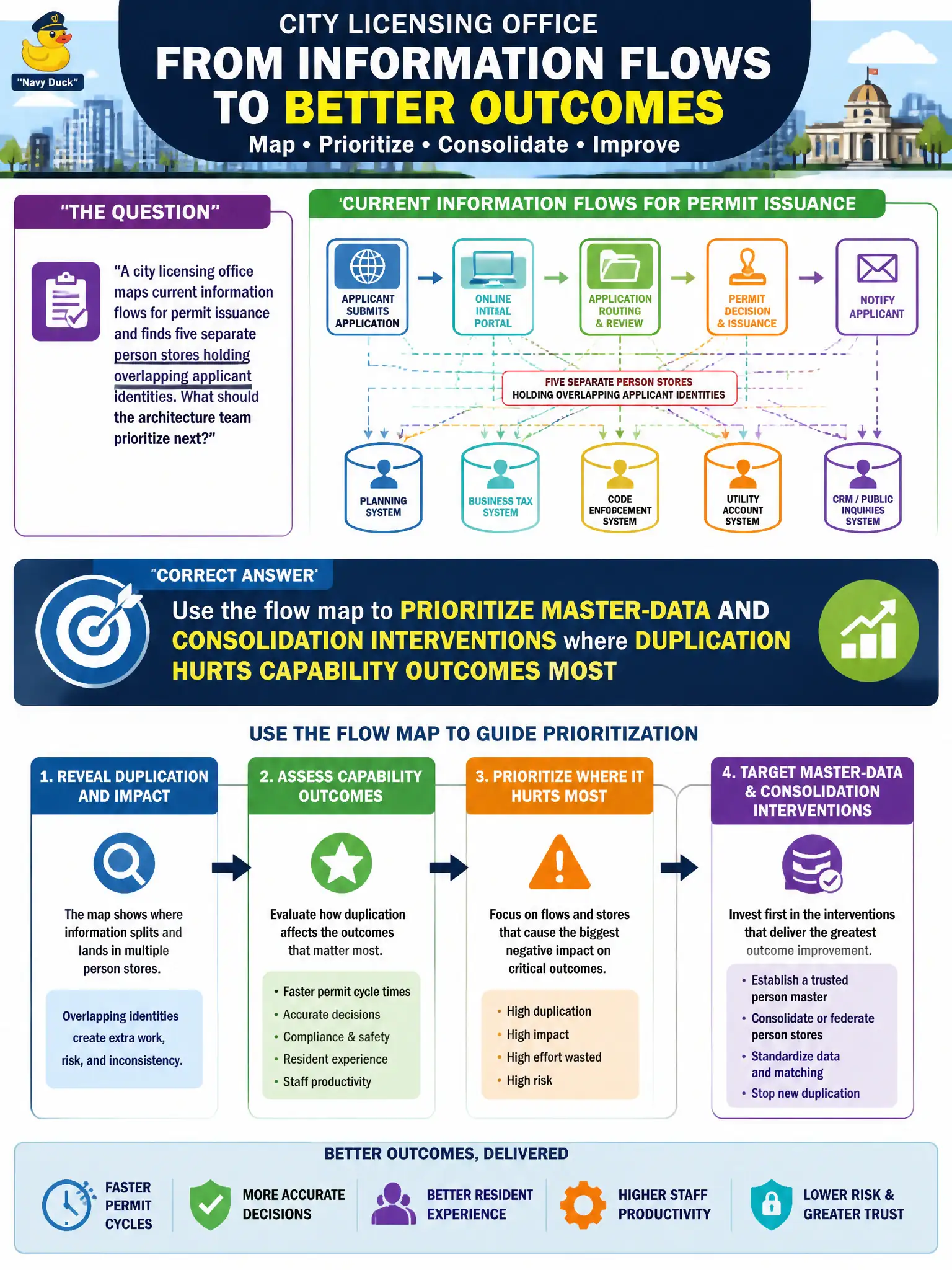
A city licensing office maps current information flows for permit issuance and finds five separate person stores holding overlapping applicant identities. What should the architecture team prioritize next?
Select an answer to reveal the explanation.
Short Explanation
Think of five filing cabinets all claiming to know the same resident. The map is not decoration—it shows where duplication burns the licensing capability. Use it to prioritize MDM and consolidation where the pain is highest, not to buy more shelves.
Full Explanation
Current-state information-flow maps expose redundant stores, brittle handoffs, and ownership gaps that product catalogs alone hide. For a municipal licensing capability, five overlapping person stores typically drive wrong applicant matches, repeated data entry, inconsistent notices, and eroded citizen trust. Architecture should convert that visibility into prioritized master-data and consolidation interventions—golden-record rules, stewardship agreements, survivorship, and controlled migration—aligned to where duplication most harms capability outcomes rather than treating every store as equally urgent. Buying a larger warehouse so each store grows independently expands storage without resolving identity conflict, so operational pain and report disagreement continue. Deleting four stores overnight without stewardship or golden-record rules risks destroying legitimate history, breaking dependent processes, and creating unsafe merges. Replacing every application with a single vendor suite before documenting ownership boundaries confuses platform shopping with architecture: brand consolidation without interface and accountability design often recreates the same duplication inside a new stack. Exam caveat: flow mapping is a diagnostic and prioritization tool, not automatic permission to purge or re-platform; interventions still need sequenced cutovers, data quality gates, and legal retention awareness. Operational check: score each duplicate store by impact on permit cycle time, mismatch incidents, and citizen rework; pick the highest-impact identity domain; assign a steward; publish matching rules; and track reduction in conflicting applicant records after the first consolidation wave.