
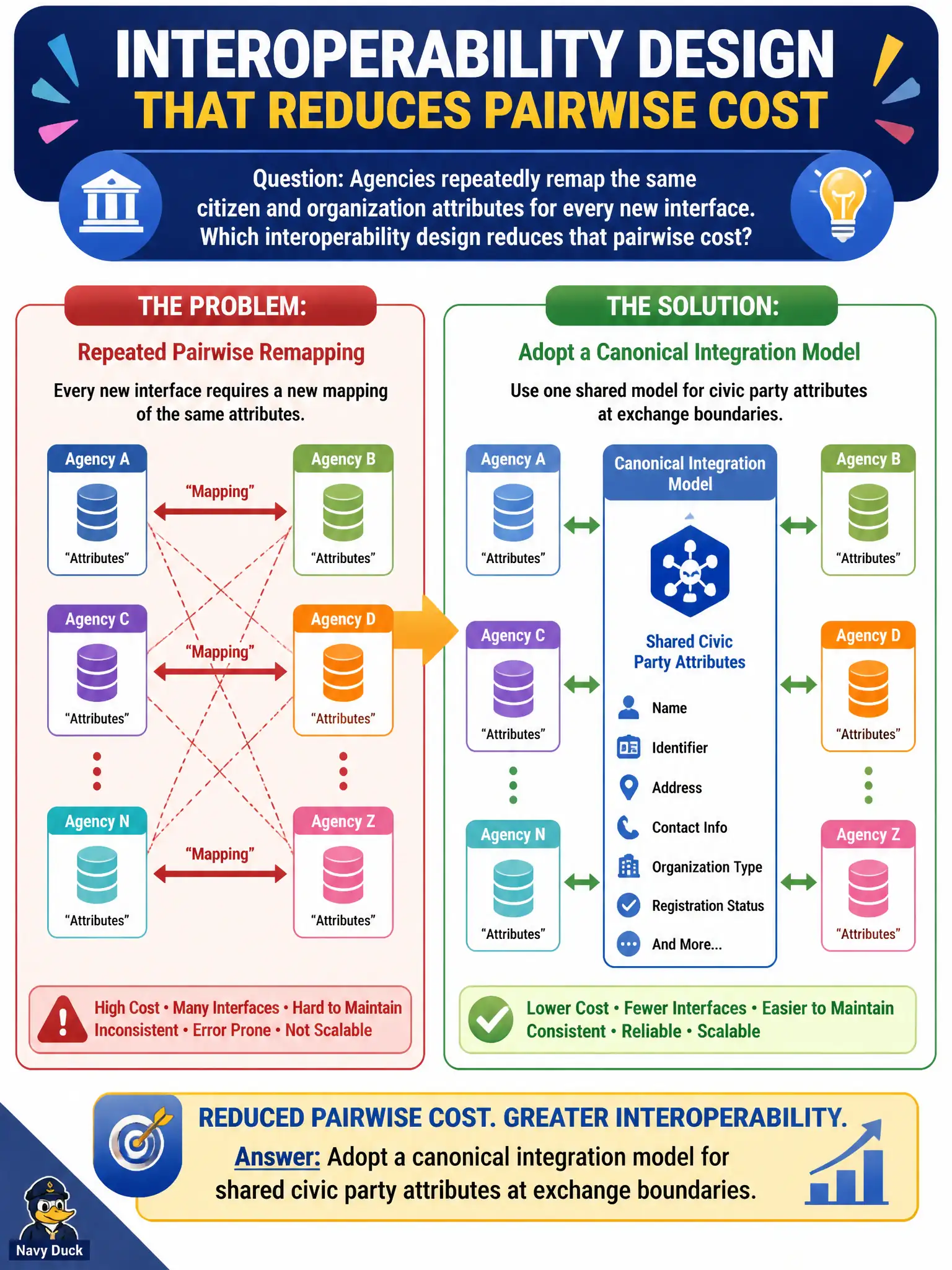
Agencies repeatedly remap the same citizen and organization attributes for every new interface. Which interoperability design reduces that pairwise cost?
Select an answer to reveal the explanation.
Short Explanation
If every agency invents its own word for ‘address,’ every handshake needs a translator. A canonical model at the boundary is the shared dictionary—map once to the common shape, then reuse it across interfaces.
Full Explanation
Repeated remapping of the same citizen and organization attributes for every new interface is pairwise interoperability waste. Adopting a canonical integration model for shared civic party attributes at exchange boundaries reduces that cost and stabilizes meaning. Keeping unique field names and meanings for each bilateral feed forever maximizes mapping labor. Storing party data only as free-text blobs to avoid modeling destroys validation and matching. Forbidding shared attributes so each agency invents private synonyms entrenches silos. Exam concept: canonical model at exchange boundaries. Caveat: canonical models need stewardship and versioning; an unowned canonical layer becomes another conflicting dialect. Operationally, publish the party canonical attributes with definitions, require new interfaces to map to them, and measure reduction in unique pairwise field maps across agency projects. Measure unique pairwise party-field maps before and after canonical adoption to prove interoperability cost is actually falling. Canonical party attributes at the boundary still require local systems to map honestly—publish mapping quality checks so agencies cannot claim conformance while sending incompatible payloads.