
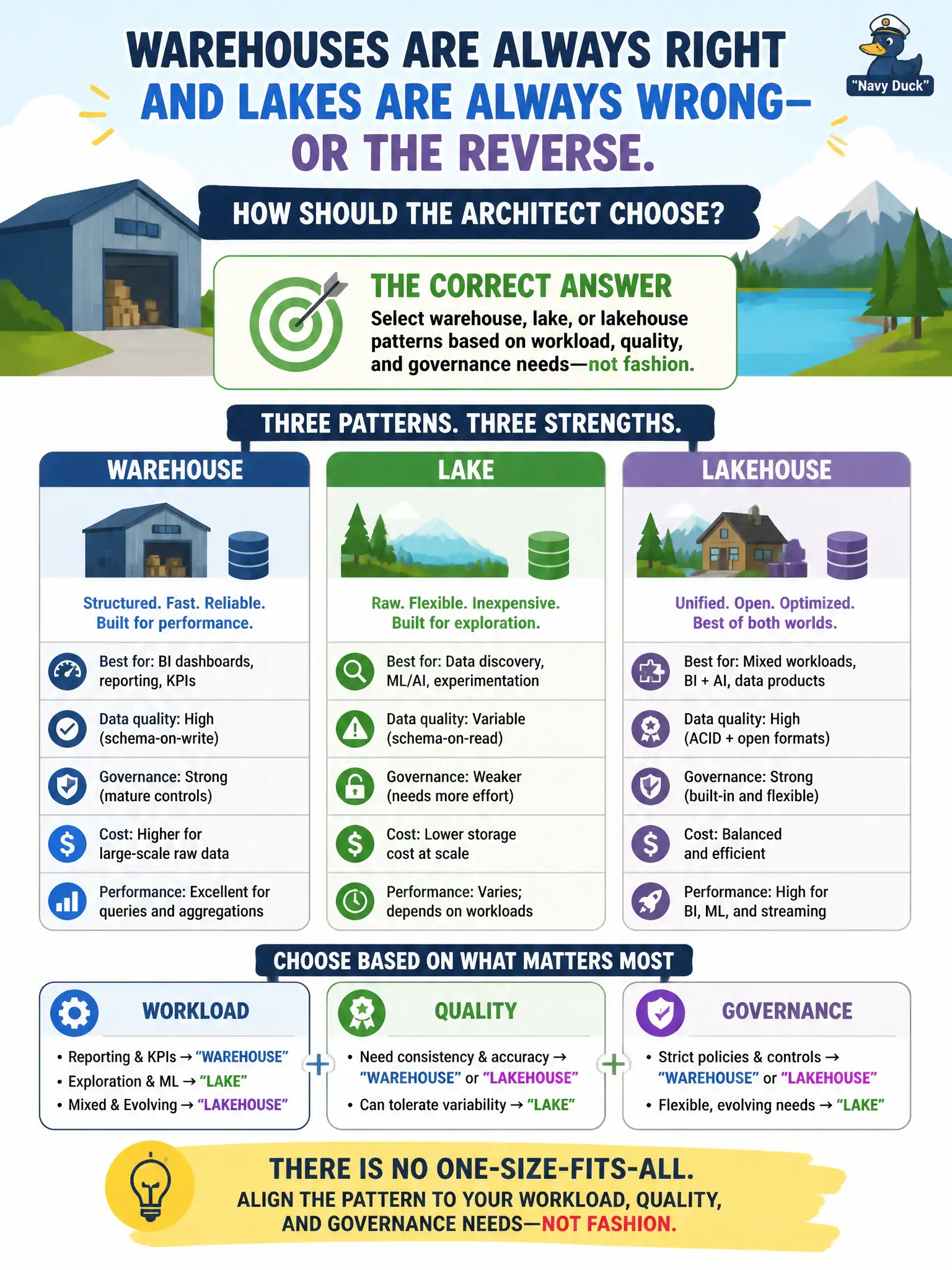
Leaders argue endlessly that warehouses are always right and lakes are always wrong—or the reverse. How should the architect choose?
Select an answer to reveal the explanation.
Short Explanation
Tools aren’t religions—they’re tools. Pick the pattern that matches how you query, how clean the data must be, and how you’ll govern it. Fashion slogans about warehouses versus lakes don’t design your estate.
Full Explanation
Warehouse versus lake versus lakehouse debates should be settled by workload, quality, and governance needs—not fashion. Architects select patterns based on how structured civic analytics, raw landing, and stewardship will actually operate. Always standardizing on whatever won the last industry survey ignores local constraints. Rejecting lakes because “analytic architecture forbids raw landing zones by definition” is dogma; governed landing can be valid. Treating pattern choice as irrelevant once cloud credits are purchased abdicates design. Exam answer: fit-for-purpose pattern selection. Caveat: hybrid estates are common—raw zones plus curated warehouses—so the decision is often composition and controls, not a single slogan. Operationally, classify major municipal workloads by structure, quality bar, and latency; map each to an explicit pattern with controls; and refuse project funding that names a trendy store without that mapping. Score pattern proposals against workload classes and governance controls in architecture review; reject “because the survey said so” as insufficient rationale. Document why a lake, warehouse, or lakehouse was chosen for each major civic workload so future teams inherit rationale instead of reopening fashion debates every budget cycle.