
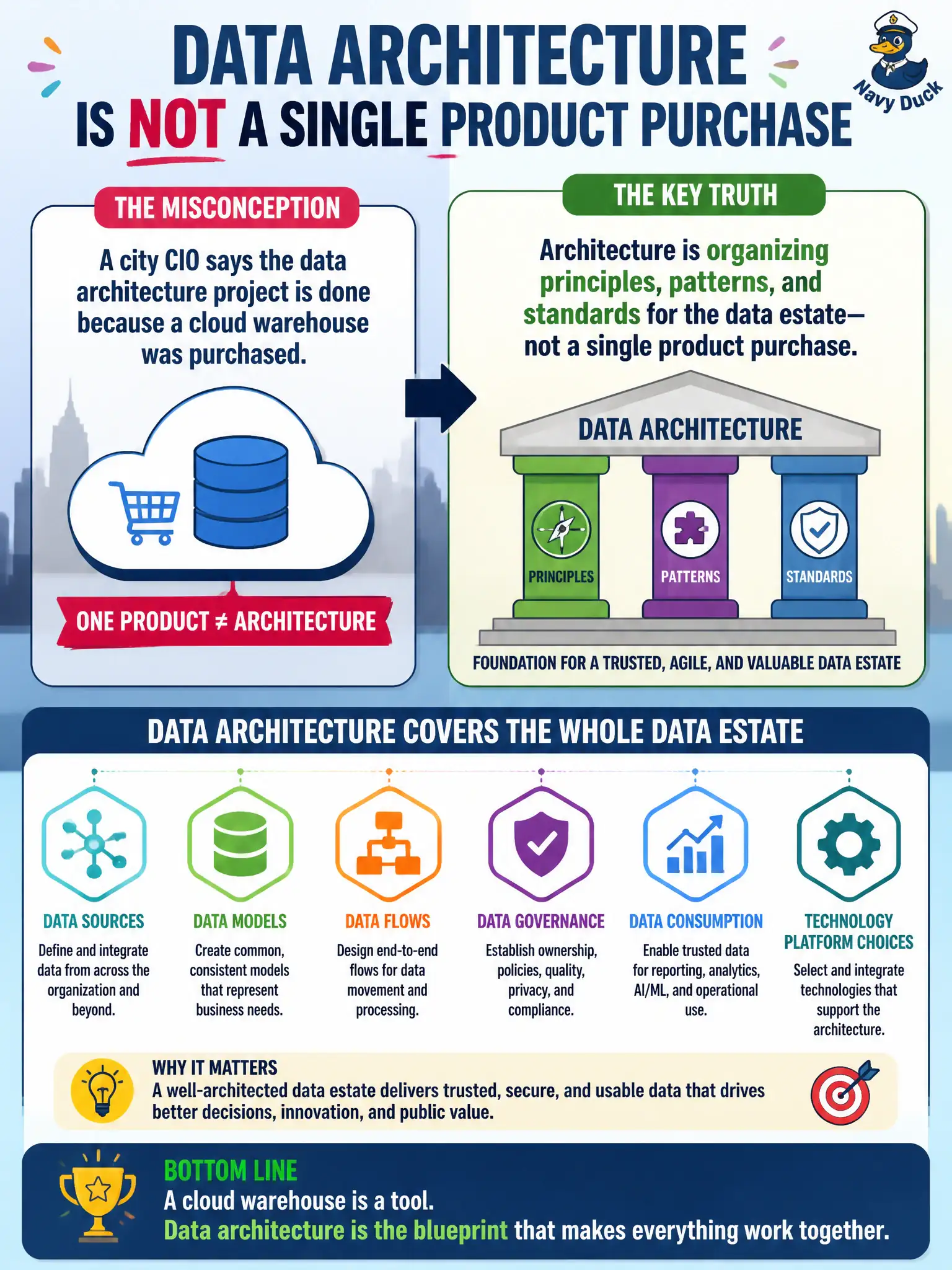
A city CIO says the data architecture project is done because a cloud warehouse was purchased. What should the information management lead emphasize?
Select an answer to reveal the explanation.
Short Explanation
Buying a warehouse is like buying a gym membership and calling yourself an athlete. The building helps, but architecture is the playbook—principles, patterns, and standards that guide how data is organized across the estate. A product alone is not that playbook.
Full Explanation
Purchasing a cloud warehouse does not complete municipal data architecture. Architecture is the organizing set of principles, patterns, and standards that shape how the city’s data estate is structured, integrated, and governed—not a single product license. Warehouse licensing does not automatically define enterprise data domains or stewardship models. Cloud warehouses do not replace the need for operational data standards across permitting, finance, and public-safety systems. Architecture work does not end once any analytic store is under contract. Exam distractors equate tooling with architecture; reject that collapse. Caveat: platform choice is an architecture decision, but it sits inside broader capability, integration, and governance choices that still must be designed. Operationally, publish a short architecture principles and domain map for the civic data estate, show how the warehouse fits as one pattern among operational systems and exchange standards, and require new projects to cite those principles—not only the warehouse SKU—before funding. Attach every major funding request to the architecture principles it advances—warehouse spend included—so purchases do not substitute for design.