
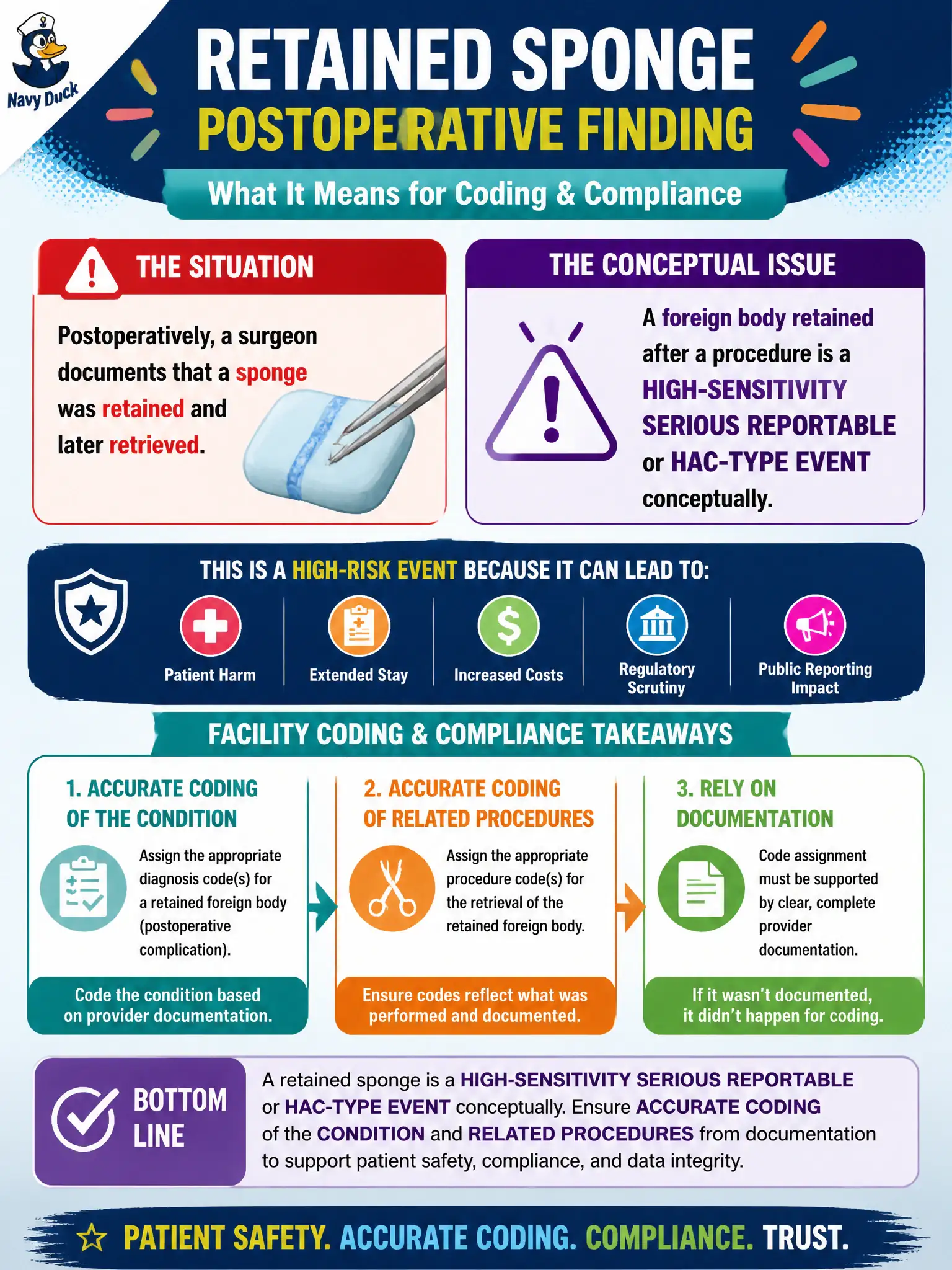
Postoperatively, a surgeon documents that a sponge was retained and later retrieved. From a facility coding and compliance standpoint, what conceptual issue does this raise?
Select an answer to reveal the explanation.
Short Explanation
A sponge left behind is not a paperwork shrug—it is a never-event style signal. Code the retained foreign body and the retrieval from what the surgeon wrote. Do not wait for someone to scrub the note so the scoreboard looks prettier.
Full Explanation
A retained surgical sponge documented and later retrieved at a municipal hospital raises a high-sensitivity serious reportable or HAC-type conceptual issue: the retained foreign body and related retrieval procedures must be coded accurately from surgeon documentation. Public operating rooms are accountable for never-event transparency; coding is part of that accountability, not a delay until risk management rewrites the note. Coding retained foreign bodies only as aftercare Z codes without any complication diagnosis understates the event. Automatically replacing the original principal diagnosis with the retained sponge on the index admission may violate principal-diagnosis selection when the sponge discovery was not the reason for that admission. Waiting until risk management deletes the note before coding subordinates the legal record to optics and risks missing reportable conditions. Exam caveat: code what the authenticated record states; risk review does not erase coding duties. Operational check: capture retained foreign body and retrieval procedure codes from operative and progress notes, set POA appropriately, escalate to compliance/risk as required, and refuse instructions to withhold codes pending note deletion. Sustain civic accountability by pairing correct code assignment with transparent denial, quality, and privacy escalation paths so public reporting and payment integrity move together.