
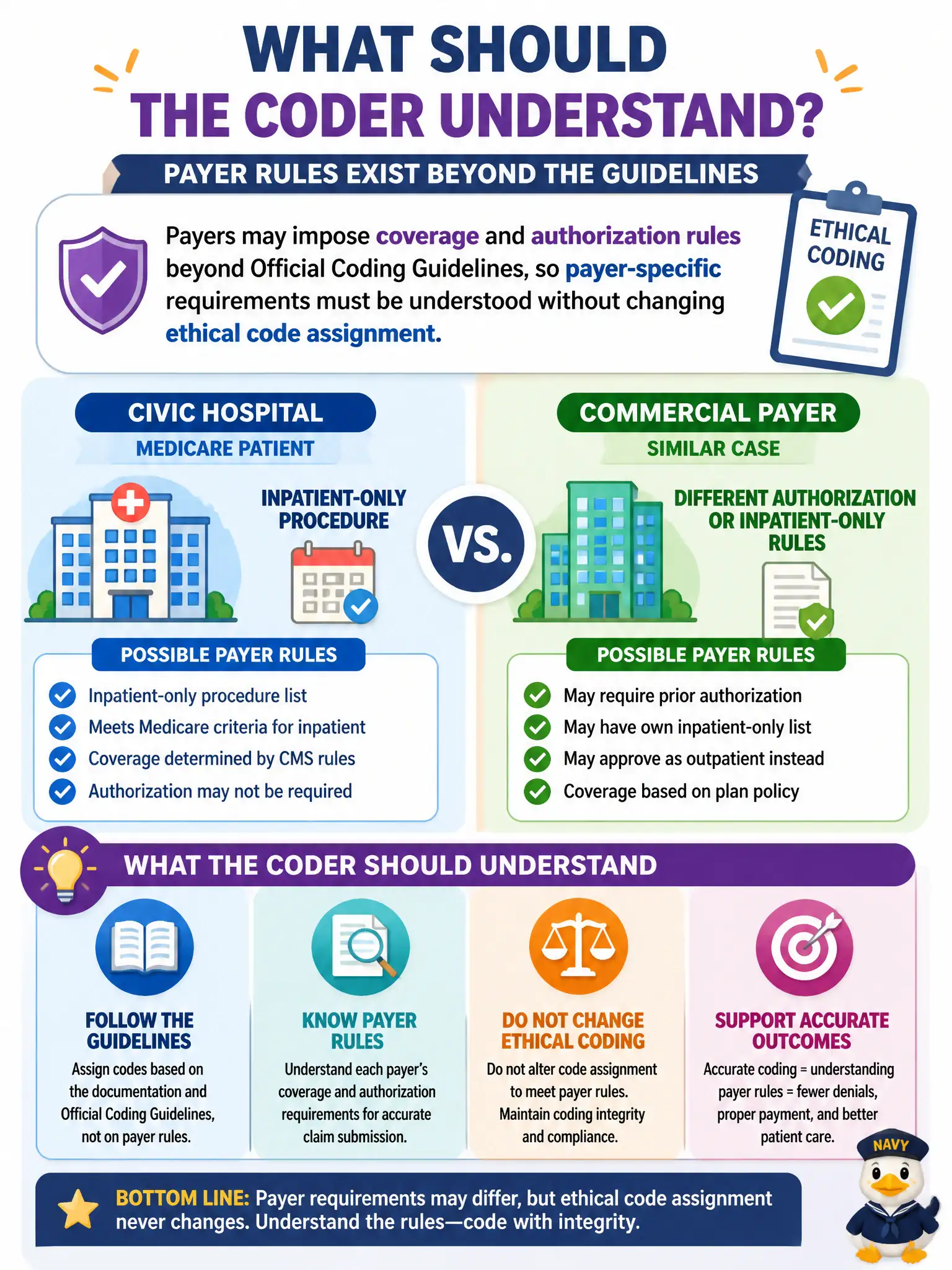
A civic hospital schedules an inpatient-only procedure for a Medicare patient, while a commercial payer for a similar case may use different authorization or inpatient-only rules. What should the coder understand?
Select an answer to reveal the explanation.
Short Explanation
Coding guidelines tell you how to assign codes; payer rules tell you what gets paid and authorized. Medicare and commercial plans can diverge on inpatient-only lists and auth — know the difference without rewriting the clinical truth. Ethics stay put even when payers differ.
Full Explanation
A civic hospital scheduling an inpatient-only procedure for a Medicare patient must understand that commercial payers for similar cases may use different authorization or inpatient-only rules. Payers may impose coverage and authorization requirements beyond Official Coding Guidelines, and those administrative rules must be understood without changing ethical code assignment based on documentation. Official Coding Guidelines do not already include every payer's authorization rules; guidelines govern code assignment, while payer policies govern coverage and payment conditions. Commercial payers need not always follow Medicare inpatient-only lists exactly. Coders should not alter the procedure code to whatever the payer prefers regardless of documentation, because that is fraudulent code shopping. Exam caveat: separate "what is the correct code" from "will this payer pay under this status/auth"—both matter operationally, but only documentation-driven codes are ethical. Operational check: assign codes from the record and Official Guidelines, then apply Medicare versus commercial inpatient-only and prior-auth edits as billing rules without rewriting clinical codes. This discipline protects patients, supports accurate public reporting for municipal hospitals, and keeps the coded abstract defensible when auditors compare codes to the authenticated record.