
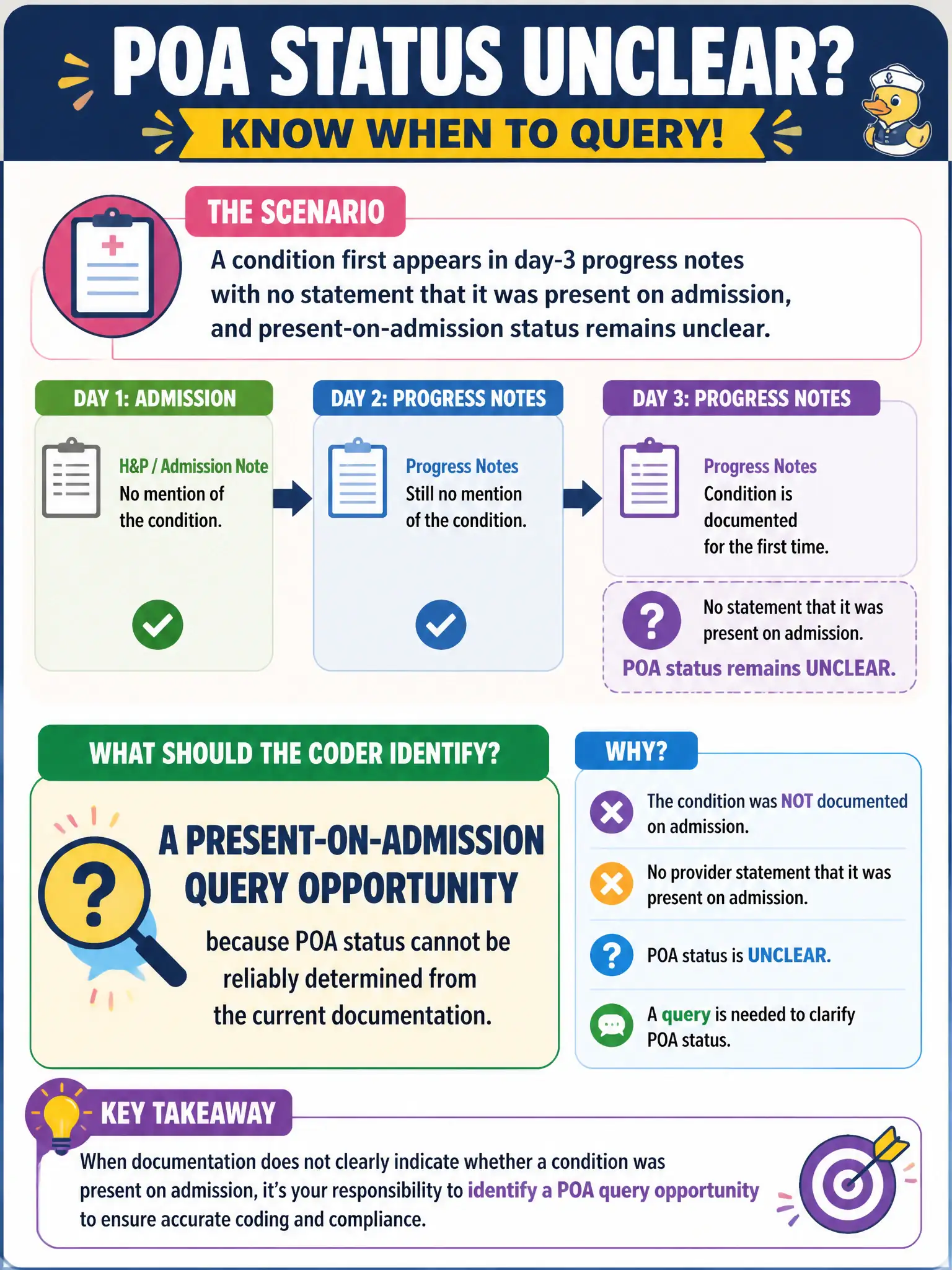
A condition first appears in day-3 progress notes with no statement that it was present on admission, and present-on-admission status remains unclear. What should the coder identify?
Select an answer to reveal the explanation.
Short Explanation
POA is the admission timestamp stamp on a diagnosis — if you cannot tell whether it walked in with the patient, you do not guess. A condition that first shows up on day 3 with no admission reference is a textbook unclear-POA query. Clarify first; do not invent yes or no.
Full Explanation
When a condition first appears in day-3 progress notes with no statement that it was present on admission and POA status remains unclear, the coder should identify a present-on-admission query opportunity because POA cannot be reliably determined from the current documentation. Assigning POA yes because most hospital conditions began before admission is statistical guessing. Assigning POA no automatically for any condition first written after hospital day 1 ignores conditions present at admission but documented late. Omitting the diagnosis entirely until the billing office forces a decision may underreport a clinically valid secondary condition rather than clarifying POA. Exam caveat: use official POA indicators and query when documentation is silent or conflicting about admission presence, especially for hospital-acquired condition–sensitive diagnoses in municipal reporting. Operational check: compare admission H&P and ED notes to the day-3 onset language; if still unclear, query POA with nonleading options before final indicator assignment. This discipline protects patients, supports accurate public reporting for municipal hospitals, and keeps the coded abstract defensible when auditors compare codes to the authenticated record.