
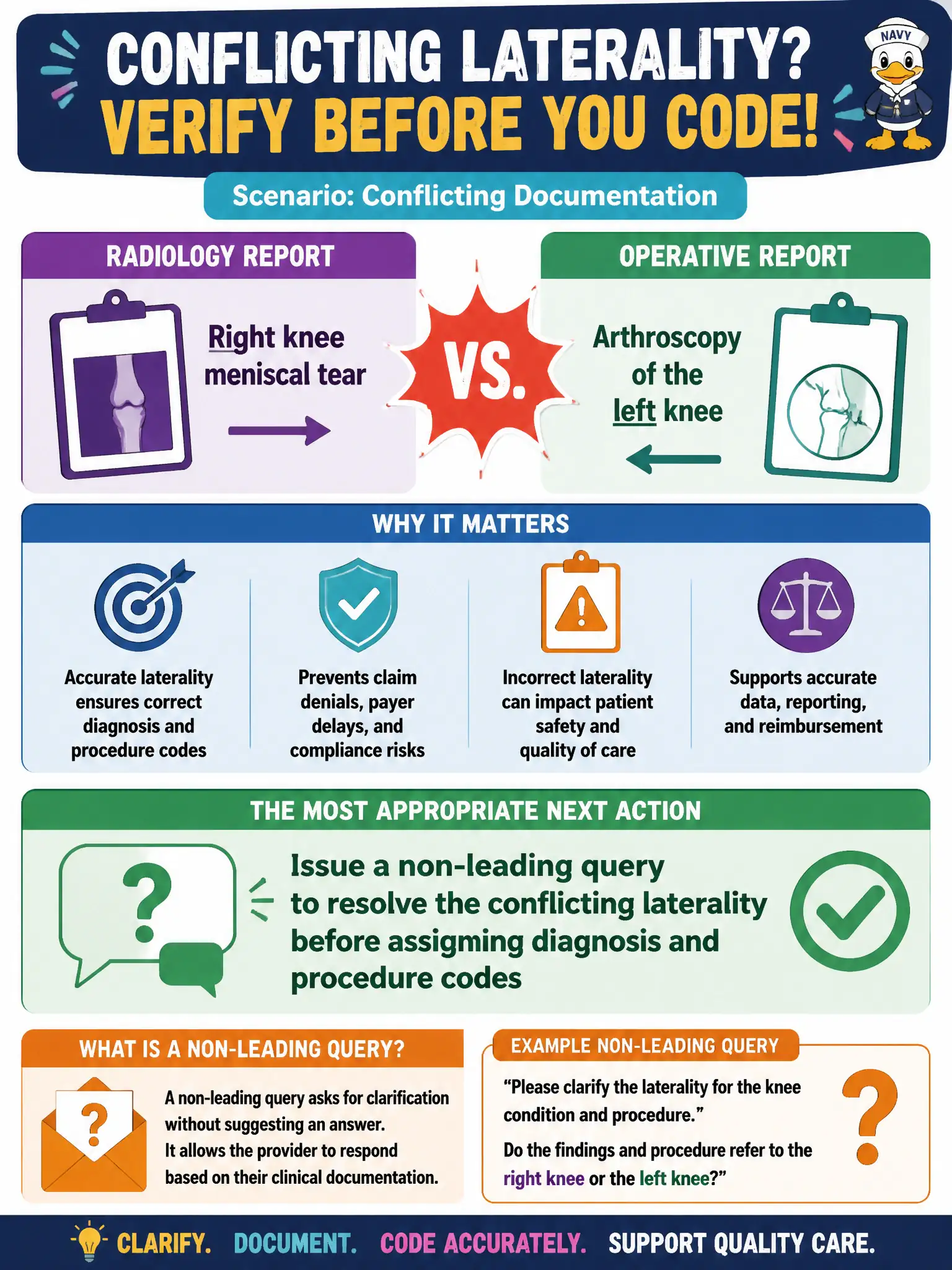
At a county hospital, radiology reports a right knee meniscal tear, but the operative report documents arthroscopy of the left knee. Before final coding, what is the most appropriate next action?
Select an answer to reveal the explanation.
Short Explanation
Think of laterality like labeling the wrong shelf in a warehouse — you do not ship until the labels match. When imaging and the op report disagree on left versus right, that conflict is a classic query trigger, not a coin flip for the coder. Get a clear, non-leading clarification before you lock codes.
Full Explanation
At a county hospital, when radiology reports a right knee meniscal tear but the operative report documents arthroscopy of the left knee, the most appropriate next action before final coding is to issue a non-leading query to resolve the conflicting laterality. Diagnosis and procedure codes cannot both be accurate while laterality remains contradictory. Coding the right knee from imaging because radiology seems more specific ignores the operative narrative of what was surgically addressed. Coding both knees so neither conflict is "lost" invents bilateral disease and surgery. Defaulting to unspecified laterality and finalizing without contacting the provider may under-specify an obtainable clarification and leaves a known conflict unresolved. Exam caveat: site and laterality conflicts are high-risk for wrong-site concerns—escalate clinically when patient-safety issues are possible, and use compliant queries for documentation resolution. Operational check: suspend final side-specific coding, send a balanced laterality query citing both reports, and code only after reconciliation. This discipline protects patients, supports accurate public reporting for municipal hospitals, and keeps the coded abstract defensible when auditors compare codes to the authenticated record.