
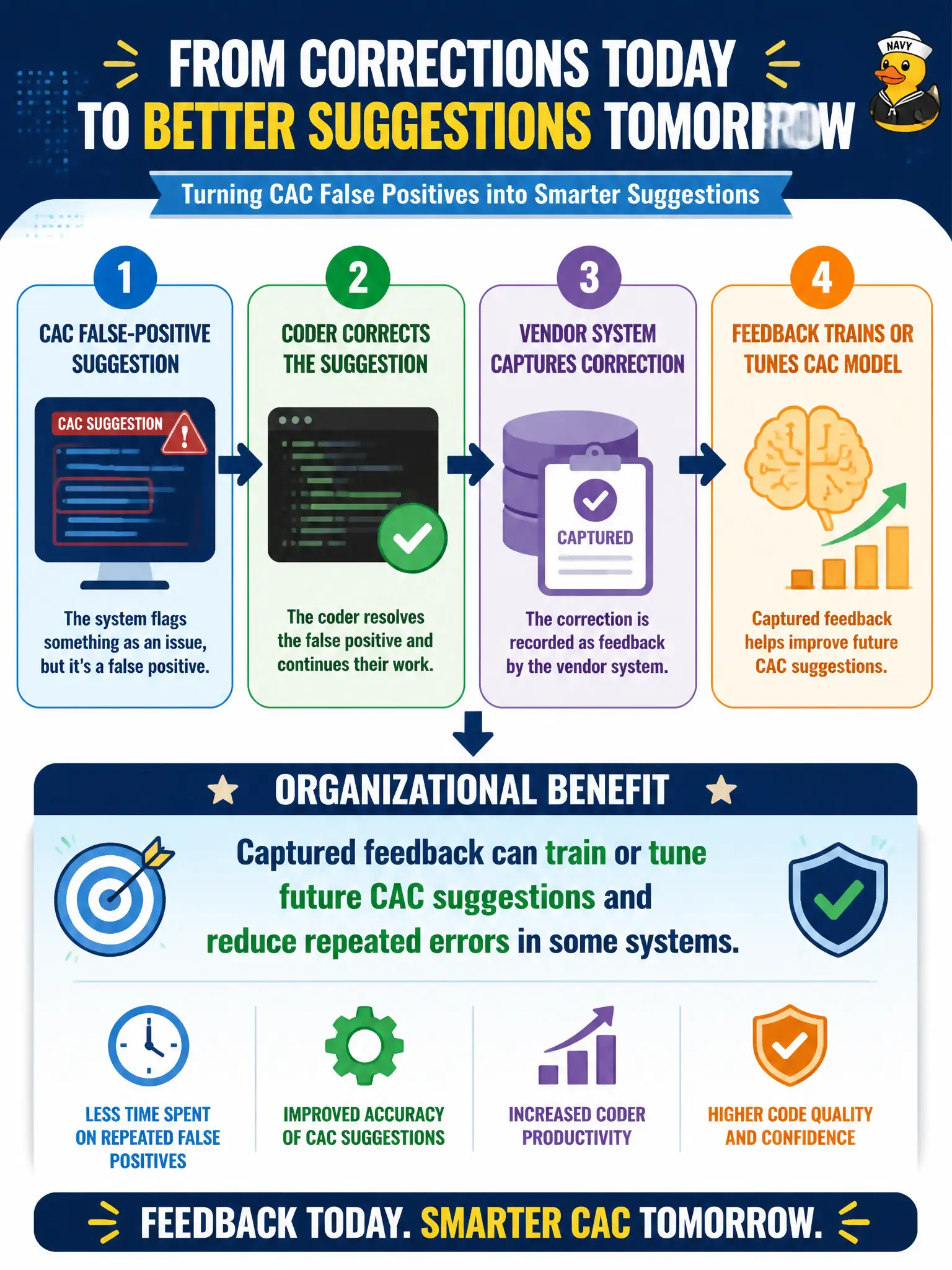
Coders consistently correct the same CAC false-positive suggestion, and the vendor system captures those corrections. What organizational benefit can result?
Select an answer to reveal the explanation.
Short Explanation
When you keep swatting the same wrong CAC suggestion and the system learns from it, you’re teaching the tool. Good feedback loops mean fewer repeats of yesterday’s mistake.
Full Explanation
When civic hospital coders consistently correct the same CAC false-positive suggestion and the vendor system captures those corrections, an organizational benefit can be training or tuning future CAC suggestions to reduce repeated errors in some systems. Feedback loops turn frontline expertise into better public-sector automation. Believing corrections automatically create billable physician queries without documentation invents CDI from NLP edits. Claiming feedback loops legally replace AHIMA Standards of Ethical Coding confuses tool improvement with professional ethics. Asserting correction logs exempt the facility from HIPAA access audits invents an unrelated safe harbor. Exam caveat: captured corrections may improve CAC; they do not replace ethics or privacy duties. Operational check: enable and review CAC feedback analytics, prioritize high-volume false positives for tuning, keep human validation in place after tuning, and maintain separate HIPAA audit-log programs. Treat encoders, groupers, and CAC as assistants inside civic HIM: useful for speed, never a substitute for documentation review, Official Guidelines, or PHI safeguards. Re-read the authenticated record before finalizing whenever tools, payers, or dashboards push a result the documentation does not support.