
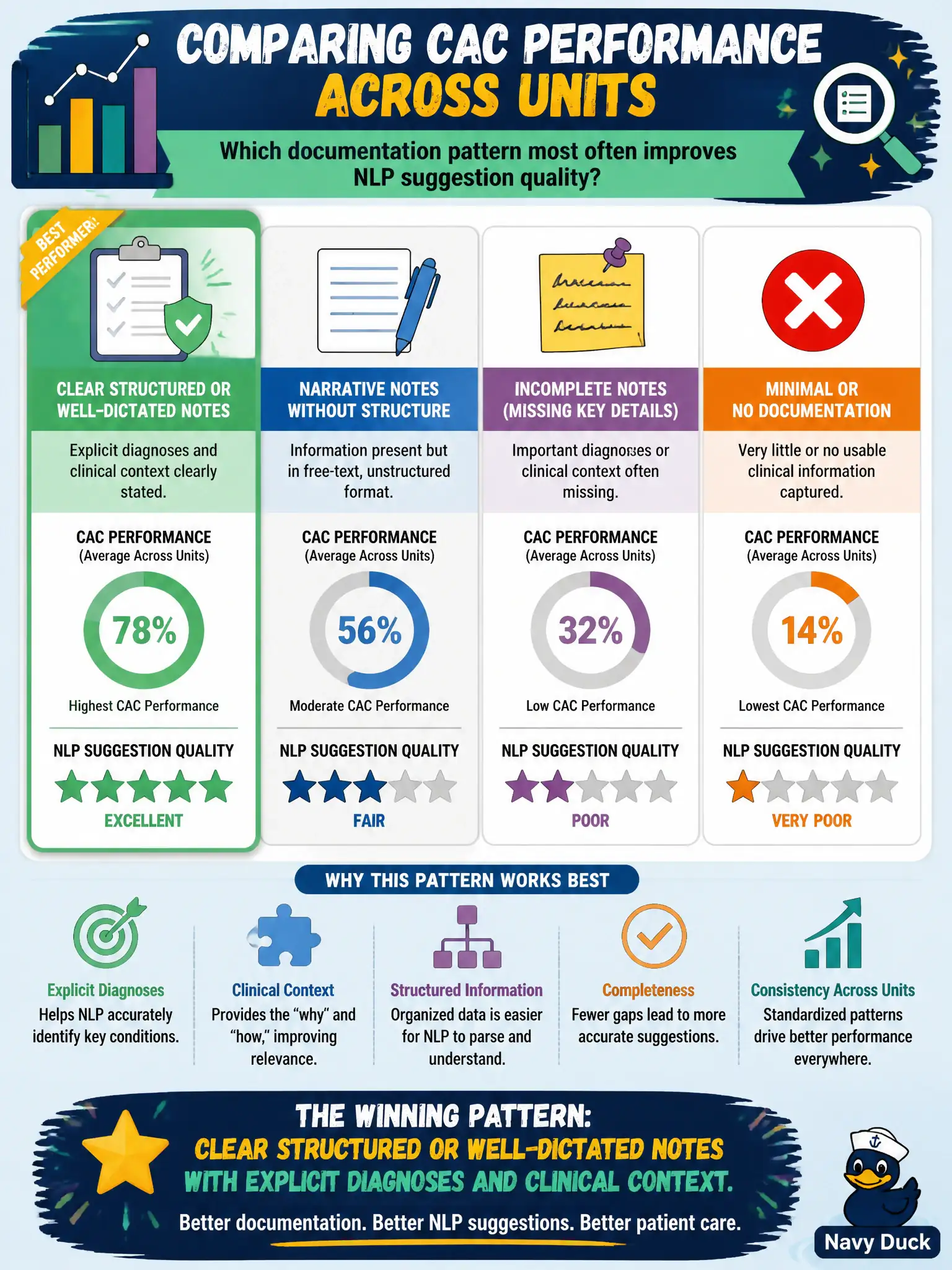
Comparing CAC performance across units, which documentation pattern most often improves NLP suggestion quality?
Select an answer to reveal the explanation.
Short Explanation
Garbage text in, garbage codes suggested. CAC loves clear, structured, or well-dictated notes and struggles when the chart is a sparse macro salad.
Full Explanation
Comparing CAC performance across units in a municipal system, clear structured or well-dictated notes with explicit diagnoses and clinical context most often improve NLP suggestion quality. Civic documentation standards are thus both care tools and coding-automation fuel. One-word ED macros with heavy abbreviations and no assessment narrative starve the engine of usable text. Scanned handwritten notes with no electronic text layer give NLP little or nothing to parse. Empty template shells where clinicians never complete fields produce hollow suggestions or misses. Exam caveat: CAC quality tracks documentation quality; software cannot invent clarity absent from the record. Operational check: promote structured problem lists and complete assessments, reduce empty templates, prioritize OCR/text layers if handwriting remains, and pair CAC rollout with documentation improvement rather than expecting NLP to fix sparse charts. Treat encoders, groupers, and CAC as assistants inside civic HIM: useful for speed, never a substitute for documentation review, Official Guidelines, or PHI safeguards. Re-read the authenticated record before finalizing whenever tools, payers, or dashboards push a result the documentation does not support.